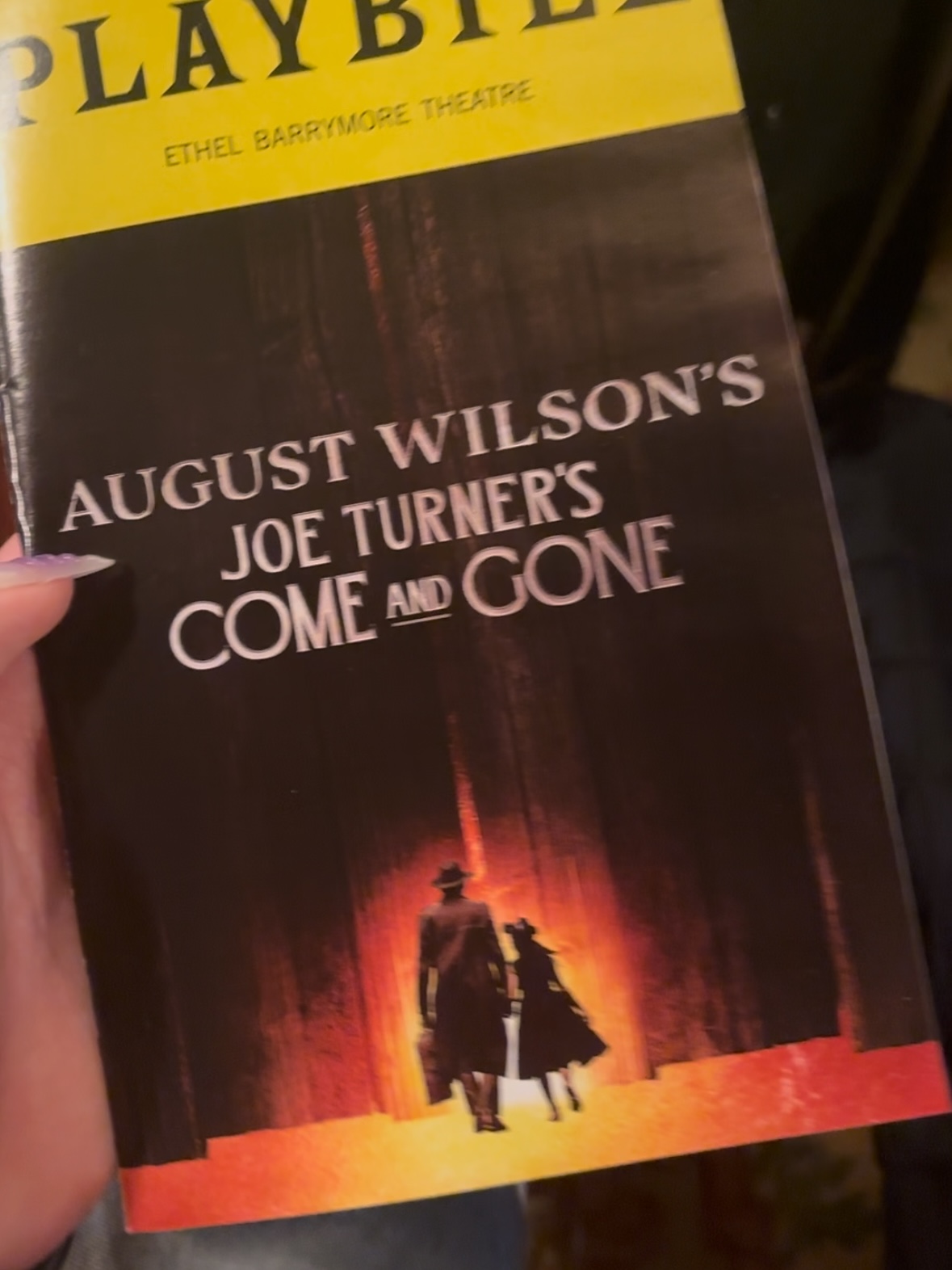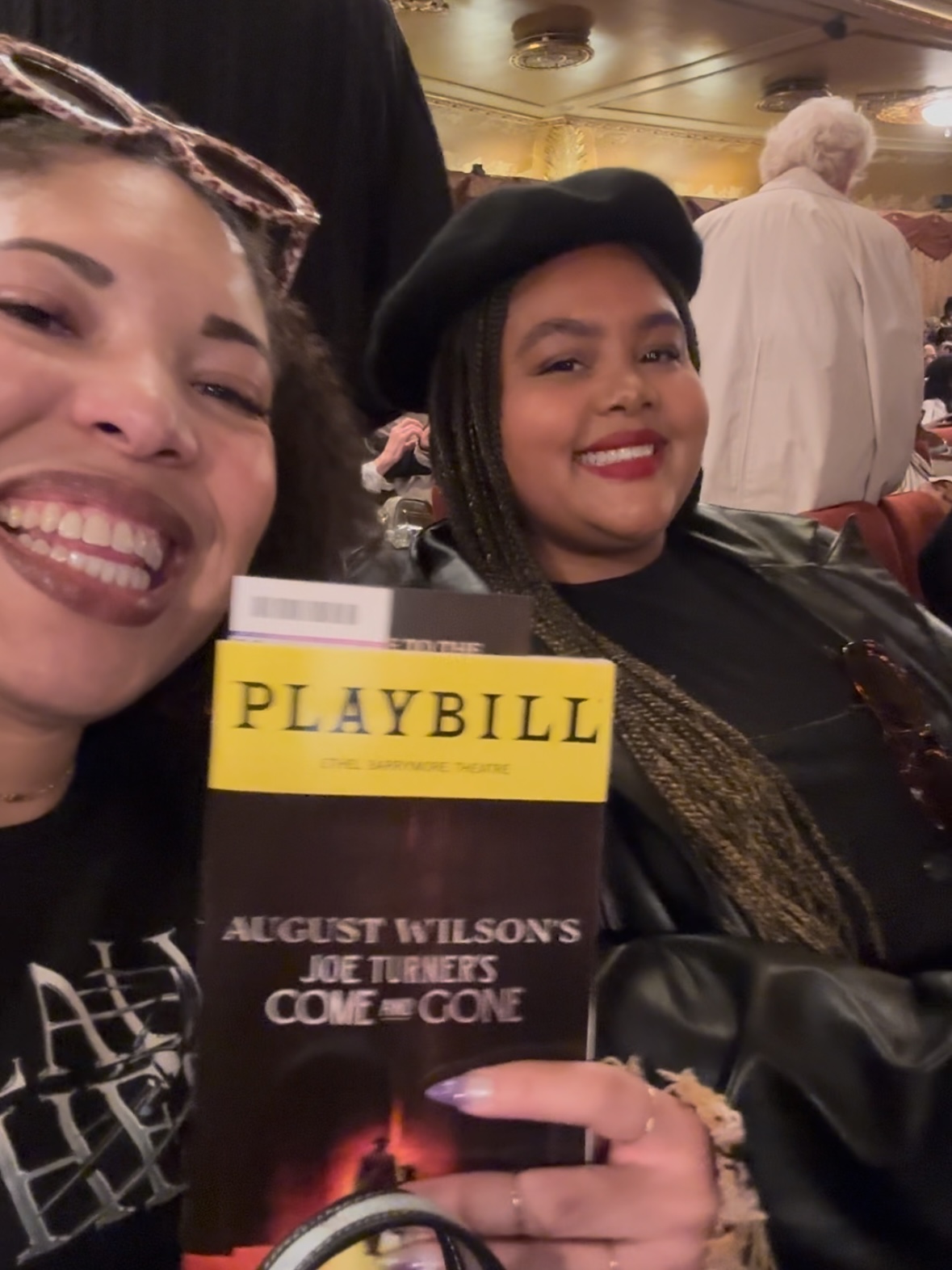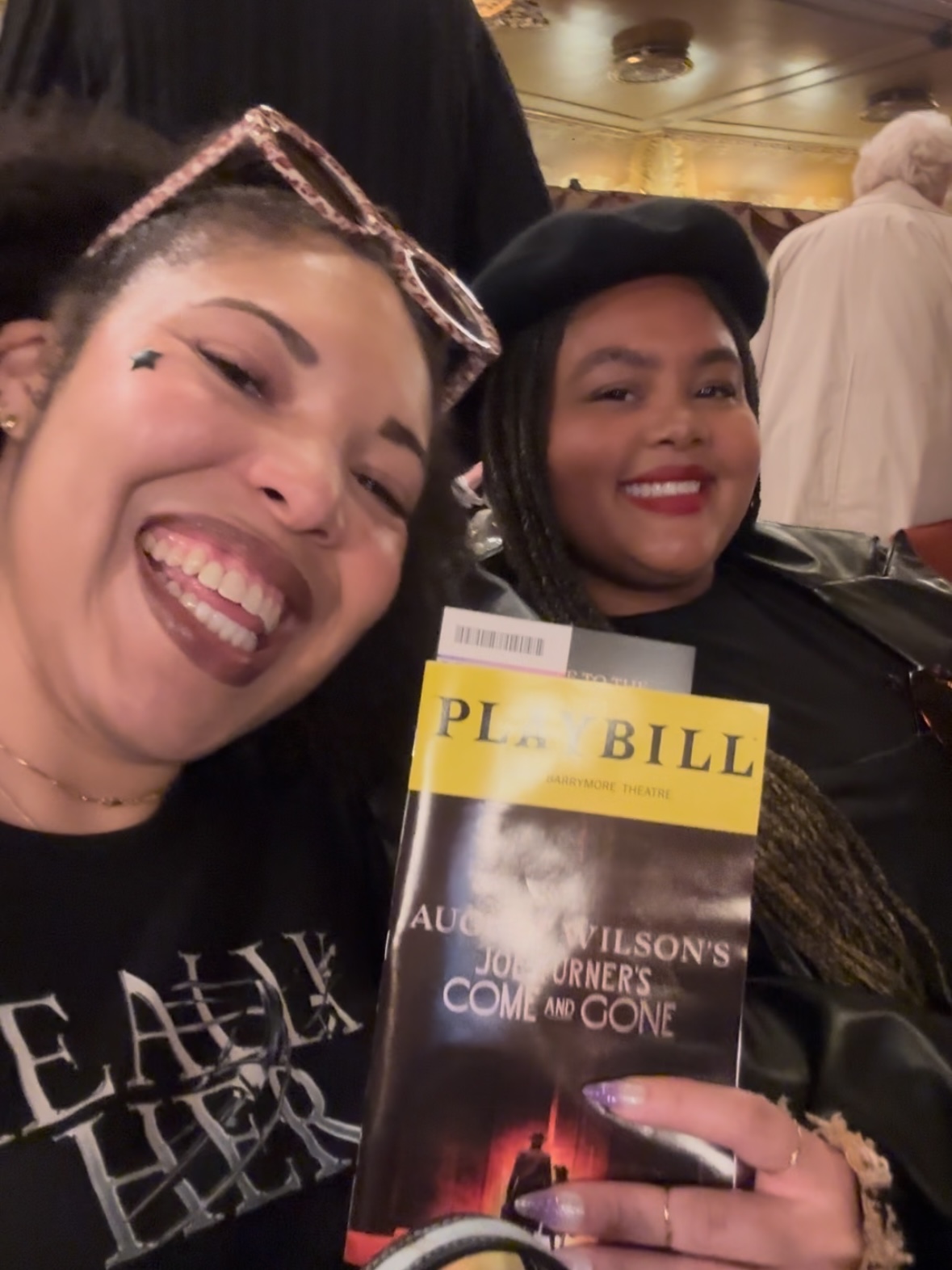

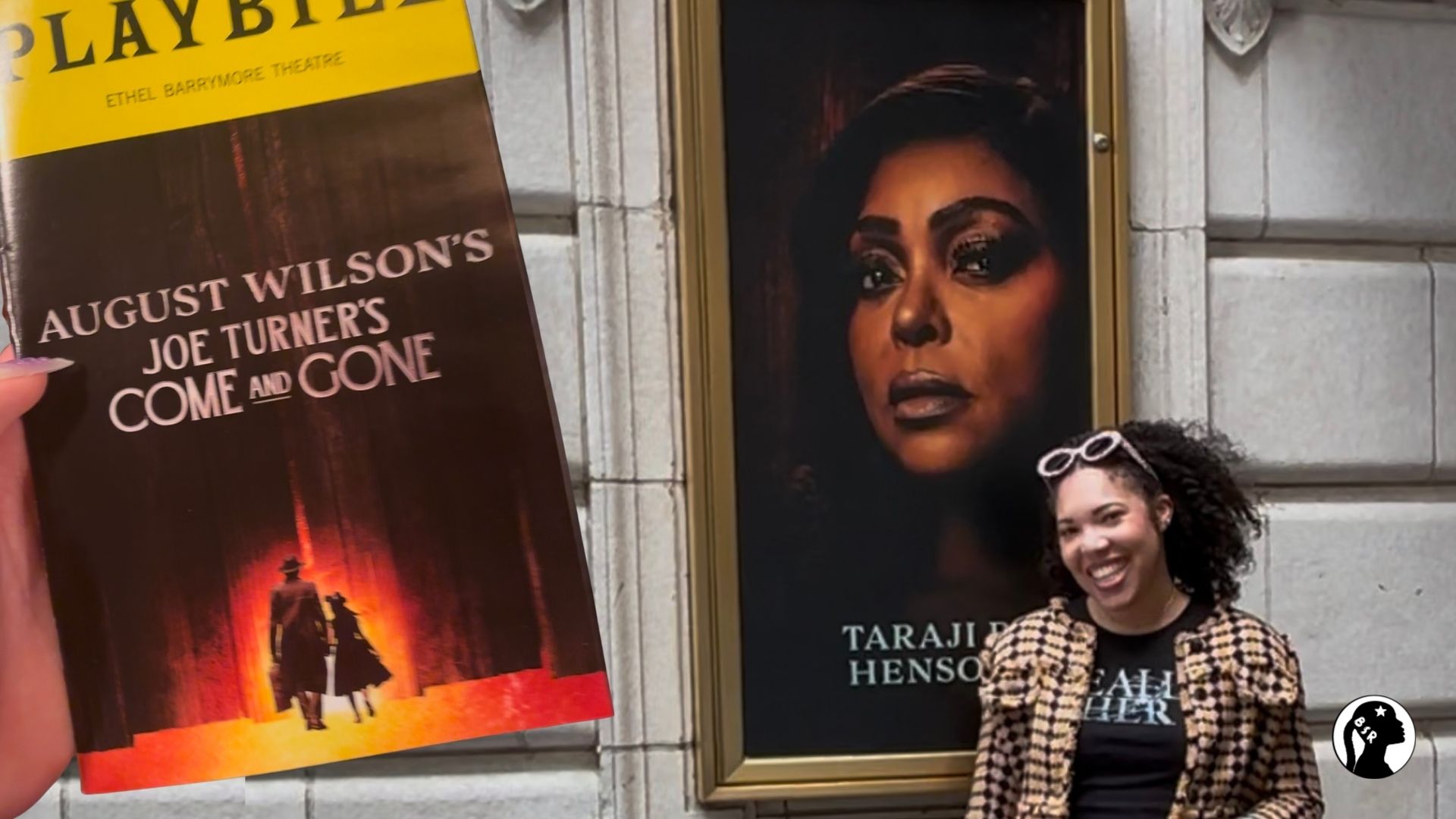
August Wilson’s Joe Turner’s Come and Gone returns to Broadway
Debbie Allen takes us back to August Wilson’s vision of 1911 with freedom lessons fit for 2026
“I ain’t never seen Joe Turner. Seen him to where I could touch him. I asked one of them fellows one time why he catch n-ggers. Asked him what I got he want?…He told me I was worthless. Worthless is something you throw away. Something you don’t bother with. I ain’t seen him throw me away…So I must got something he want. What I got?” – Herald Loomis, from Joe Turner’s Come and Gone
Only a fool robs the worthless and last I checked, “The Man” won’t no fool. For all the talk of our broken democracy and how much our votes “don’t count”, the system has exerted a great deal of effort to disenfranchise Black voters in the South. The Supreme Court’s recent ruling on Louisiana vs. Callais effectively undoes the work of the Voting Rights Act of 1965, the rights the marchers in Selma were beaten for. It’s enough to make one wonder what’s got our current roster of elected officials so intimidated by Black influence that they’d rewrite the rules and redraw the maps just to erase us. For the historically informed, it’s enough to make you wonder why they’d work to strip us of the same right twice — once in Reconstruction, and again now — when they know we have a strong history of resistance in this country and abroad. It’s enough to make you think, we must got something he want.
In August Wilson’s Joe Turner’s Come and Gone, we don’t ever meet the titular character and none of the other players do either. He is a bogeyman, mythologized in song, but actualized in the interrupted lives of his victims. Turner catches Black men, puts them on a chain gang for seven years and then turns them loose. Joe is not the law. The men in his gang are not serving any official punishment; they were snatched up for being at the wrong place at the wrong time and enslaved thirty years after Emancipation. (Before you question the legal logistics of how this could happen, please remember that brown people are being snatched off the street without due process in the present. Twenty-nine people have died in ICE custody since October.)
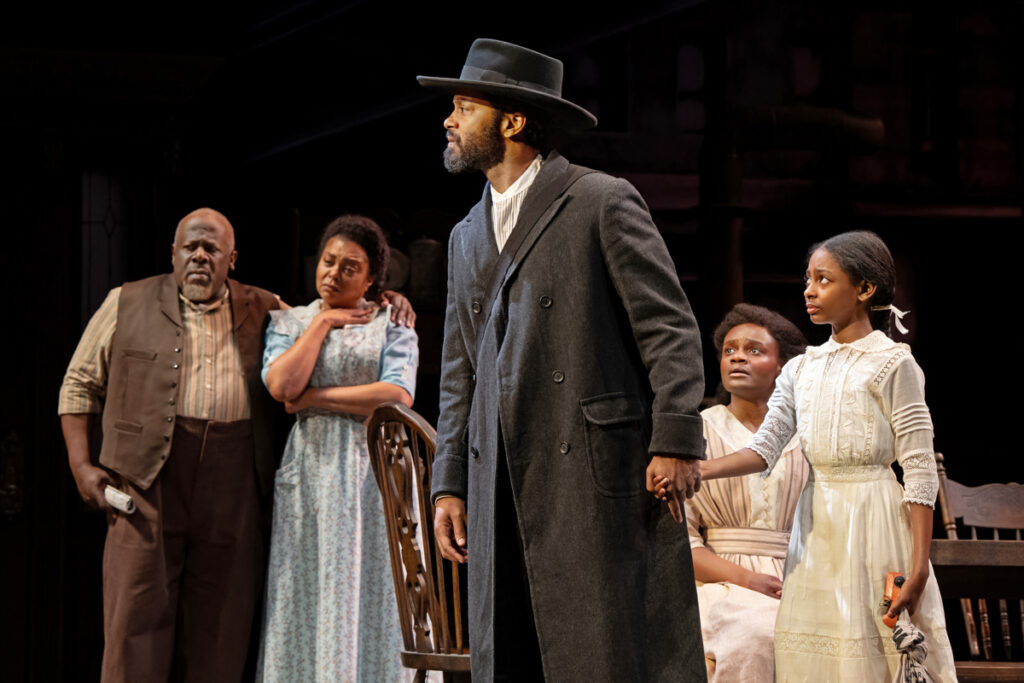
The cast of Joe Turner’s Come and Gone • photo by Julieta Cervantes for Broadway.com
Herald Loomis was a Turner man. His seven years on the chain gang are in the rearview, but the lingering anger and bewilderment drive him through the story with all the force of a fourteen-wheeler. The action begins when he and his daughter, Zonia, come looking for a room at the boardinghouse run by Seth and Bertha Holly. The Hollys and their existing guests take note of Loomis’s odd ways: he wears a coat and a hat at all times, has a mean-looking face, and his halting conversation is gruff, at best. (Zonia seems normal enough.) The Hollys rent the father-daughter duo a full week of room and board for $2. Loomis explains that it will be a short-term stay. The two are in town to find a woman named Martha, she’s Herald’s wife, Zonia’s mother, and described as “brown-skinned, with long pretty hair, about five feet from the ground”. When Herald got back to their sharecropping farm after being freed from Joe Turner, she was gone.
Loomis doesn’t do much, if anything, to improve his reputation amongst the other boarders and focuses on finding Martha. The other boarders have their own lives to live: Jeremy builds roads and plays guitar on the side, his girlfriend Mattie is waiting on her other man to come back, Molly’s only in town because she missed her train to bigger and richer things.
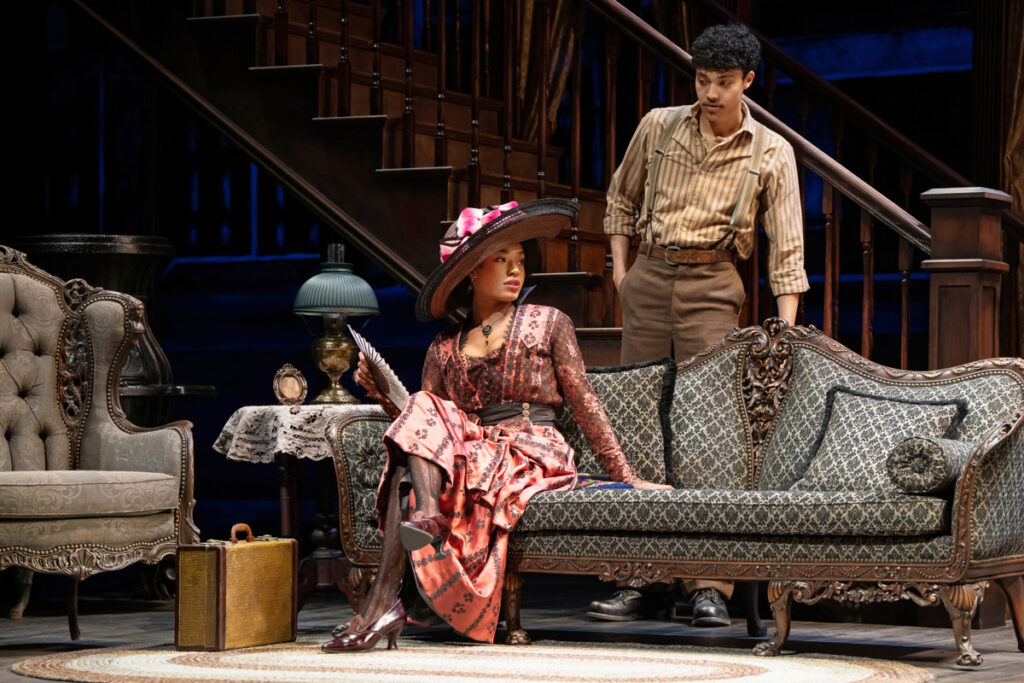
Maya Boyd as Molly Cunningham and Tripp Taylor as Jeremy Furlow • photo by Julieta Cervantes for Broadway.com
In this expertly-directed production from Debbie Allen, Wilson’s masterpiece becomes a kaleidoscope of themes — freedom, innocence, seduction, ancestry, search, ascension — through which we can view each character’s fullness. While most stories would struggle to hold so many glimpses of the human condition in its subplots, Joe Turner stretches to make space for not just one life, but ten. Most impressively, Wilson’s work remains percipient, this play is as much about Black life in the 1910s as it is about Black life in the 2020s. More on that later.
This production works because of the full-fledged dedication of Joshua Boone who performs Herald Loomis with the fervor of a man who’s committed to throwing himself off a cliff. He foams at the mouth, his eyes engorge at the sight of his own blood, his screams reveal a graveyard at his core. Boone’s Loomis is consumed with reunification, and his determination paces with him like a shadow tacked onto his heels.
He’s aided by Bynum, a root worker named for his ability to bind, played by Reuben Santiago-Hudson (This World of Tomorrow). Santiago-Hudson’s professional ties to Wilson are well-documented and the two were close up until Wilson’s death in 2005. In other words, any Broadway production of an August Wilson play that does not include Ruben Santiago-Hudson would be a disservice to audiences. Santiago-Hudson’s Bynum is a man of many minds. He gives practical advice to heartbroken young women (and distracted young men), playfully teases the lady of the house about her ‘biscuits’ (he’s not always talking about bread), gathers roots from the yard, stays searching for the “shiny man” from his dreams, and is the only one who runs toward Loomis’s haunting visions of “bones people stepping out the of sea” while everyone else runs away. Santiago-Hudson slides between worlds, from the tangible to the ethereal, like water.
As much as people want to hear a critique of the production, it was the off-stage performances that formed by biggest qualm. I loved to see Black theatre-goers come out in full force for the Saturday matinee (actor Tom Hanks was the only white man in his row at our show), but I was irritated by the string of late-comers squeezing into their seats, some of which arrived more than 30 minutes after the show began. And one more point of order from my Miss Manners high-horse: too much laughter at inopportune times. Chuckles when Loomis describes his visions and snickers when Selig (Bradley Stryker) explains his family’s trade in human goods may be a symptom of discomfort with certain topics and a hint at conversations we need to have in community. On the other hand, it was a pleasure to giggle with the room when the neighborhood kids share their first kiss, and groan at Jeremy’s skirt-chasing non-logic. It was like Harlem’s Magic Johnson theater had relocated to Broadway.
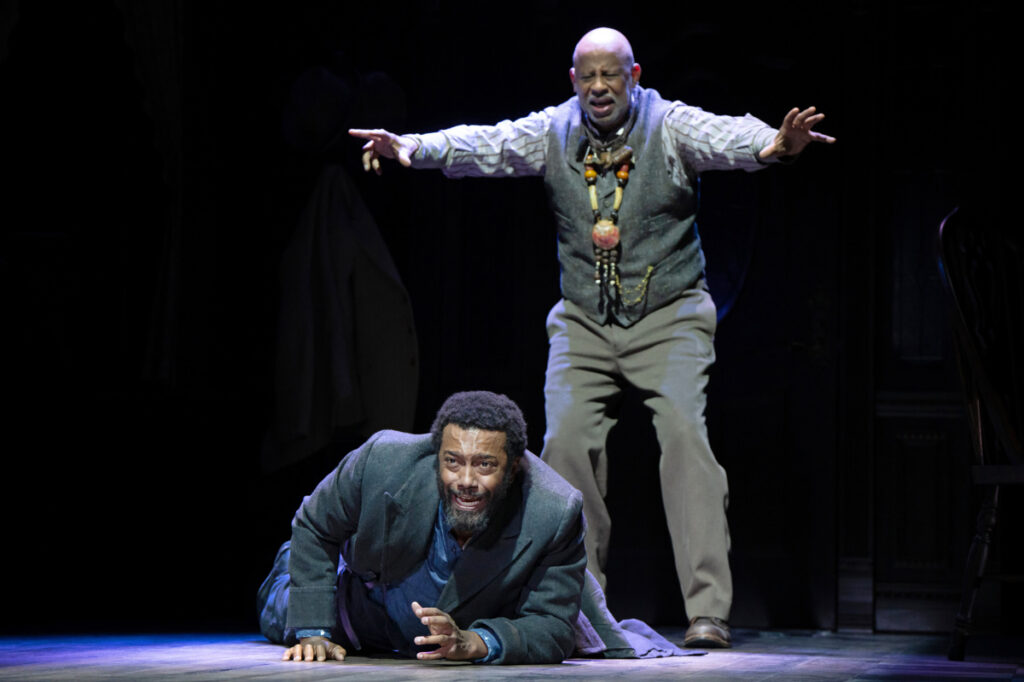
Joshua Boone as Herald Loomis and Ruben Santiago-Hudson as Bynum Walker • photo by Julieta Cervantes for Broadway.com
The performers didn’t let any audience antics throw them. Everyone on stage was dialed in, which the actors attribute to Allen’s direction. When I met the cast for press day back in March, they each alluded to her high expectations with gratitude and reverence. Both Taraji P. Henson, who tidies up the boardinghouse chaos with wit and warmth, and Cedric the Entertainer, whose charming delivery proves both his comedy chops and an astute understanding of the time period, made the same joke about being cast by Ms. Allen: when she calls you answer. An added benefit to casting Hollywood stars is getting to see fresher faces like Maya Boyd, Tripp Taylor, Abigail Onwunali, and Nimene Sierra Wureh keep pace and show out.
I was shocked, when the Tony nominations came out two weeks after I saw the show, to see so few nods for this discerning revival. The production received nominations for its score, lighting, sound design, costumes by Paul Tazewell, and Ruben Santiago-Hudson’s performance, but Joe Turner didn’t make the cut for direction or best revival, which is a snub if I’ve ever seen one. So far, 2026 is no repeat of 2025 — Beyonce’s Cowboy Carter won Album of the Year, Kendrick Lamar headlined the Super Bowl, and Purpose won Best Play — and we seem to be getting ego-checked at every turn.
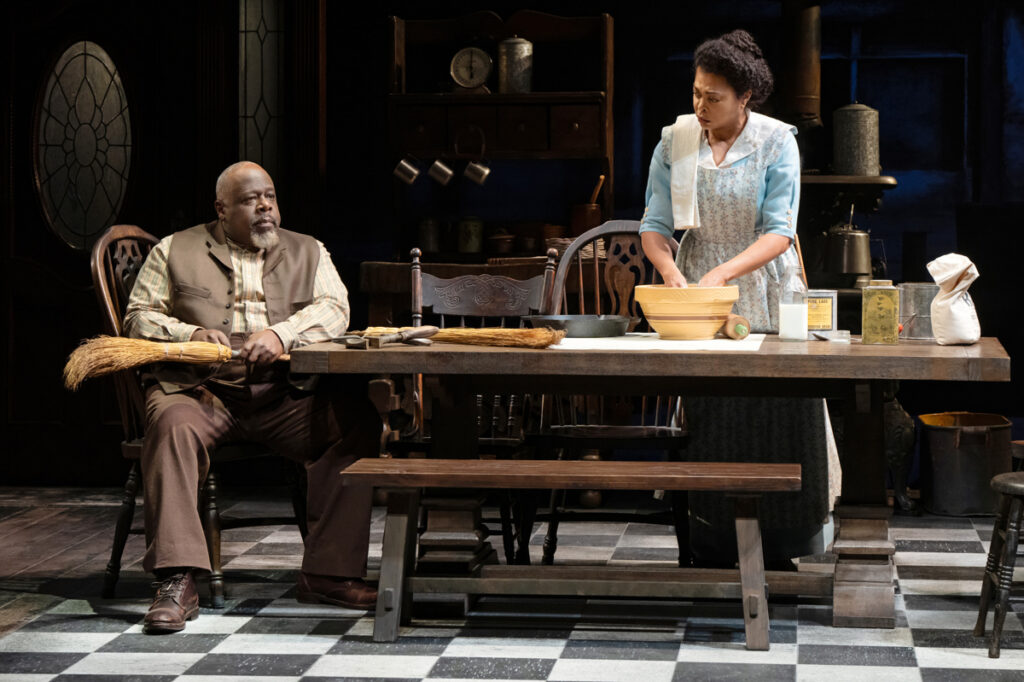
Cedric the Entertainer as Seth Holly and Taraji P. Henson as Bertha Holly • photo by Julieta Cervantes for Broadway.com
But this is the magic of Wilson’s “Century Cycle”: to show us how things change and how they stay the same. To ground us in how we have and will continue to overcome. As Loomis tries to wrap his head around irrational hatred, he asks Why he pick me? What kind of mark I got on me? What I got that he want?
In response, Bynum explains that Turner wanted Loomis’s song. “Every nigger he catch he’s looking for the one he can learn that song from. Now he’s got you bound up to where you can’t sing your own song. Couldn’t sing it them seven years ‘cause you was afraid he would snatch it from under you. But you still got it. You just forgot how to sing it.”
Bynum, via Wilson, has a clear view of 1911 and the present. The Joe Turners of this world will tell you you are worthless, while keeping you in their possession. They will tell you you are not exceptional, while making sure they do not miss a moment. They will tell you you have no voice, while working overtime to silence you. The Joe Turners of this world cannot make peace with the reality that they cannot have the thing they want from us, nor can they kill it. It’s time to dig the old songs up, it’s time to remember how to sing ‘em. Whether they come with 40 links of chain or 17 redrawn districts won’t matter; you can’t bind what don’t cling.
blacklove 🖤 and starlight 🌟
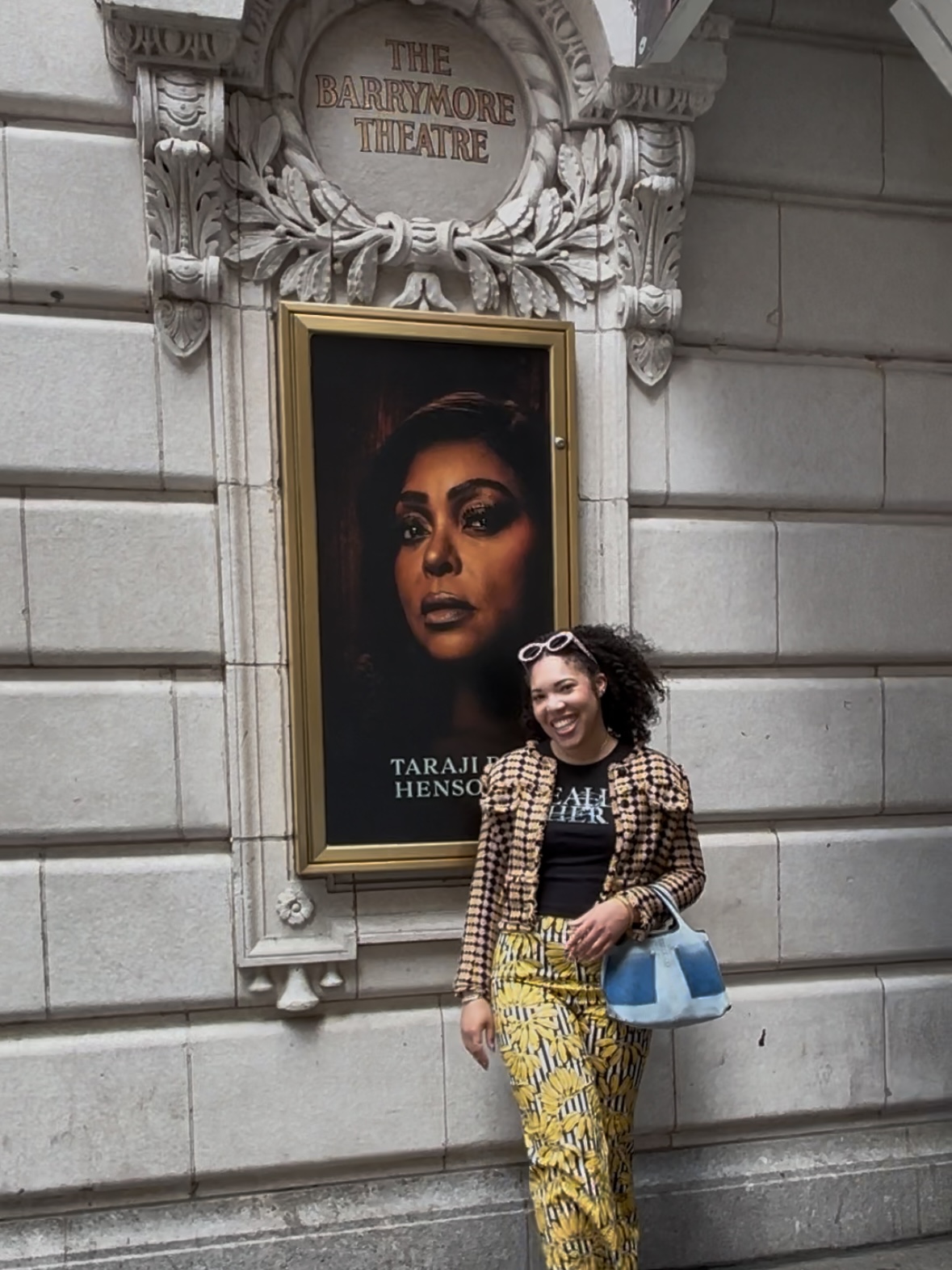
The 2026 revival of August Wilson’s Joe Turner’s Come and Gone opened on April 25, 2026 at the Barrymore Theater. The production was directed by Debbie Allen and stars Taraji P. Henson, Cedric The Entertainer, and Ruben Santiago-Hudson. The cast also includes Joshua Boone, Maya Boyd, Abigail Onwunali, Bradley Stryker, Tripp Taylor, and Nimene Sierra Wureh. This play was written by August Wilson and premiered on Broadway at the Barrymore Theater in 1988. I received a press ticket for this performance and offer my thanks to DKC/O&M.
The strictly limited engagement will run through July 26, 2026. Tickets for evening shows are $69 and up.
-
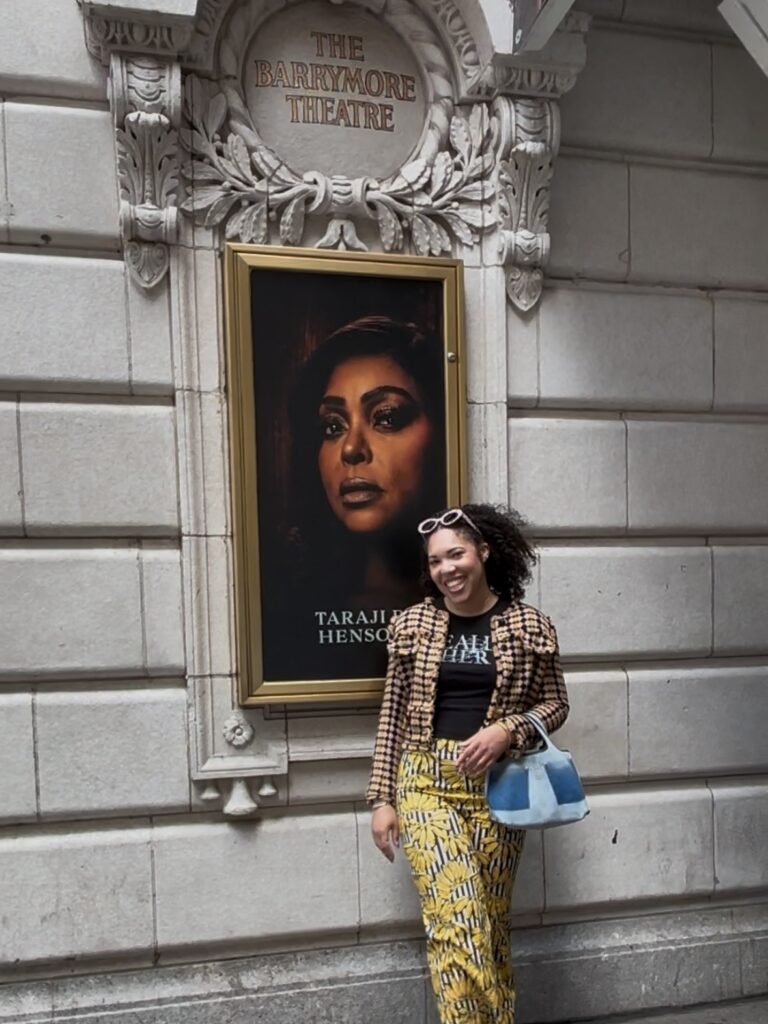
- The 2026 production returned to the Barrymore Theater where it premiered in 1988.
-

- The cast takes a bow at curtain call