

Grasping At Euphoria: Misery, Company, and Virality
A video I posted is going viral, but the moment doesn’t feel how I thought it would
When I started my YouTube channel in 2024, which was the first iteration of Black Star Reviews as a concept, I was of two minds when it came to virality.
On the one hand, yes! I wanted the immediate glitz and glam of being internet famous, of gaining hundreds or thousands of subscribers overnight, of being ‘monetized’ (a status level that pays out a portion of the ads viewers endure while watching your uploads). It would be an instant affirmation that my dreams were worthwhile and coming true.
On the other hand, I could think of nothing scarier. My life could turn itself upside down in a day. The fame could turn to mockery like that of Gorilla Glue Girl, who became a household name when she made the mistake of setting her hairstyle with Gorilla Glue instead of hairspray. Dermatologists and trichologists that came to her rescue rode on her viral fame, as did the Gorilla Glue brand who used the moment as proof of superior product. When she was freed from her not-so-quick weave, her audience disappeared. No amount of viral dances, trending voiceovers, or lifestyle content satisfied the masses of people trapped in their Covid-era bubbles and hooked on ‘trainwreck-tainment’ like Tiger King on Netflix and Gorilla Glue Girl on Instagram. Even worse, she told Vox she never liked that nickname. (Her real name is Tessica Brown.)
Before I pressed post, I would mellow my own expectations for my videos by asking What would you do if you went viral today? or double-check my intention with How would you feel if *this* were your viral moment?
I had a brief moment in the algorithm’s scorching sun with my 9th YouTube episode about the Harlem Renaissance exhibition at the Met. It was just over 49 minutes long, an in-depth look at all 13 sections of the exhibit plus a deep dive into the Met’s fraught history with uptown artists. (In hindsight, it was definitely overkill.)
When it crossed 250 views within the first 24 hours, I believed this was my moment, that I’d found an audience for my takes on art and the Black historical record. But when I scrolled through the comments to join the discourse I saw that people had watched, liked, and commented because of a half-second reaction.
I hadn’t realized I’d forgotten to wear my signature black star until the very end of my recording session. When I rewatched the moment during the edit, I decided the candid mix of shock and disappointment rippling through my expression might grab attention so I placed it at the start of the video. To a certain extent it worked, but it was a hollow win. My video had views but it was unclear whether the viewers had any intellectual takeaways. To be even more candid here than I was in that moment: that sh*t pissed me off.
Eventually, I stopped chasing virality — even subconsciously — and perhaps that’s why it ended up on my doorstep.
Today, February 17, is a little more than halfway through Black History Month and less than a month of living and posting on Larry Ellison’s OracleTok. As I told my dear readers (that’s you), I would be highlighting 28 Days of Black Art for Black History Month. Each day, I’ve been diligently posting my recommendations to TikTok, then to Instagram, and then adding the link to our running list on the website.
At times, this work has felt like a dusty walk through a desert wasteland. Every so often, a tumbleweed will roll by in the form of a comment or a new follower and I’ll feel deeply grateful. But it also feels like the wasteland is a container, that I’m intentionally being siloed off to the feeds of my most ardent followers and friends. Like I’m just a wall away from a lush garden of wider attention. It’s frustrating and disorienting, the way it can make you doubt your own experiences, but it’s not enough to discourage me from my beliefs about the importance of Black creativity.
In order to make 28 days of recommendations, I have to have seen at least 28 things. And that’s how I ended up in the mezzanine for a Friday night performance of Bug seated alongside the other access ticket holders from TDF and MTC’s Under 35 program. The poster features a white woman, Carrie Coon, and a Black man, Namir Smallwood, peeking anxiously into the lens. I’d seen the ads on the subway and received a few mailers.
The best thing about the performance was running into a friend and supporter in line outside and, separately, getting a special pass to the Patron’s Lounge where I could drink and eat all the wine and chocolate covered almonds I wanted. Outside of that, there was little else I liked about my night out. I closed my notebook halfway through the first act, knowing there was no way this show would be one of my 28 recommendations.
The two young women sitting behind me couldn’t have disagreed more. When the second act paused for a medical emergency in the audience, I heard them discussing how “powerful” the story was. Outside, I read the NYT’s take which called the performances “gripping”. On the ride home, I tried to put my finger on what it was that bothered me.
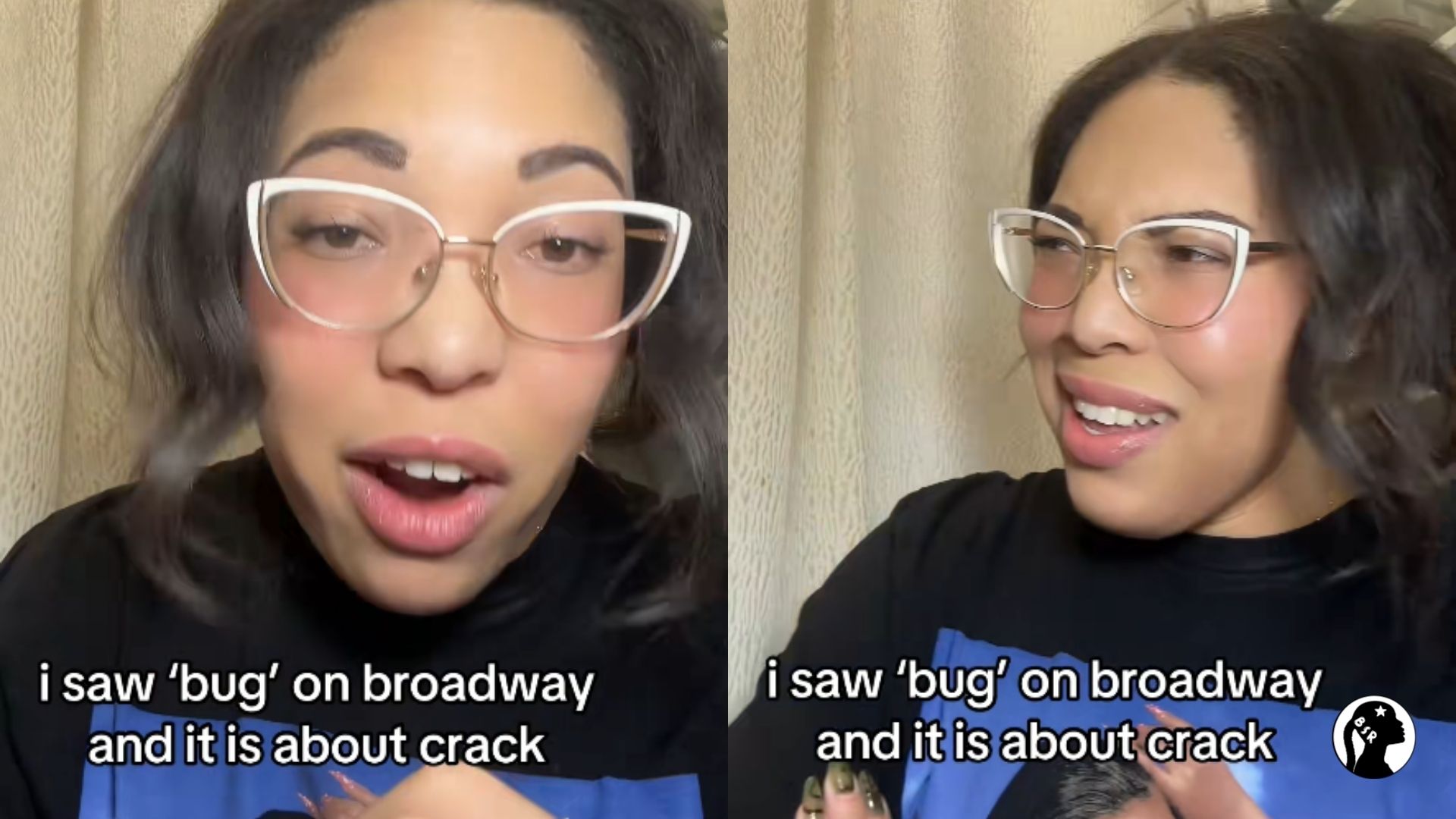
When I finally figured it out later that night, I turned on my camera and my selfie light and recorded the following 3 and 1/2 minute unscripted take. You can watch it, but here’s the transcript:
“I went to go see Bug on Broadway cuz wasn’t nobody in my circle talking about it and I decided I needed to go find out for myself, but here’s the thing: issa reason why nobody I knew was talking about it, issa reason why. So I’ma tell you, so you don’t have to do what I did.
Bug at the Friedman Theater, produced by Steppenwolf and the Manhattan Theater Club is the story of two crackheads in love. And that is not an exaggeration at all. I am talking about two people smoking real crack.
Here’s the thing though, I’ve never actually smoked crack and you probably haven’t either. 90% of the people in that theater have not smoked crack. So there was a little bit of an aspect of, like, poverty porn happening where I’m like, y’all nodding along talmbout some “oh this is powerful” (pause) Have you smoked crack?!
So we got a white lady, okay, who’s trying not to fall back in with her abusive ex husband who just got out for doing a bid, okay? And she comes across this nice, “nice” young Black man who is a veteran, alright? And together the two of them like to smoke crack in the hotel room where she lives. Now what she don’t know is this “nice” young man, he has a mental condition and he really should not be smoking crack, okay? He is paranoid. That’s why the show is called ‘Bug’. Because what they do most of the time is talk about bugs. They look for bugs, they searching for bugs. And I’m not talking about listening devices, okay? I’m talking about creepy, crawly little bugs. They trying to cut the bugs out they own [skin].
And what I need you to know is you don’t have to pay no money to see this. This is — this is on the corner! This is on the corner. You could take the 4/5 train to see this show for free.
Now I did read the little poster they have outside the show about what the New York Times said about the show and the New York Times says this story is of-the-moment, it’s gripping, it’s exactly what we need to be talking about right now. And they said the fact that they cast somebody Black in the role of the nice young man who is extremely paranoid, who sets off all this nonsense about bugs post-crack. They said that casting him, having him be the person who delivers the line about soldiers in the military, and Tuskegee, and how the government — you know what I mean — they said that that added, the racial aspect added a layer of how important this story is.
Here’s what I’ma say. I’m not saying this story wasn’t important. And I’m not saying that the people did not do a good job with the performances. But I want you to know that this is a story about two crackheads and it ends exactly the way you think it would when crack is involved.
So if crack and crack antics are interesting to you…if you wanna know what it’s like inside the mind of somebody who smokes crack, you should go see this show. But if you don’t have any interest in watching people suffer, watching people literally lose their minds for circumstances far beyond their control, then this is not the show for you.
So that has been another Black Star Review. I’m not writing a review of this show for my blog. I don’t have anything else to say besides the fact that this is — this is some crackhead sh*t. Peace be with you. Cuz peace was not with them.”
That was Friday night. By Saturday, a few friends had commented. By Sunday, people I didn’t know had found the video and commented, mostly in agreement. By Monday, a sprinkle of theater die-hards had arrived to scold me for criticizing an “American Icon”. (I’ll have to use this line next time someone critiques Beyoncé!) And now, Tuesday, the discourse continues in five main trendlines:
- I agree with this review and poverty porn is gross
- I think you missed the mark, the show is really about…
- It’s your fault that you didn’t know what to expect, it was already a movie…
- I love listening to you talk! You are very entertaining
- You’re really pretty
The Barclays Center where the Brooklyn Nets play holds 19,000 people. Levi’s Stadium, which hosted the Bad Bunny Bowl, holds 68,500. Somehow, my video is at 47,700 views and counting. I’ve gained more than 400 followers in the last 4 days. I should be excited, but mostly these numbers just make me want to roll my eyes.
Here’s how I’d summarize what’s happening: A white man from Oklahoma wrote a play about poor people in Oklahoma and how shared trauma can fuel drug use and conspiratorial beliefs. The play becomes a movie and then it becomes a play again, only this time the male lead is played by a Black actor. A Black woman who writes about theatre (that’s me) goes to see the show. She shares her experience of feeling miserable watching people act out the same misery she sees in her neighborhood every day. The miserable Black woman gains an unprecedented audience by sharing her distaste for Black misery.
This is a circle-jerk. Crack has been a scourge on the Black community and a cultural weapon of mass destruction. I am vehemently anti-crack and now my most popular ‘take’ is about crack. The “crack video” has led to no discernible bump in views for any of the 17 installments in my Black history series posted before or since.
This is the algorithm’s attempt to taunt me, to malign me, to lift me up high enough to show me the lush garden just over the wall. I can go there if I get with the program. More hot takes, more controversy. Less intentionality, less inspiration. More caricature, less character. More minstrelsy, less mission. I am not interested.
It’s a reminder, at least to me, that ‘art is movement work’ and that having our own spaces — where we can speak freely without anticipatory self-censorship will be a most valuable currency in the face of revolution. It’s why I/we have this website, where I am/we are not beholden to an algorithm that widely disseminates low value ideas and gatekeeps anything liberatory.
I think back to the question I used to ask myself, What would you do if you went viral today? It seems fitting that it’s come back around so close to my 2nd anniversary. I wasn’t prepared then to see through the schadenfreude of intangible metrics — views, likes, follows, comments, shares. But after almost 2 years, I’ve had time to find my footing and to root in what matters to me and my beloved community. It will take more than stadiums’ worth of imaginary people to sell us out.
The thing I’ve been told about crack is that it’s highly addictive, more so than other substances. The high you get from your first hit can never be recreated, but users spend the rest of their lives grasping at euphoria. In between the middling highs, there’s paranoia, and chaos, and withdrawals, and misery. In Bug by (American Icon) Tracey Letts, the journey ends in self-immolation. But crack is not the only thing that will run you up the flagpole and leave you there to dry, nor is it the only thing that’s been maliciously unleashed on the community, or threatens to change our minds.
The wasteland looks bare, but it is real — it is the place we can control and make fertile with effort, and labor, and patience. The lush garden over the wall is a hallucination; getting in and staying in is just as impossible as getting high and never coming down. Misery loves company. What is virality but audience?
blacklove 🖤 and starlight 🌟
