Review: ‘The Brothers Size’
Tarell Alvin McCraney’s ‘modern-day fable’ is still a moving portrait of love and sacrifice 20 years after its premiere
Funerals, though attended by the living, are filled with the dead. On a fall day in Mississippi, we gathered at the rec center in mourning attire to say our goodbyes. Despite the deceased’s personal relationship with God, a church would not have been the right locale. There were too many guests who needed to pay their respects but wouldn’t have done so beneath the watchful eye of a white Jesus. The service had been well under way when a brown-skinned man entered looking like he’d stepped out of a Ford commercial. He wore a cowboy hat, a button down shirt, and jeans fastened with a wide, metal buckle. He beelined toward the mic, his cowboy boots tapping on the gym’s hardwood floor.
Through gold crowns and a Southern drawl, he told coded stories most of us couldn’t understand, but a few men near the back clapped and nodded knowingly. I intuited enough to figure that he’d known my big cousin inside; they’d bonded behind bars and over Cup Noodles, they’d even talked about death. Maybe my cousin, who passed away at 45, had known that the end wasn’t too far off and wanted to have his affairs in order. He’d made his friend promise to come to his funeral dressed like a rancher and sing; here, he’d made good on the deal. As neighbors, family, and childhood friends shared their eulogies I wondered who knew him best: the folks from his free life outside, or the men with whom he’d shared his sentence.
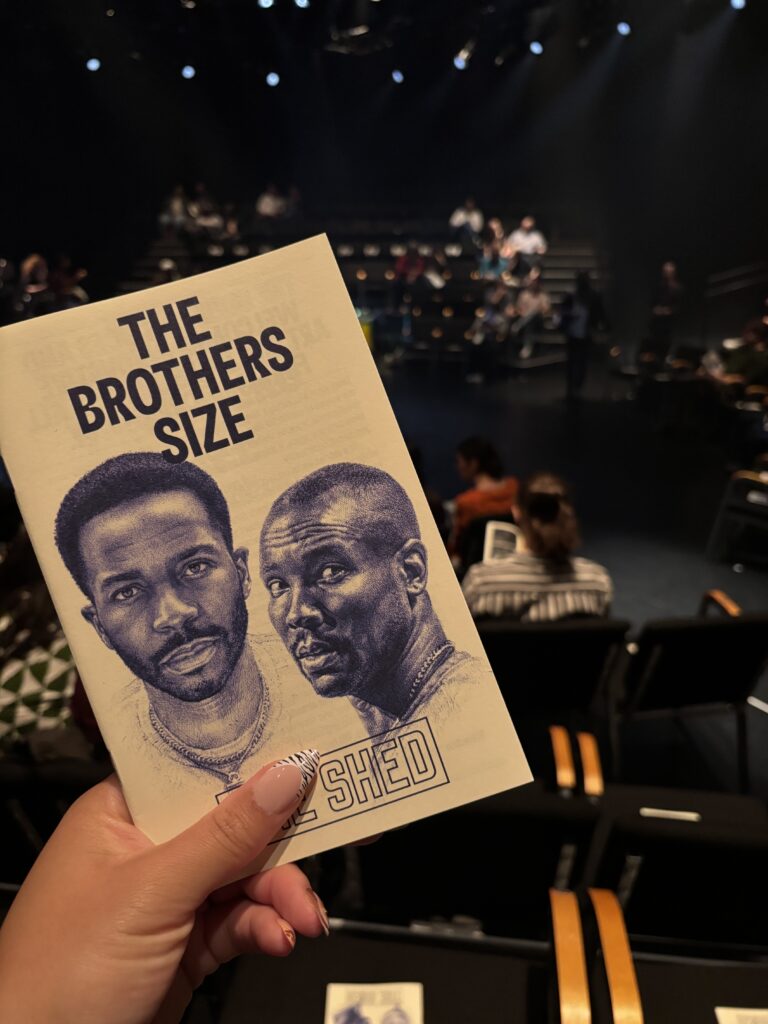
The Brothers Size unzips the distinct parts of self at play for the formerly incarcerated. In this play, which was written by Tarell Alvin McCraney more than 20 years ago, we find Osoosi, who is physically out of prison, but still haunted by nightmares and hounded by parole conditions that often follow men home. He’s staying with his older brother, Ogun, an honest, stern man who owns an auto repair shop. Osoosi and Ogun are visited by Elegba, a neighborhood man who did time with Osoosi and appointed himself to be Osoosi’s “brother” inside.
Now that Osoosi is out and free, his top priorities are to sleep, to ride around the bayou, and get as close to pretty women as those women will allow. He does not want to work at Ogun’s car shop or anywhere else really, which creates tension between the two brothers Size. In fact, while Ogun works, Osoosi prefers to distract him with performances of R&B songs, thrusting dance moves, and questions about former lovers. Since the two were orphaned at a young age, Ogun is equal parts brother and father to Osoosi and the fatherly side of him disapproves.
Tensions escalate when the town sheriff starts to pick on Elegba. The sheriff is Black and anti-Black and his directions for Elegba contradict themselves in a similar fashion. If he sees Elegba standing still, he’ll lock him up for loitering. If he sees him running, he’ll lock him up for moving suspiciously. He should only ever be working or commuting but not too fast or not too slow. As long as Osoosi spends his time riding around with Elegba, the two are in the trigger-happy crosshairs of the law.
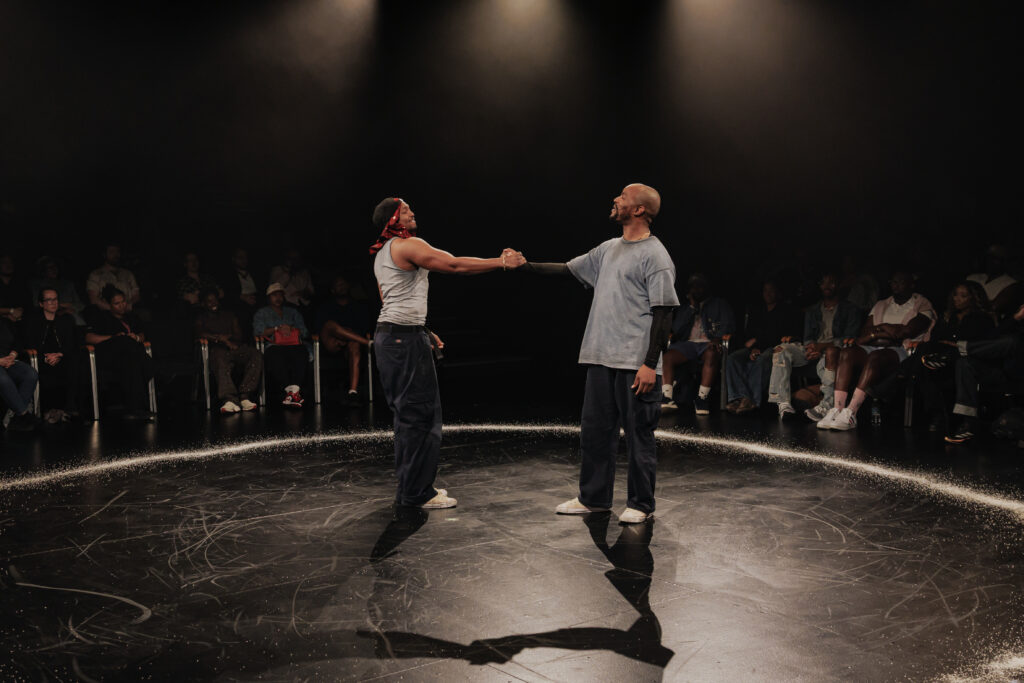
Elegba (Mays) and Osoosi (iLongwe) shake hands standing inside of a white circle • Photo by Marc J. Franklin. Courtesy The Shed
The sheriff, the house, the auto body shop, and the house never appear on stage. Instead, the actors speak stage directions (“Ogun goes under the car”) and recount run-ins with other characters (“So he says to me…”). It’s enough to create a lush background even when the set is just a ring of white powder poured onto the ground in the opening sequence. This strikes me as one of many symbols in the story. A circle of salt, flour, or chalk represents protection in a number of spiritual practices and the characters themselves share names with Yoruban deities or Orisha.
Ogun, who can fix any kind of car in the show, is the god of metals. Osoosi is a skillful hunter who loves beautiful things. Elegba guards crossroads and doorways. Ogun even tells the story of Oya, a woman who left him for Shango; echoing the Orisha love triangle. The playwright, Mr. McCraney cites “a Yoruba tale [he] heard when [he] was younger” as the basis for the show. The character’s names lend some depth to their story arcs, but this ‘modern day fable’ is telling its own story.
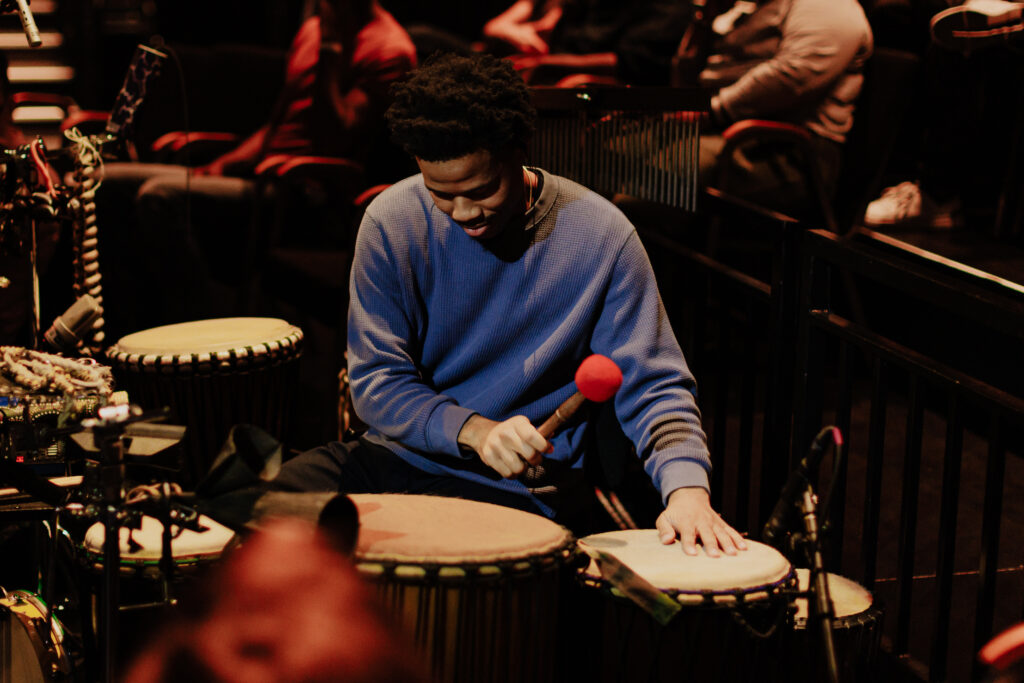
Munir Zakee provides a soundscape • Photo by Marc J. Franklin. Courtesy The Shed
Together, André Holland, Alani iLongwe, and Malcolm Mays steward us through the bonds the men share. iLongwe’s ability to embody both playfulness and vulnerability as Osoosi urges audiences to reorient the way they see felons and ex-cons. Imprisonment is brutal; our carceral state is inhumane. But incarcerated people are still people. They are just as human as you and I before, during, and after incarceration. Even Osoosi’s brother needs this reminder and Osoosi strikes back at Ogun for dropping constant reminders about his past. iLongwe offers an aching plea to be seen. When his mood changes to joyful or contemplative, you can sense and feel it with him.
For the first half of the show Ogun is brooding and repetitive, waking Osoosi up, worrying him, or asking him about serving time and I worried that André Holland — whose name appears above the title on the Playbill — was being underutilized. My concern was unfounded. When Osoosi — predictably — finds himself in trouble, Mr. Holland ignites, slamming the floor and barking at his penitent brother. Years of frustration unspool at center stage and you’re trapped between empathy for one brother and understanding for the other. You’re torn and tormented just like the characters are, sharing in the inevitability of their consequences. It’s the work of a powerful and talented actor that can transport you to the eye of the storm from your seat in the audience. In an earlier production, Holland played Elegba, the character portrayed this time by Malcom Mays. Mays’s take on Elegba enchants like smoke and mirrors. There’s something about him that spells trouble early on, but he presents so earnestly you’re willing to give him the benefit of the doubt. Mays is spot on as a trickster. He’s exactly the kind of man you should avoid, but can’t.
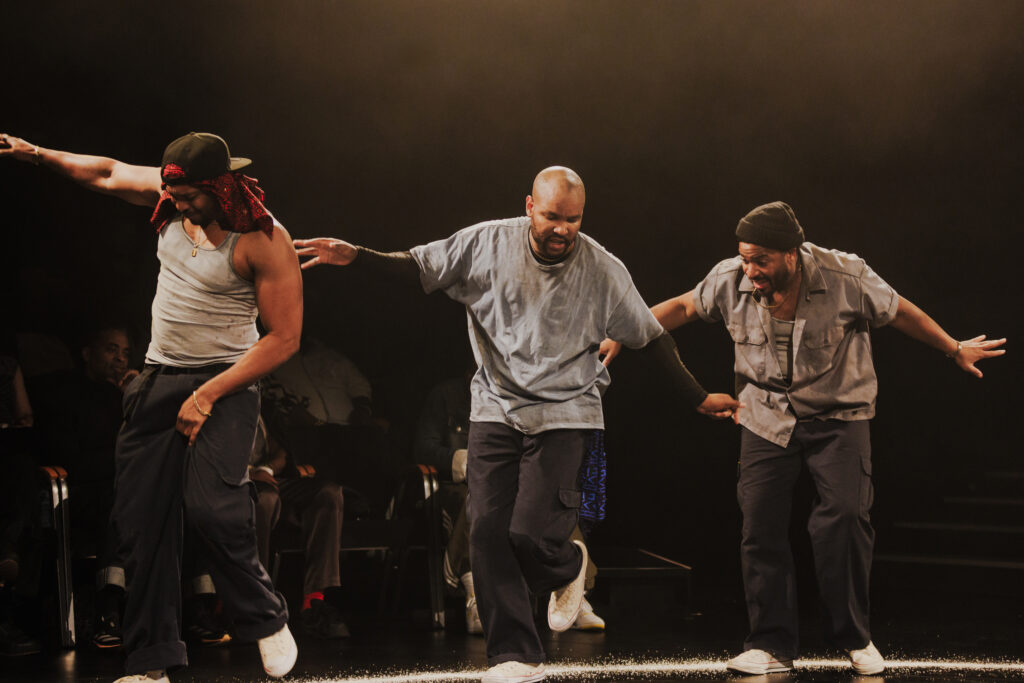
Mays, iLongwe and Holland dance in a line • Photo by Marc J. Franklin. Courtesy The Shed
Together, the three men spin, stomp and sing over soundscapes by Munir Zakee that color in the blank space of the set’s sparse design. During one transition, the men move around the circle one behind the other. They’re stepping like they’re in a Black Greek letter fraternity but the rhythm is borrowed from chain gang work songs; brotherhood for Black men is forged in many ways: through birth, in bondage, across burning sands and even with blood shed in streets, locker rooms, and trenches.
It’s become clear that I should plan to bring tissues when I see any story by Mr. McCraney. Both Moonlight, the Academy-award winning film based on his play In Moonlight Black Boys Look Blue, and The Brothers Size found me sobbing in the darkness. The sacrifices Ogun made for his brother starting in childhood and until the absolute end is enough to make the hardest heart meditate on the softness of love, even when the soul is scarred. Mr. McCraney’s vision, delivered through performances by Mr. Holland, Mr. iLongwe, and Mr. Mays, pierces through labels and categories — gay, straight, imprisoned, free, outside, inside, family, friend — and roots for the humanity in us all. Had my big cousin been in the room, I think he would’ve felt seen.
blacklove 🖤 and starlight 🌟
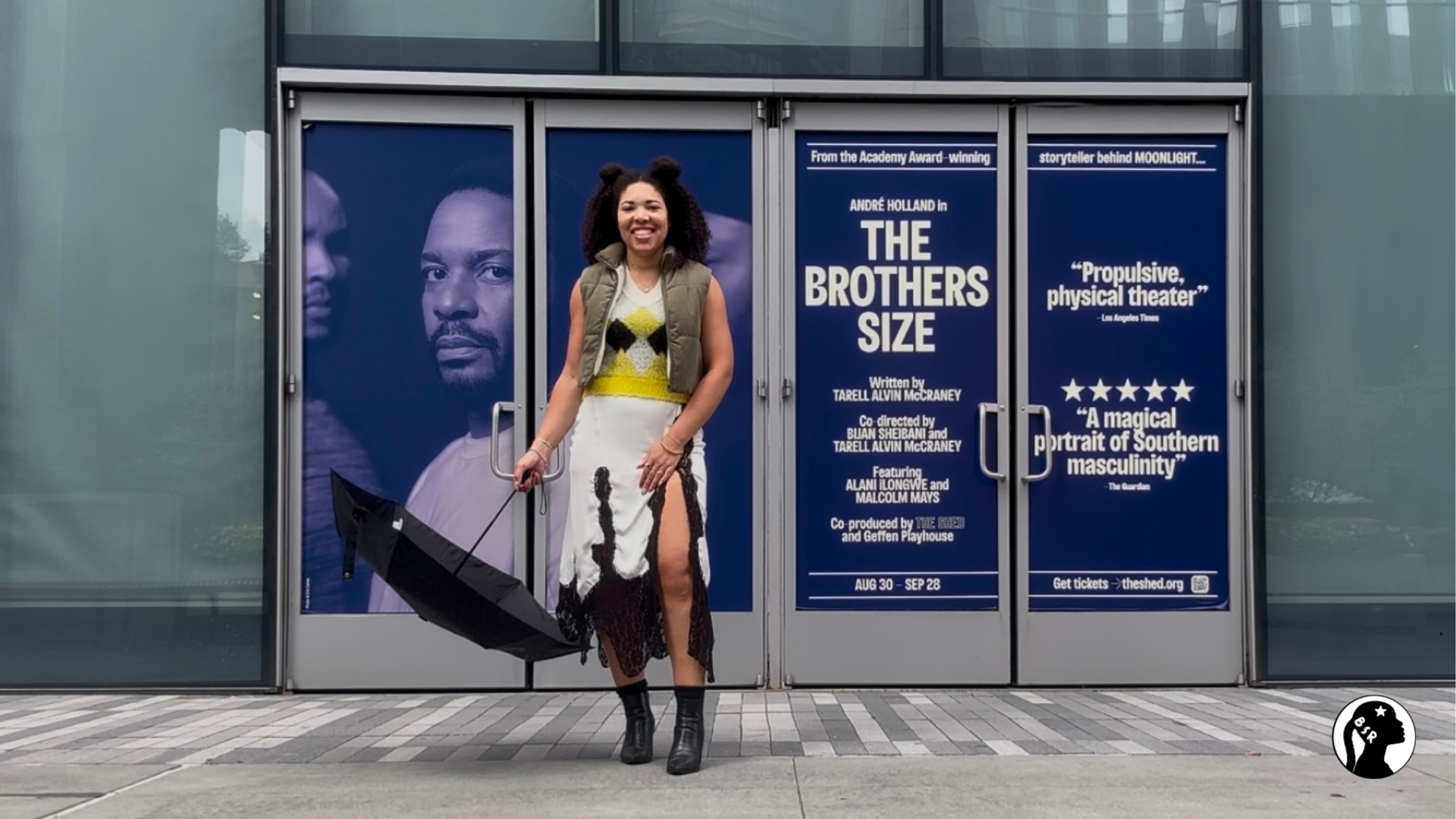
The Brothers Size will run at The Shed in Hudson Yards until September 28, 2025. The play was written by Tarell Alvin McCraney, co-directed by Tarell Alvin McCraney and Bijan Sheibani, and co-produced by The Shed and Geffen Playhouse in Los Angeles where Mr. McCraney is the artistic director. The 2025 production stars André Holland and features Alani iLongwe and Malcolm Mays. Tickets are $108 and up. ASL interpretation is available on select dates. I received a press ticket for this performance and offer my thanks to The Shed.
-
- photo: with Will, from the Black Play Club
-
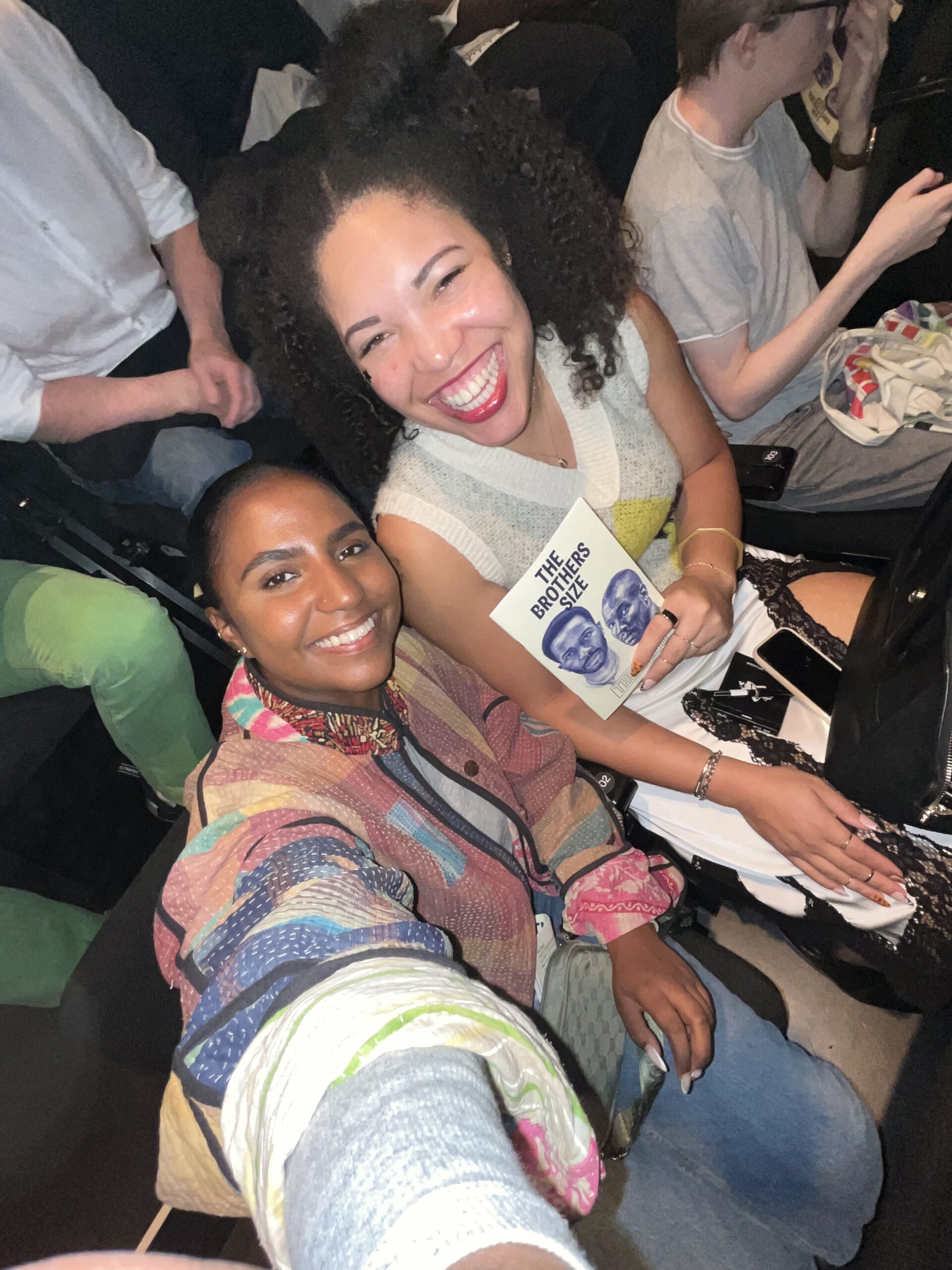
- photo: ready for the show with Yedifer