

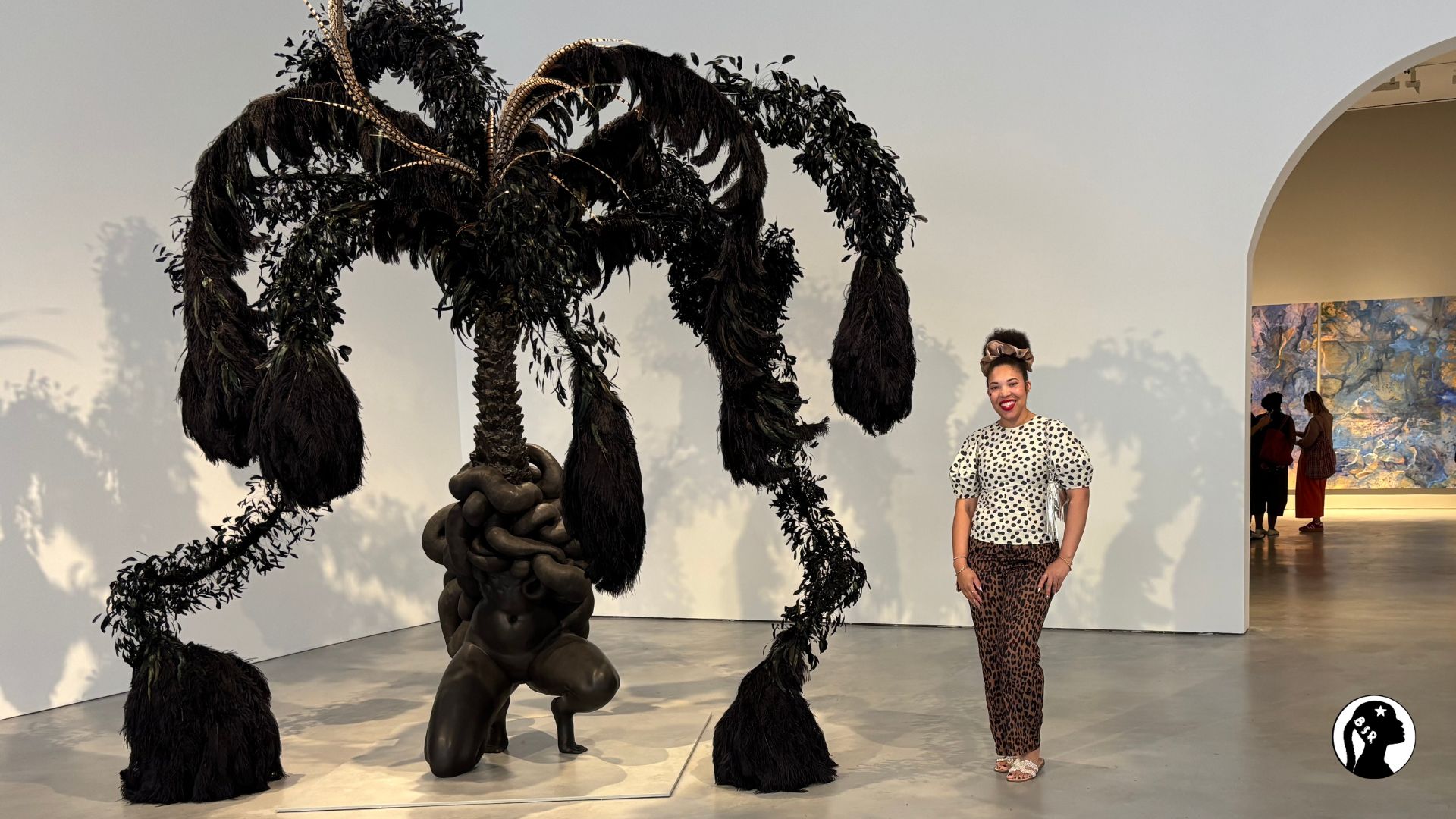
Firelei Báez: feet squelching on wet grass, nourished by uncertainty
Firelei Báez’s solo exhibition is an act of radical imagination and a gift of revolution
The nurse practitioner, who I’d always referred to as ‘Doctor’ out of respect, put her clipboard down. “Is there something on your mind?” she asked.
Moments earlier, I’d asked her what NYU Langone does with the samples they collect in order to run a comprehensive metabolic panel, test me for STDs, and check that loathsome box for my pap smear. Weeks earlier, I’d read The Immortal Life of Henrietta Lacks by Rebecca Skloot, a non-fiction book about a Black woman named Henrietta Lacks whose cells were harvested by Johns Hopkins Hospital in the 1950s. The infinitely replicative ‘HeLa’ cells have been instrumental in medical discoveries and pharmaceutical inventions that have paid out billions of dollars to corporations and research institutions, while her family only recently began receiving any payment, mostly through settling lawsuits for undisclosed amounts.
When I asked Dr. Newland about rights to privacy regarding my own biological material, I wasn’t worried about a payday. I was concerned about theft, dishonesty, the perpetuity of labor; that my cells might spend forever splitting under some man’s microscope and used to extend some lives while disposing of others. Lacks’ story, like her cells, echoes in our collective imagination. As Firelei Báez revealed during her artist talk, Ms. Lacks appears in her recently opened exhibition and in the conscience of Octavia Butler whose novel Kindred (1979) inspired another work in Ms. Baez’s exhibition.
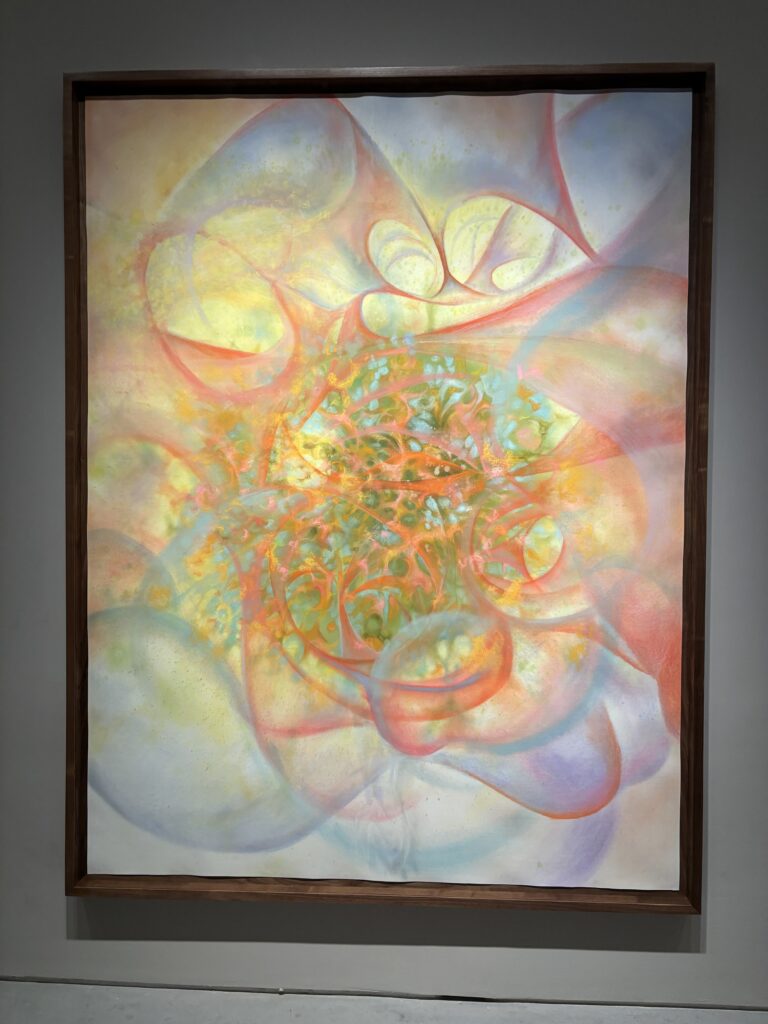
“Cuepa (joy spinning like the mist in the morning light)” (2026) by Firelei Báez; Hauser & Wirth New York, 22nd Street
Báez’s show is titled feet squelching on wet grass, nourished by uncertainty and fills two floors of Hauser & Wirth’s gallery space on 22nd Street. During her ARTNOIR artist talk, the artist explained that works upstairs “navigate places of being” while the ones downstairs are “enmeshed…corporeal”. You’d notice clear delineation in form and feel even if you visited the gallery without her. Upstairs, traditional canvas is replaced with Evolon paper that allows pigments to flow through rather than accumulate on top. The result is fruit-colored organic shapes on stark white backgrounds that could be displayed as two-sided if they weren’t hanging on a gallery wall. Imagine an aura painting in conversation with an aerial action shot of a dye droplet splashing into a sea of milk (an activity I vaguely recall from middle school science class). The image feels deeply familiar, but I find them hard to describe, and I’m even more at a loss to imagine how Báez transmuted these concepts from her muses. I can understand that the 4 works on Evelon upstairs and the “atemporal cloud” of transfigured book pages in the side room are about the existence of space, but the writer that I am is better equipped to cover things that exist in space. (I hope in the near or far future that I’ll be the kind of writer who can take you upstairs.)
From a craft perspective, it’s an extremely daunting task to translate Báez’s visual works onto the page. With her hair pulled back in a thick, low braid, wearing a purple linen dress not unlike what you might see on a spring day at the farmers market, she stands only about half as tall as the canvases that border the room while she explains the rationale of her artistic practice. The longer I listened, the more I pictured Ms. Báez as a magical sponge, constantly soaking in information and squeezing it out in new colors and textures. She’s amassed so much historical knowledge and mythology that it feels impossible to encompass all that she narrated, all that’s visually there, and all that went into a single work let alone the six paintings, 2 sculptures, and 8 panels of “View of Nature” that develop across the ground floor. When she talked about pouring water onto canvases and working around the resulting shapes, I thought of Khari Turner, who does the same with water he’s collected from places of import in the trans-Atlantic slave trade. Lo and behold, Khari was there at the talk, as was Jeffrey Meris, and Ekene Ijeoma — all artists I’ve written about here on Black Star Reviews, artists who revere Báez and eagerly asked to be pictured with her. Firelei Báez may very well be your favorite artist’s, favorite artist.
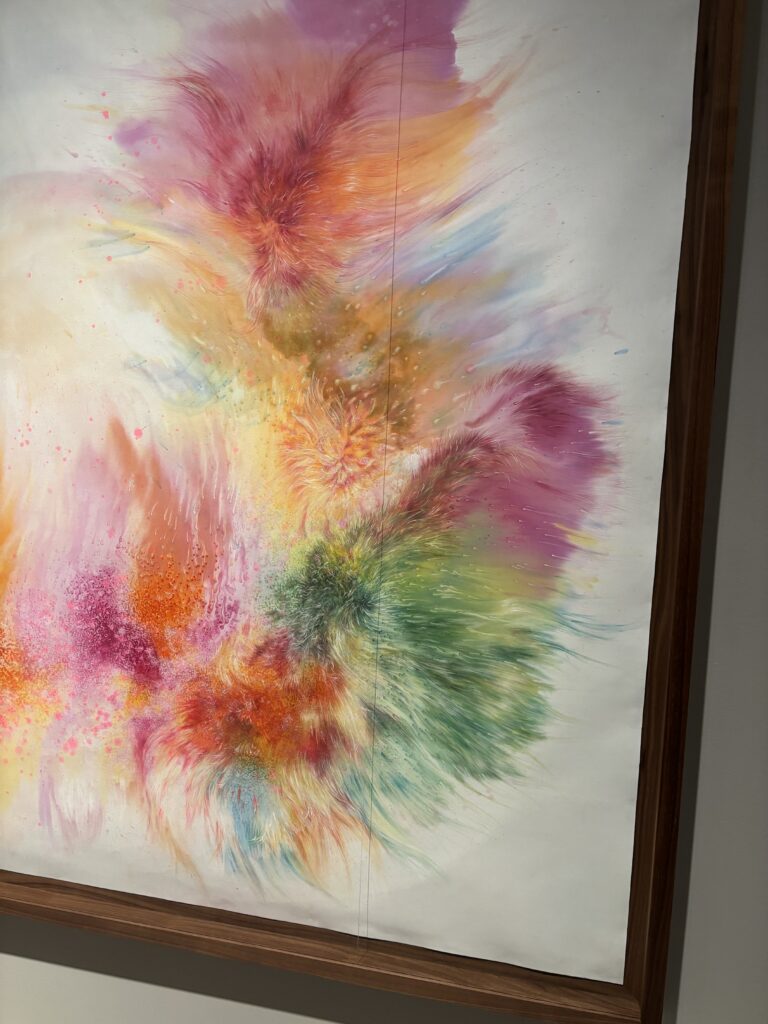
detail from “Muzidi (enacting an autonomous space for transformation)” (2026) by Firelei Báez; Hauser & Wirth New York, 22nd Street
That said, I acknowledge this challenge and take it on, since one thing Ms. Báez appreciates about visual art and that she sees as a limitation of writing is: the viewer completes the experience of the work with their own ideas. I heard her say this on an Atlantic podcast with novelist Edwidge Danticat, who was born in Haiti on the other side of the island from Ms. Báez. Well, here goes.
On the opposite wall from the “View of Nature” behemoth 8-panels is a painting of a nipple titled “View from the tower”. Painted on top of a round panorama centered on Großer Inselsberg mountain in Germany, the nipple that now covers the peak is plump, and pink, and true to form with capillaries gathering in the areola and small cracks at the teat. The only hints of the silver bar that run through it are the telltale silver balls on either side, slightly off center. In the silver’s shining reflection, I could see a house and trees, as if the nipple was exposed outside. Fascinating and hyper-realistic, it felt like a treatise on womanhood until Ms. Báez disclosed that she chose to paint a nipple because “we all have a heartbeat, we all have a nipple”. Somehow I’d forgotten that men had nipples, too. I took another look but remained certain that the nipple depicted is a woman’s.
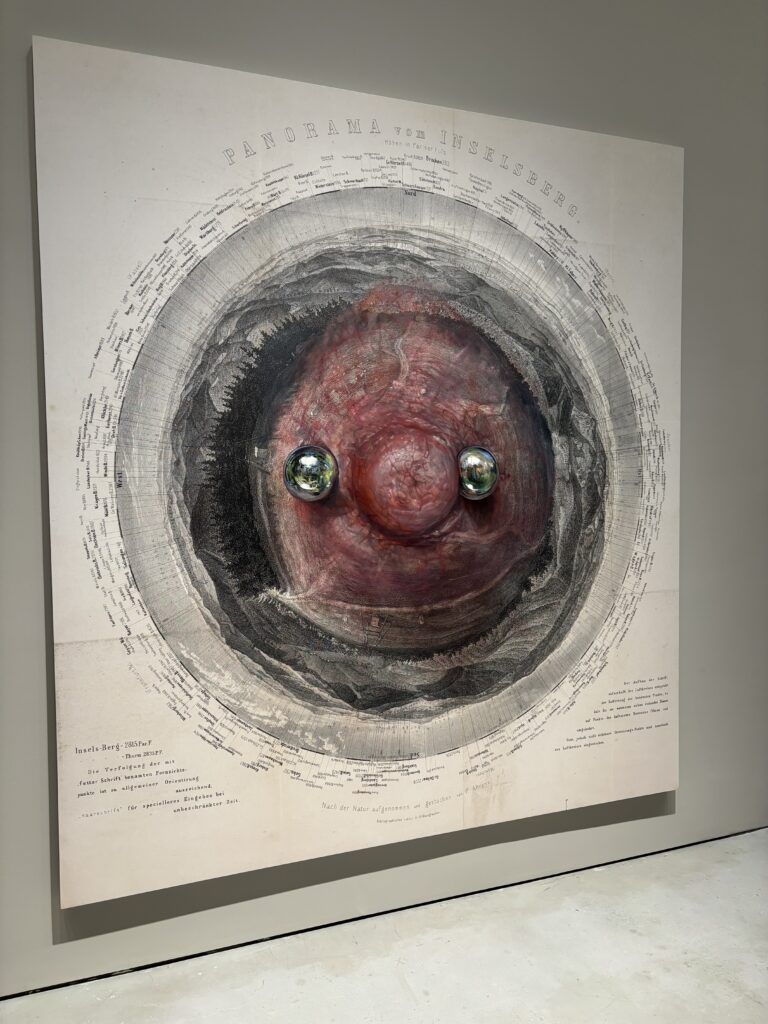
“View from the tower” (2026) by Firelei Báez; Hauser & Wirth New York, 22nd Street
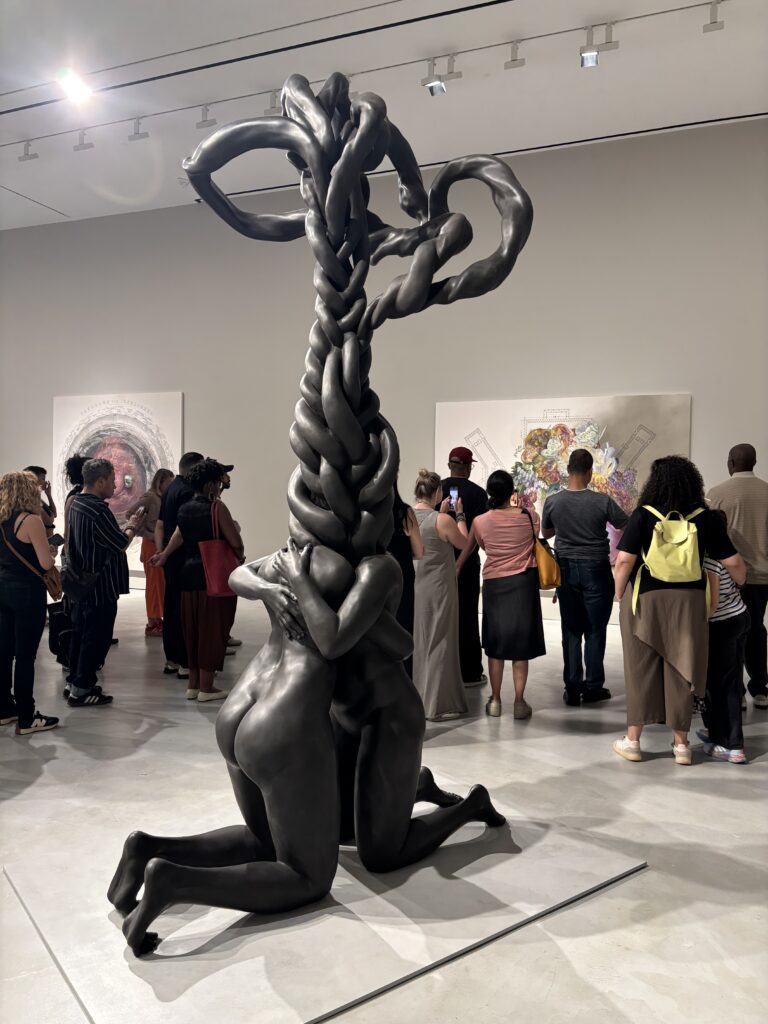
“Ciguapa Ooloi (Unburdened of the master script of our planet’s assumed demise)” (2025-2026) by Firelei Báez; Hauser & Wirth New York, 22nd Street
When I surveyed the space, I saw women everywhere. In sculpture, in painted flora and fauna, in the curve of a hip. I didn’t feel like I was adding my own ideas, it just felt like it was. The sculpture in the room “Ciguapa Ooloi (Unburdened of the master script of our planet’s assumed demise)” is a bronze of two woman figures hugging on their knees with their feet flexed, but there are rope-like tree limbs where their heads and shoulders would be. The limbs twist and braid into a plume, like lucky bamboo sprouts into sprightly green leaves. I can’t tell you why I feel that the women hugging are Black, or why I’m certain that the figures are women. But I am. This was the work that Báez linked to Octavia Butler’s Kindred. The fantasy novel centers on a Black woman writer named Dawn who goes back in time and meets her ancestors, but the time is slavery and her ancestors are enslaved on a Maryland plantation. (Butler called the story a “grim fantasy”) Dawn’s existence is proof that her ancestors survived and a charge that she persist in the present. Both this novel and Báez’s bronze are Afro-futurist assertions. That something indivisible might sprout from our collaboration, from our embrace. That even from our knees we might reach great heights. She referenced the trickster from Dominican folklore ciguapa — analogous to West Africa’s Anansi, and Southern America’s Brer Rabbit — as resistance personified.
Báez mentioned that Butler, too, had been fascinated with Henrietta Lacks and in my own searching I found a Butler scholar’s synopsis of the first novel in the Lilith’s Brood trilogy (1987-1989) where,
“…a Black woman named Lilith considers helping a group of aliens who are interested in interbreeding with humans in a way that would effectively “end” the human race. Lilith, who has a history of cancer in her family and a tumor that the aliens removed, has what the aliens call a “talent for cancer.” They’re interested in the possibilities that could come from regulating cellular growth.”
The Ooloi aliens won’t survive without interbreeding. Butler built on Henrietta’s story in a trilogy that seats a Black woman’s cells as the crucial ingredient for assured interplanetary survival. Though Butler takes the idea much further in the next two parts of the trilogy, it’s essentially just a science-fiction version of what actually happened. Modern medicine, and all who benefitted from advances since 1951, would not be what it is without the nonconsensual collection of Lacks’ cells. Báez’s artistic interpretation of the story is hopeful in visage and title.
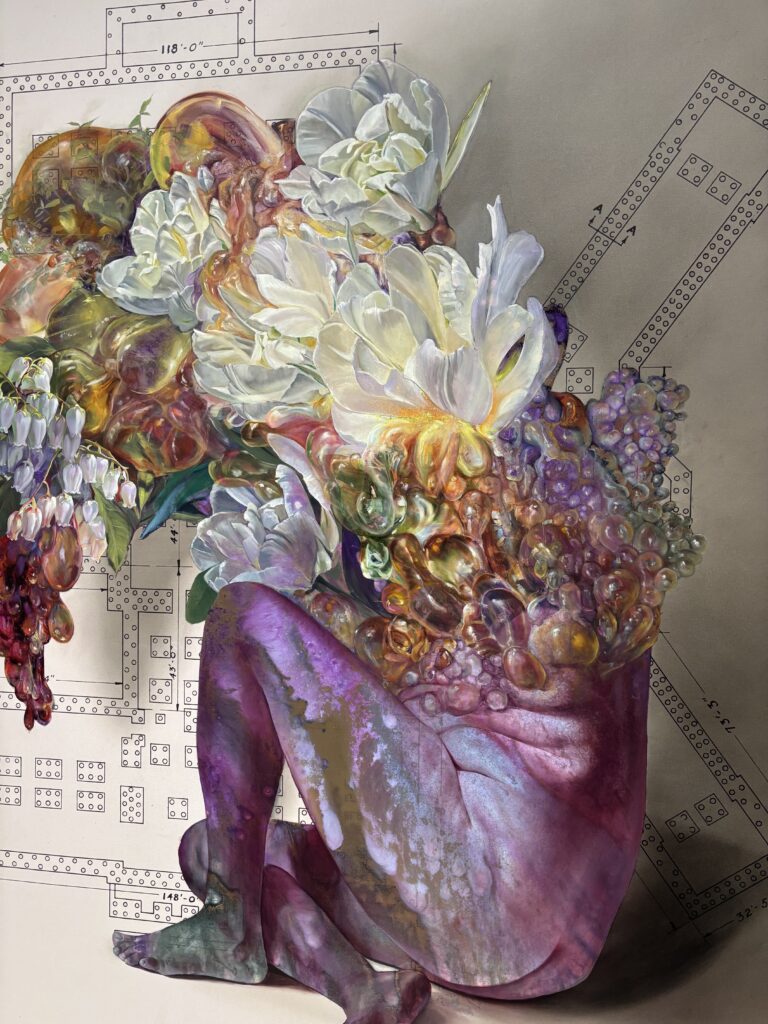
detail from “Yagé (towards a honeyed absolution)” (2025) by Firelei Báez; Hauser & Wirth New York, 22nd Street
Facing the “Ciguapa Ooloi” bronze is Báez’s painting “Yagé (towards a honeyed absolution)”. Like “View from the tower”, she’s painted on top of an archival document, this time a blueprint of a hospital. The superimposed figure is a curled up purple body casting a hazy shadow on the right hand side of the canvas. Midway up the back, the body bubbles in jewel-toned boils but as it arcs toward the light, the figure blooms into crisp magnolias, pale bluebells and bunches of grapes. Yagé is another name for ayahuasca, a ceremonial drug that comes from plants, no human harvest needed. As the title indicates, it’s a wish for a resolved future, where things are forgiven.
The way Báez combines archive, deep knowing, and liberatory framing in her artistic practice is her gift to the revolution. In the same podcast with Ms. Danticat, the two relay the inspiration of Toni Morrison’s 2015 essay in The Nation “No Place for Self-Pity, No Room for Fear” and lessons from the Freedom Fighters. In times of resistance, everyone is not on the front line — someone has to rest for the next shift, wash the clothes and cook the food, or make the art. Báez says, “We need to create moments of imagining so we can get ourselves out of here.” I see the radical imagination in the twisting, climbing limbs of “Ciguapa Oooloi”, the reminder of our shared humanity in “View from the tower”, the boundlessness of atemporal clouds and significant beauty of shapes that defy description. I think that Ms. Butler, Ms. Morrison, and Ms. Lacks would take in Ms. Báez’s contributions and feel that not only did they leave behind invaluable gifts, but that they are plenty-deserving of rest.
blacklove 🖤 and starlight 🌟
‘feet squelching on wet grass, nourished by uncertainty’ is a solo exhibition by Firelei Báez at Hauser & Wirth New York, 22nd Street. It is on view from May 12 – July 31, 2026.
-
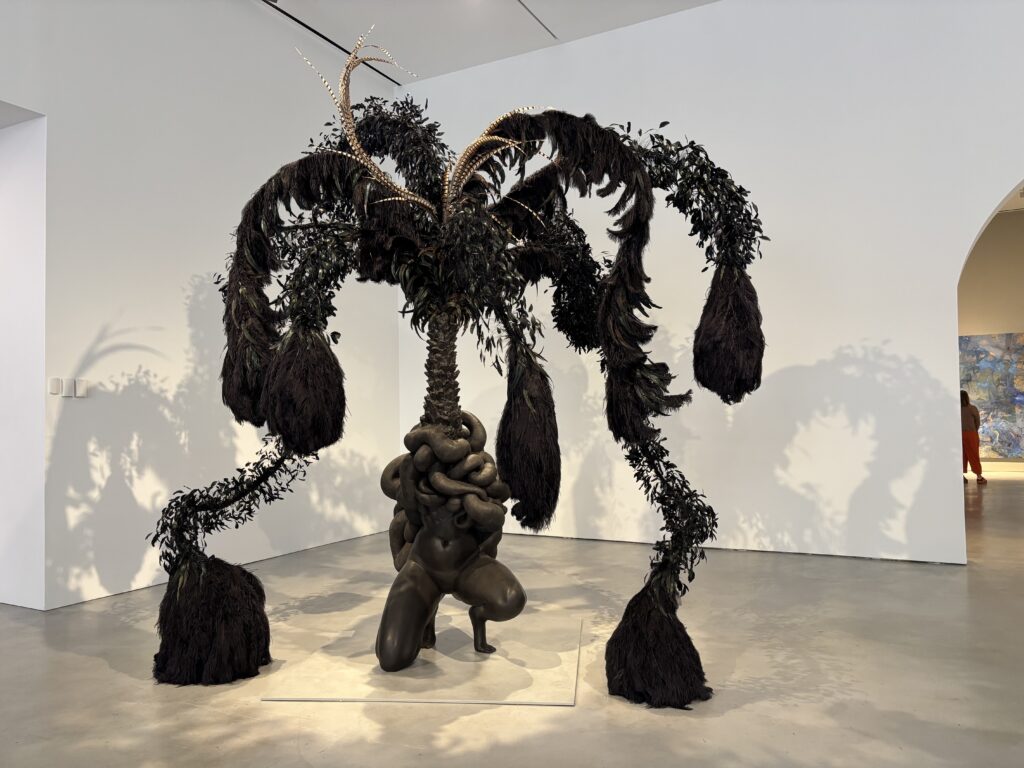
- “Ayida” (2025-2026) by Firelei Báez; Hauser & Wirth New York, 22nd Street

-
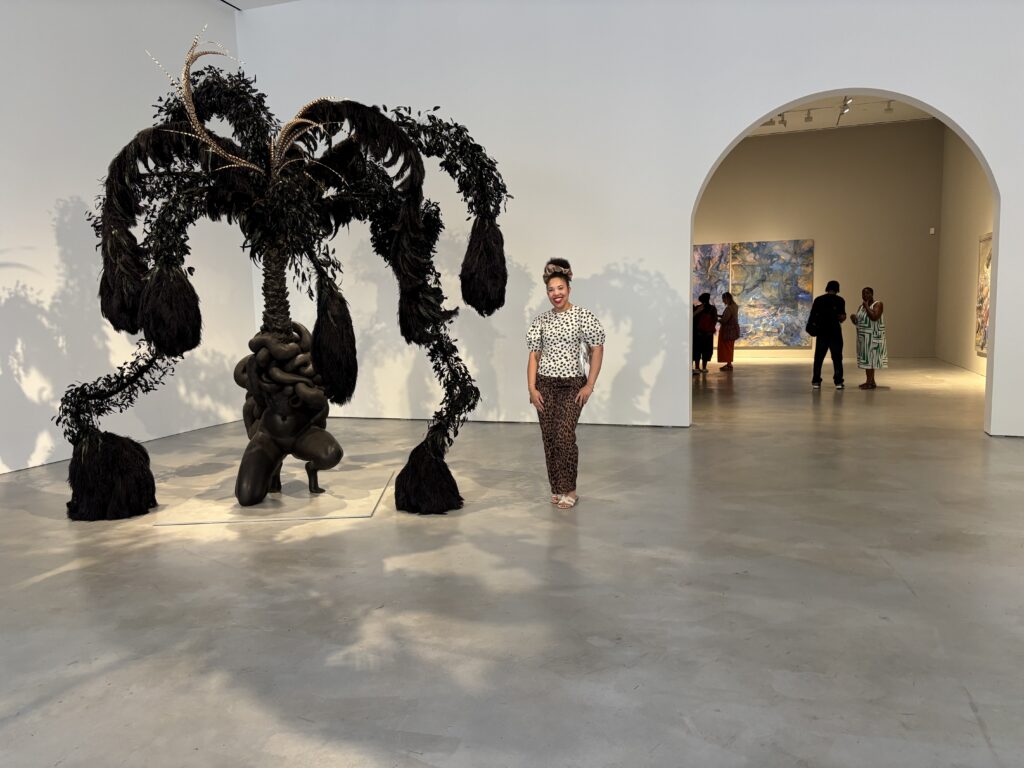
- pictured with “Ayida” (2025-2026) by Firelei Báez; Hauser & Wirth New York, 22nd Street

-
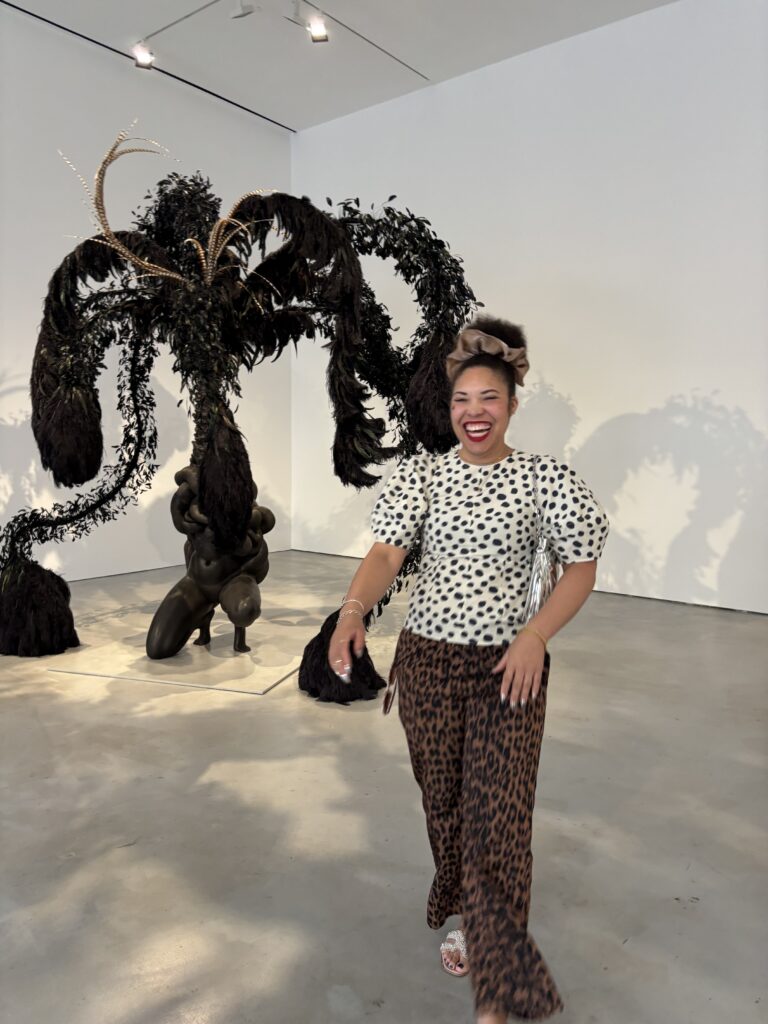
- pictured with “Ayida” (2025-2026) by Firelei Báez; Hauser & Wirth New York, 22nd Street

-
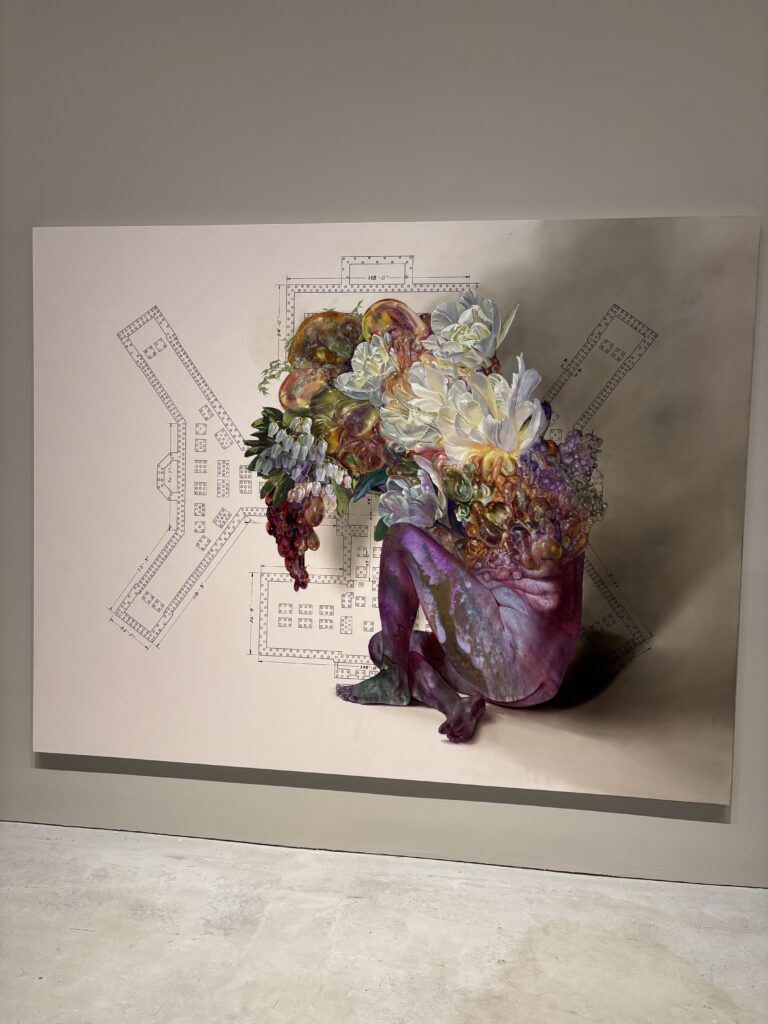
- “Yagé (towards a honeyed absolution)” (2025) by Firelei Báez; Hauser & Wirth New York, 22nd Street

