
On ‘Cabaret at the Kit Kat Club’
Marisha Wallace’s moving performance in Cabaret makes the clear danger of fascism both undeniable and urgent
I was determined to kick the habit. Binge watching was ruining my evenings. I’d start one episode of Columbo, allow autoplay to lead me into another, and — 3 episodes later — move from the couch to the bed to see him solve just one more case. I finished the show (I’m not a quitter!) and tried a documentary for a mental palate cleanse. Number One on the Call Sheet, the 2025 Apple TV documentary about Black film actors at the top of their game, kicked off another watchable marathon. Working my way through the Black film canon has me in and out of a time machine; I robbed a casino with Sammy Davis, Jr. and had a whirlwind Paris romance with Sidney Poitier. I’ve been diligent but disciplined — one movie per day — and only on nights when I don’t have theater tickets. Or, I was diligent, until I saw Cabaret. Since then, my watchlist is filled with dictators, genocide, and the Third Reich. Harry Belafonte has had to wait.
I wouldn’t have gone to see Cabaret if Marisha Wallace and Billy Porter weren’t in it. Since it opened in April 2024, starring pairs have cycled through the subway ads: Eddie Redmayne and Gayle Rankin, Adam Lambert (from American Idol) and Auli’i Cravalho (the voice of Disney’s Moana), Orville Peck and Eva Noblezada. (Wallace and Porter are the final pair for this production, which will close on October 19.) Despite the constant promotion, this production hasn’t been a hot topic in my social circle and I found myself, again, in the audience for a show I knew nothing about. Earlier that day, my friend, Michaela, mentioned that “it was about fascism” which I thought a strange contrast to the fanfare-burlesque aesthetic of the ads. In every iteration of the poster no matter the stars, the male lead wears a comically small party hat surrounded by green mist.

Attendees enter the theatre through a grungy alley that evokes Jazz Age Berlin
We arrived in time for the prologue, a flurried folk performance that starts before seating opens and spans two levels. I wanted to record a video of the accordion player in overdrawn flapper makeup and ruffled bloomers squeezing her organ and showing a little leg, but ushers had used stickers to cover the cameras on our phones before we came in. The cheeky stickers matched the club’s logo and read “Keep it in the Kit Kat Club”. I began to doubt Michaela — maybe she’d recalled the wrong musical since this one seemed determined to arouse — and I held onto that doubt for most of the first act.
We were one number away from the intermission and all that had happened so far in the A-plot was that a British cabaret performer called Sally had been fired from her job and moved in with a very hesitant and queer-curious man named Cliff, who had come to Berlin from the States to write. The music and lyrics concerned itself with the hedonistic bacchanal of the Kit Kat Club, where the performers urged you to keep their rebellion just between you and them (“Don’t Tell Mama”) and impressed that, in the bedroom, more is more (“Two Ladies”).

Ushers covered our phone cameras with stickers. You’re not allowed to take photos and videos of the production.
Meanwhile, Fraulein Schneider (Ellen Harvey), the older woman renting a room to Cliff (and Sally, once she invited herself in) was falling in love with Herr Shulz (Steven Skybell), a grocer who was courting her with gifts of exotic fruits like pineapples and oranges. At this time in Berlin, nobody has any money and they’re all just trying to make do. Fraulein Schneider, understanding the low odds of finding another tenant, rents the room to Cliff at a deep discount. Another boarder named Fraulein Kost (Michella Aravena) is hosting a revolving door of sailors to make her rent money the old-fashioned way. Before long, Cliff, who couldn’t get much writing done after Sally butted into his life, is considering Ernst Ludwig’s (Henry Gottfried) suggestion of using his American passport to smuggle luxury goods from Paris. It’s a gig that pays handsomely, but is a little too clandestine for Cliff’s straight-edge tastes and curiosity toward Ludwig’s motives. They’re all poor, but life’s a party.
In the final moments of the first act, Ludwig the smuggler takes off his coat and, in doing so, inadvertently reveals his political affiliations with the Nazi party. Ludwig is wearing a red armband with a black and white swastika. Sally, Cliff, Fraulein Schneider, and Herr Schulz watch as an engagement party descends into a militant rally for the future of Germany and guests sing “Tomorrow Belongs to Me” for the second time. (The first time, the meaning of the song went right over my head.)
Intermissions are usually abuzz with audience reactions and cheerful recaps of favorite moments, but the intermission at Cabaret was more like a moment of silence. Lines were long at the bathrooms, but short at the bars. Who can focus on buying a themed cocktail when you know the Nazis are coming?

The graffiti in the entryway foreshadows the show’s political undertones
The second act follows each character’s response to the coming lethal revolution. Fraulein Schneider believes it best to hold off on marrying her Jewish beau Herr Schulz. Herr Schulz is not immediately convinced of danger, but eventually moves to the other side of Berlin “just in case”. Cliff and Sally make plans to leave Berlin and return to Cliff’s roots in the US. Even as the city crumbles around her and the stage lights start to flicker, Sally chooses to stay in Berlin on the slim chance that she’ll become a star. Now, they’re still poor, but the party is over, and few can see the destruction that’s coming next.
The show ends with an unfinished lyric. The floor is covered in paper triangles that represent broken glass, and the audience files out silently. As I see it, there are three forces sucking the air out of the room: our current political moment, the audience’s awareness of our current political moment, and Blackness.
In the second act, the Emcee dances lovingly with a gorilla and sings about how his love for her is misunderstood by passers-by. I may have been slow on the uptake with “Tomorrow Belongs To Me”, but I knew where this song was going. I had already flashed back to the offensive memes of First Lady Michelle Obama circa 2010 before the song’s ending punchline, “if you could see her like I do/ she wouldn’t look Jewish at all”.
When Adam Lambert played the Emcee in February, he made news for reprimanding the audience after the show, but a better headline would’ve blamed the audience for laughing after “If You Could See Her”, a painfully obvious piece of anti-semitic propaganda that should warrant nary a chuckle.
On the night I attended, the people near me watched the hair-raising musical number in confusion and horror. It’s not February anymore. The current administration celebrated 200 days in August and it’s easier to see where we’re headed than it was before. (I’d argue that it was always clear if you were paying attention.) The Department of Education has been effectively dismantled, the Smithsonian museums are under review, vaccines and public health resources are scarce, and eggs are not any cheaper now than they were in 2024. Unless members of the public demand change, we’ll soon be faced with the same decisions as Fraulein Schneider, take what you can get or hold out for something better, and Cliff, stay and suffer or get out while you still can. Finding refuge is a guessing game since it remains to be seen if the rise of fascism in America is only one ripple in a global trend or a uniquely American problem one can evade with relocation.

The August Wilson Theatre was completely redesigned to accommodate this production of Cabaret, which is staged in the round.
Watching from the future makes it too easy to assess the wisdom of the characters’ choices. Herr Schulz moved to another part of the city, but he probably didn’t go far enough. The Nazi regime would soon occupy all of Berlin, all of Germany, and a huge swath of Europe. The safest thing he could’ve done as Jewish man in Weimar Germany was cross an ocean and not look back. Watching him pack his bag to “wait things out” feels like watching the remaining survivors “split up” during a horror movie. They’re clueless, but you know how it’s going to end.
With Marisha Wallace in the role, we know how things will end for Sally, too. Marisha and Calvin Leon Smith, who plays Cliff, are Black. (Billy Porter is also Black but he was out with an illness on the night I attended and was replaced by the excellently chilling Marty Lauter.) This makes Cliff’s instinct to bust out of Berlin even more believable. As a Black man in the 1930’s, he’d be returning home to voter disenfranchisement, Jim Crow, lynchings, and other uniquely American horrors but at least he has the sense to know when to make an exit. Cliff’s assuredness and urgency feels akin to the Black voices sounding alarms every day about how democracy is hanging on by a thread. Then, as now, most people aren’t listening.
Likewise, Marisha’s identity as a Black woman deepens Sally’s motivations. Her desire to be a famous singer and her feeling that she has a better shot in Germany than anywhere else is echoed in the real life experiences of Josephine Baker, who Wallace cites as an inspiration for her performance in the role. Sally’s choice to move in with Cliff makes sense, too, because as a Black British woman in Berlin where else would she go? But, when Sally gets the call to return to the Kit Kat Club and decides to stay in Berlin you know that she’s flat out delusional. The Nazi party did not discriminate in its hatred of non-“Aryans”, Black Sally is in just as much danger as Herr Schulz. In her final solo, Wallace pulls notes from low in her hips and sends them soaring for the rafters. It’s enough to break your heart. Life is not a cabaret, old chum, life is a minstrel show.
An interesting bit of subtext here: Wallace, a full-figured Black woman, has had to claw her way into leading roles. She tells the story candidly on her 2025 album Live In London. After a rough go playing one-line roles on Broadway, she filled in as Effie White in Dreamgirls on the West End in London. Since then, she’s found the fame, recognition, respect, and acceptance she’d been denied in the US and has gone so far as to become a British citizen. Wallace understands Sally’s determination to make it even when it means abandoning the familiar, as good as anyone can.
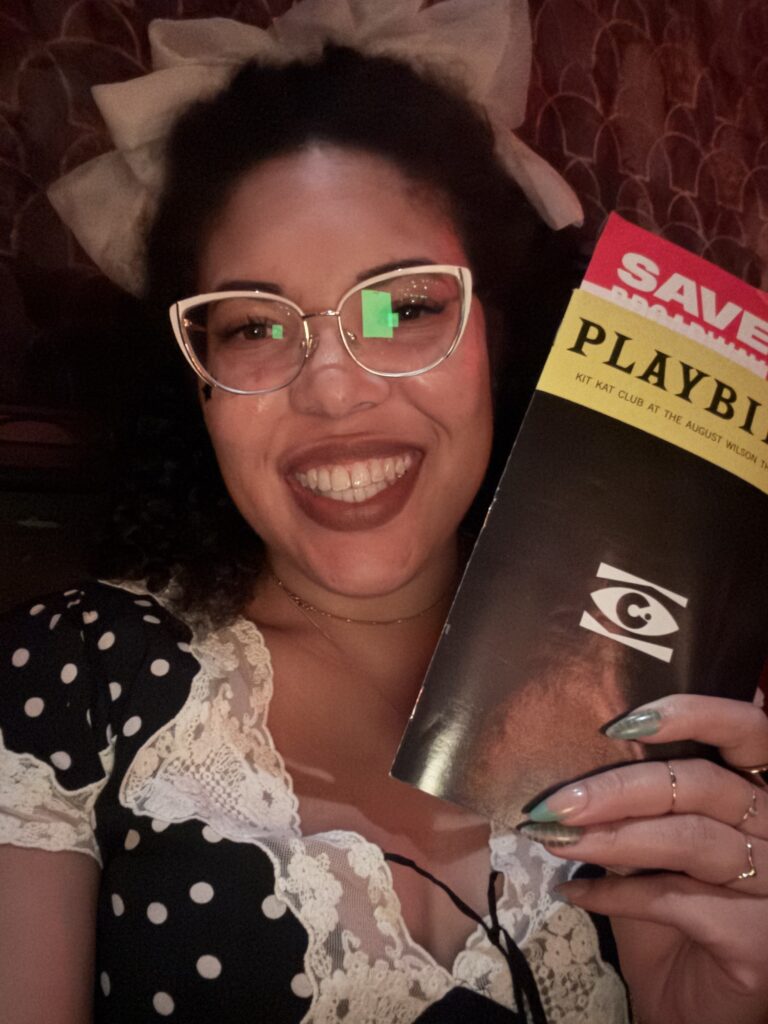
During intermission, I took a selfie with my front-facing camera (which I hope was not against the rules!)
I could imagine — during Liza Minelli’s film performance, or that of Judi Dench, (white) Michelle Williams, or Emma Stone on Broadway — how their whiteness make space for the audience to rationalize Sally’s choice to stay in Germany and perform for rooms full of Nazis. Maybe, if she sings well enough, or beds the right military officer, or dyes her hair blonde she’ll make it out alive. But this is also a delusion. Because while Sally gets to decide to risk danger, her (enthusiastic or passive) participation in oppressive structures guarantees danger for everyone else.
White women’s presumed safety — from life-threatening pregnancies, from workplace discrimination, from needing help to feed their families — is a major obstacle to American progressivism. Casting a vote that probably won’t have any repercussions for you, but will absolutely definitely have repercussions for others is near-sighted, ignorant evil. Unfortunately, it’s a choice that the majority of American white women make time and again even when it blows up in their own faces. Watching Black Sally make this choice scrubs away the distraction of privilege and reveals unblemished insanity.
Even though Michaela warned me, the fascism in Cabaret snuck up on me the same way it appears to be sneaking up on the American public. If I had been watching closely, I would’ve seen the signs all along. Before we ever saw the cursed armband, the costumes lost color, the choreography devolved into a march, and the ensemble went blonde one head at a time. Meanwhile, the signs in our real lives grow and glow like neon: we’ve built concentration camps, we’ve fired public servants, we’ve formed alliances with countries who flaunt their human rights violations. These will be the bread crumbs and clues in the documentaries they’ll make and the books they’ll write about the fall of the American empire unless we make the effort to take our country back. The 12-part BBC docu-series I binged incorporated stories of Germans who did their part to resist: Sophie Scholl passed out pamphlets denouncing the mass murder of Jews, Claus von Stauffenberg attempted to assassinate the führer, Harro Schulze-Boysen shared military intel with Russian enemies, and his wife Libertas Haas-Haye used her access as a press officer to document war crimes. Allied forces and ‘American might’ get credit for ending the Nazi regime and putting war criminals on trial at Nuremberg, but now the watchdog of the world gnaws at its own foot. It’s on us to save ourselves.
Fascism is here and the party is ending. Whether you’ve been binge-watching crime procedurals, working towards your big break, or falling in love with your grocer, it’s worth stopping what you’re doing to pay attention.
blacklove 🖤 and starlight 🌟
Cabaret at the Kit Kat Club will run at the August Wilson Theatre until October 19. Billy Porter stars as Emcee and Marisha Wallace plays Sally. Both are reprising their roles from the January 2025 production in London’s West End, when they became the first pair of Black actors to play Sally Bowles and Emcee full-time in a commercial production. This production was directed by Rebecca Frecknall; the musical premiered in 1966 with music by John Kander, lyrics by Fred Ebb, and a book by Joe Masteroff. Digital rush tickets are available for $49 and up. I purchased a discounted ticket to this performance. Special thanks to Ms. Mary Margaret Powers.
UPDATE: Cabaret at the Kit Kat Club will close on September 21, 2025. Billy Porter has been diagnosed with sepsis and will not return. The role of Emcee will be split between Marty Lauter and David Merino.