
Review: ‘Mexodus’
Go South, Young Man! A live-looped musical about hard-won freedom struggles and shines
Sidney Poitier, the first Black person to win the Academy Award for Best Actor, made his directorial debut unexpectedly. Poitier, along with his co-star Harry Belafonte, fired the white director they originally hired for a lack of “important ethnic qualities”. To be clear, the original director was not fired because he was white, but because the co-stars felt he wouldn’t be able to deliver on “substance…nourishment…and complement”. After just a few days of filming Buck and the Preacher, Joseph Sergeant was fired and Sidney Poitier was doing double duty, calling the shots both on the set and as a gunslinging coyote named Buck. Belafonte played Preacher, a rotten-tooth grifter who comports himself as a man of God in order to hustle Black communities, collecting a tithe and going on his way.
In the film, Buck escorts wagon trains of newly freed Black people from Louisiana plantations to land they’ve purchased out West but Confederate night riders chase behind to earn bounties by terrorizing their settlements, murdering survivors, and burning anything still standing. Buck and Preacher are an unlikely duo that team up to fight back. The film also features Ruby Dee as Buck’s wife and a band of vaguely Indigenous characters played by Mexican actors, a protestable offense today. The film’s opening credits include a dedication to “those men, women and children who lie in graves as unmarked as their place in history”. These so-called Exodusters headed West in 1879, more than thirty years before the Great Migration started in 1910. But, even before the post-emancipation journey West, some found freedom by going South — in the opposite direction of the drinking gourd.

photo: Patrons line up to enter the Minetta Lane Theatre to see Mexodus
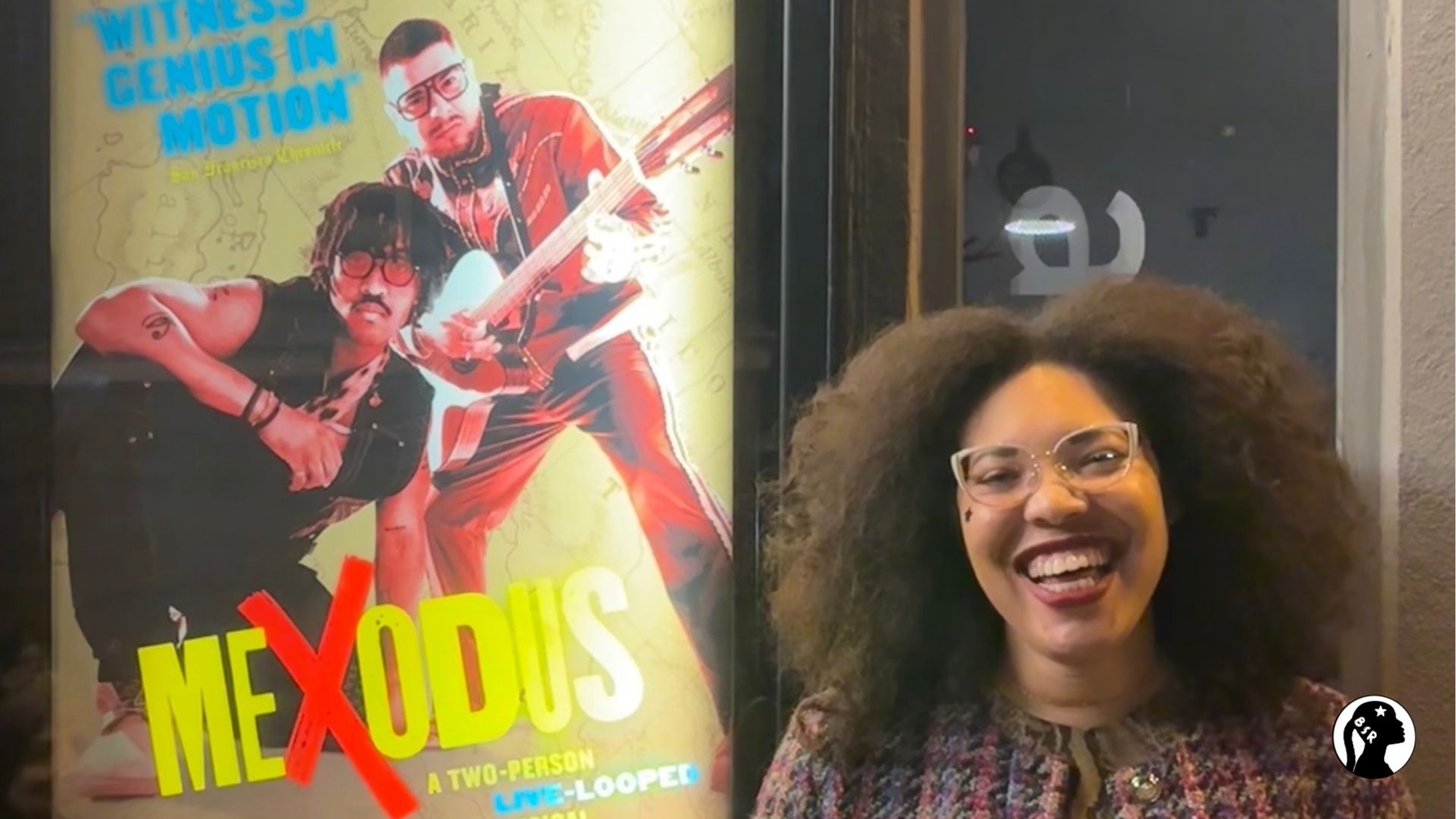
A new play called Mexodus has opened near West 4th Street at Minetta Lane Theatre. The name is a portmanteau of Exodus, the Bible’s account of the Israelites’ departure from Egypt, and Mexico, which is where half of the play takes place. The musical is a portmanteau of talent as well, squishing together the immense writing, musical and performing talent of Brian Quijada and Nygel D. Robinson, with direction by David Mendizábal, into something no one has heard or seen before.
It would seem that people are trying to make sense of the novelty by grasping at low-hanging comparisons. Brian and Nygel rap on stage, which beckons the over-used, under-analysis of “this is going to be the next Hamilton”. While it is true that Mexodus has historical merit, features men of color telling a story in verse, and has a certain hip-hop lean, the similarities mostly end there. Mexodus’s differences are what make it worth seeing, not its overlap with a global phenomenon the culture cannot seem to release.
The two-person cast sings, raps, acts and plays at least 19 instruments over the course of the show. (I tried to keep a list but I’m certain I missed something.) Using the same sort of looping technology music producers use to build a beat, Robinson and Quijada build the backing for each song one element at a time. In the opening number, Robinson starts with a dum-dum-dum on the bass, Quijada layers in melody on the guitar, Robinson adds in keys, then there’s beatbox, vocals, and — for quintessential Mexican flair — an accordion. When that musical number ends, the loops are erased and the two man symphony builds another song from scratch. If you’re wondering how they keep track of it all, take a look at the teleprompter at the front of the mezzanine overhang which tells them which loop to lay next. By the end, the list of instruments I’d seen used in the production included harmonica, maracas, cajón (box drum), turntable, washboard, spoon, bell, drum kit, electric guitar, glass bottles, megaphone, bongos, trumpet, and scissors. In fact, most of the set design by Riw Rakkulchon is made up of either instruments or disguises for instruments; the drum kit is undetectable at the center of the stage, tucked neatly under a platform for the turntable.

photo: a monitor at the base of the mezzanine cues the performers with which loop is next
The musical execution of Mexodus is what kept me tapping along, even when the story or lyrics felt off-key. Robinson, who is Black, plays Henry, a man who’s escaped enslavement on a plantation in Victoria, Texas. The dehumanization of slavery is enough to make any one want to “steal away home”, but Henry’s reason for running away is an accidental murder. When the plantation owner catches his wife sexually assaulting Henry in the barn, it’s kill or be killed and Henry is the one who makes it out alive. Then he heads to the piano for a solo. He croons if I stay brave, I won’t be enslaved and it’s in moments like this when it’s unclear whether the show takes itself seriously enough. Henry sails to freedom by floating on a bale of cotton down the Rio Grande. Brian Quijada plays a Mexican farmer and veteran medic who is the only one of his brothers to have survived the Mexican-American War, he pulls Henry from the riverbed and nurses him back to health. Again, serious and silly: Quijada wears spurs on his Adidas sneakers.
Tender moments add depth even when the lyrics float in the shallows. When Henry, who has grown up farming on Texas plantations, shows Carlos, whose farming experience is from further inland and not on la frontera, the two men plant rows of seeds with their guitars, one electric and one acoustic. Henry plays a phrase, Carlos repeats and follows, a partnership is born. Carlos’s eventual motivation to help Henry escape further into Mexico when slavecatchers come around conveys the importance of Black and brown brotherhood.
Mexodus aims to tell a story that represents an innumerable movement of enslaved people who sought freedom in a Southern direction and were aided and abetted by Mexicans who may have believed in Black people’s humanity, but also may have wanted to stick it to the Americans who’d annexed Texas. Quijada and Robinson tell us that between 1829 and 1865, historians estimate that 4,000 to 10,000 self-freed Black people started new lives in Mexico braving the odds of the river, a language barrier, and unfamiliar customs. Our contemporary struggles pale in comparison. Early on, the actors ask the audience, “What are you choosing to do with the days your ancestors have earned you?”
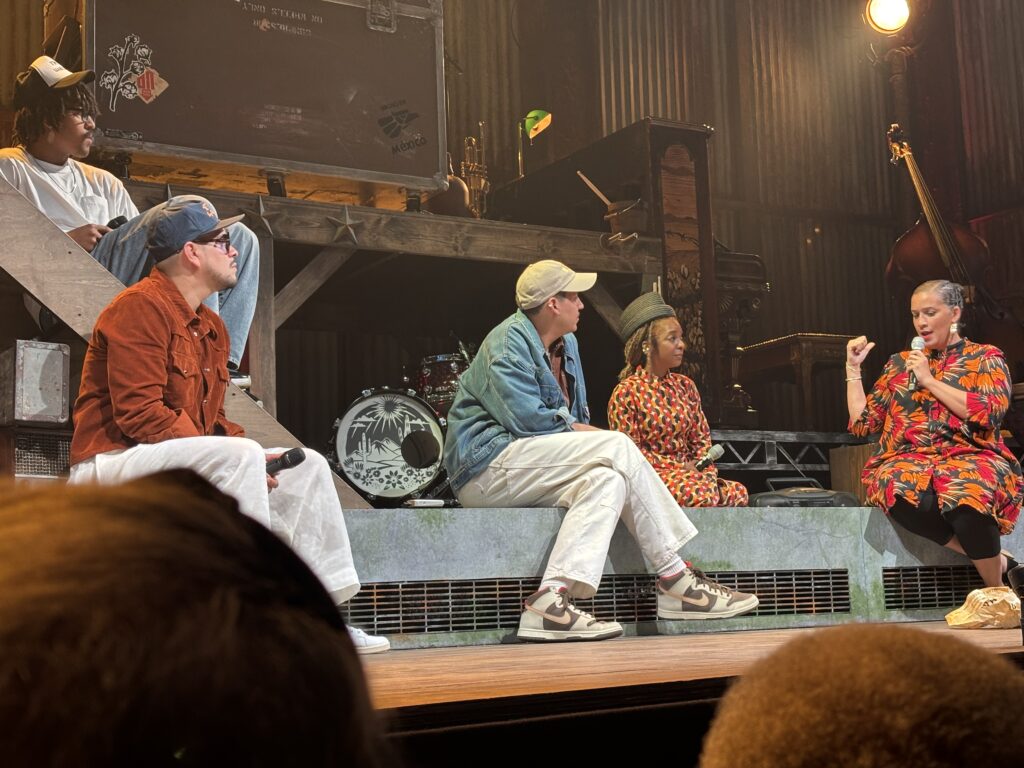
photo: (L-R) Nygel D. Robinson, Brian Quijada, David Mendizábal, Kara Young, Patricia McGregor sit on stage during the post-show talkback
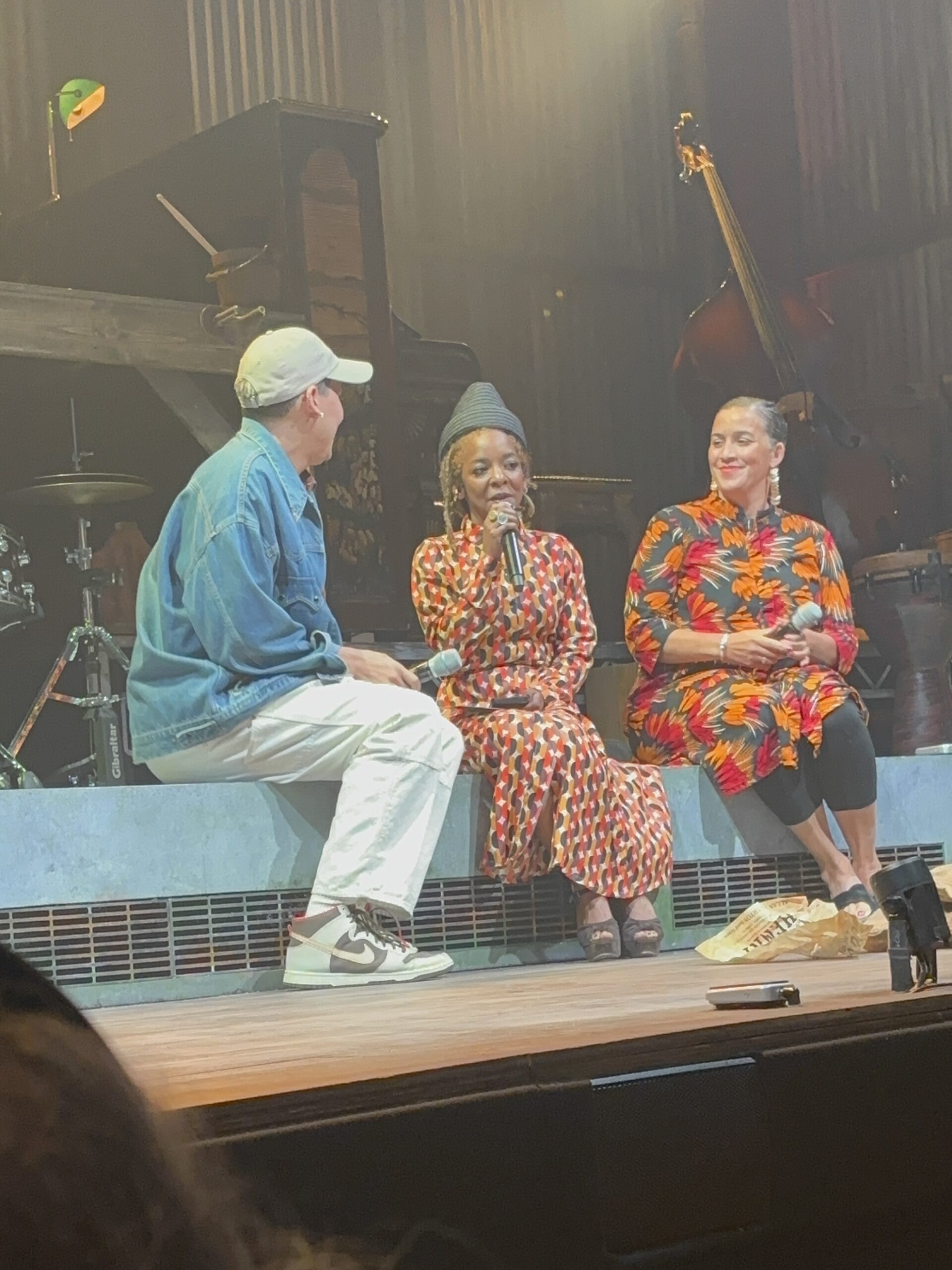
On the Monday I attended the show, the performers had just been lauded in the Times and there was a post-performance talkback with actress Kara Young (Purpose, Table 17), NYTW Artistic Director Patricia McGregor (Lights Out: Nat “King” Cole, Saturday Church, Refuge Plays), and the show’s director David Mendizábal. After starting the talkback with a “Yerrr”, Ms. Young called the show the “most important piece of theatre [she’s] seen…possibly ever” — high praise from a three-time Tony Award winner. Mr. Mendizábal remarked on how the show has evolved from its original run in Baltimore, and how a note from Ms. McGregor helped the team further develop the story. It was unclear from the conversation whether the evolution is ongoing or if the show I saw will be the same one audiences see over the remaining weeks of the recently extended run.
Stories of historical self-determination — like Buck and the Preacher and Mexodus — disrupt the idea that history happened to our ancestors, and that we should passively allow it to happen to us. Quijada and Robinson, for their demonstrated prowess across a vast arsenal of instruments and their willingness to work in tandem, bring a great deal of talent to this retelling. They’ve threaded compelling personal stories into the narrative, but there’s room to keep massaging the tone and more gracefully toe the line between severe and shallow for the segments set in the 1800s. While I am nowhere near as moved as Ms. Young was by this production, I agree that the Mexodus musical sets out to do important work: it tells a story that offers a blue print for solidarity as a means of resistance, for which there’s no better time than now.
blacklove 🖤 and starlight 🌟
Mexodus is produced by Audible Theater and P3 Productions. The musical is written and performed by Brian Quijada and Nygel D. Robinson, and directed by David Mendizábal. The show opened on September 18, 2025 and has been extended through October 18, 2025. Tickets are $50 and up. I purchased my own ticket for this production and attended on September 22, 2025.
-
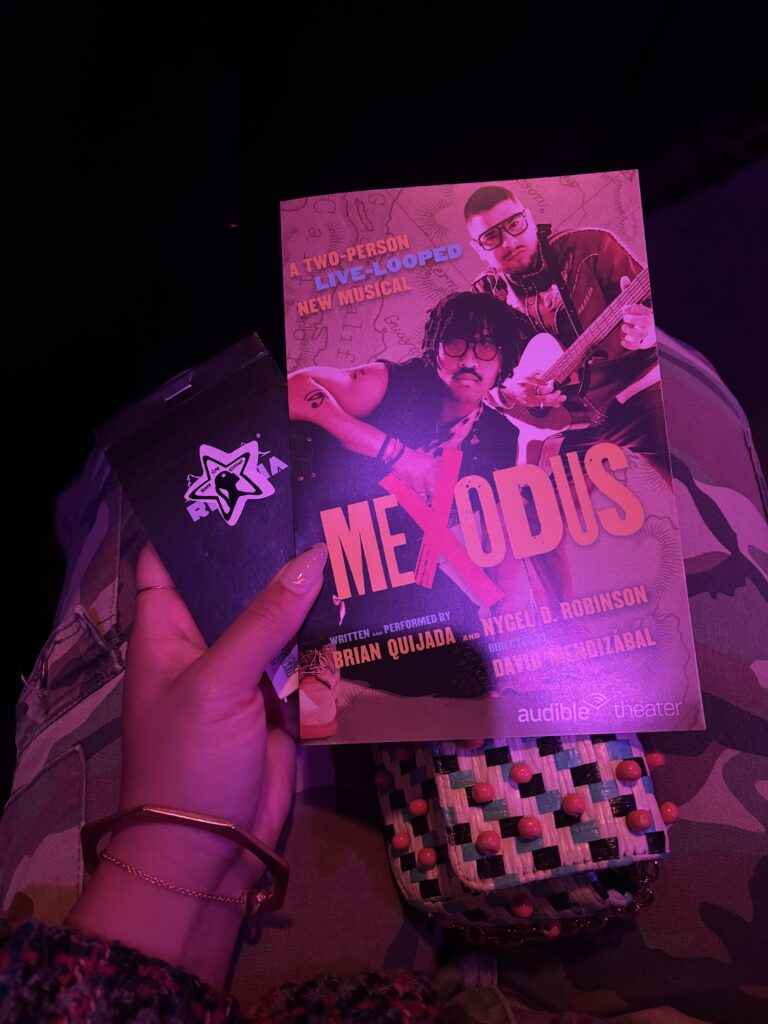
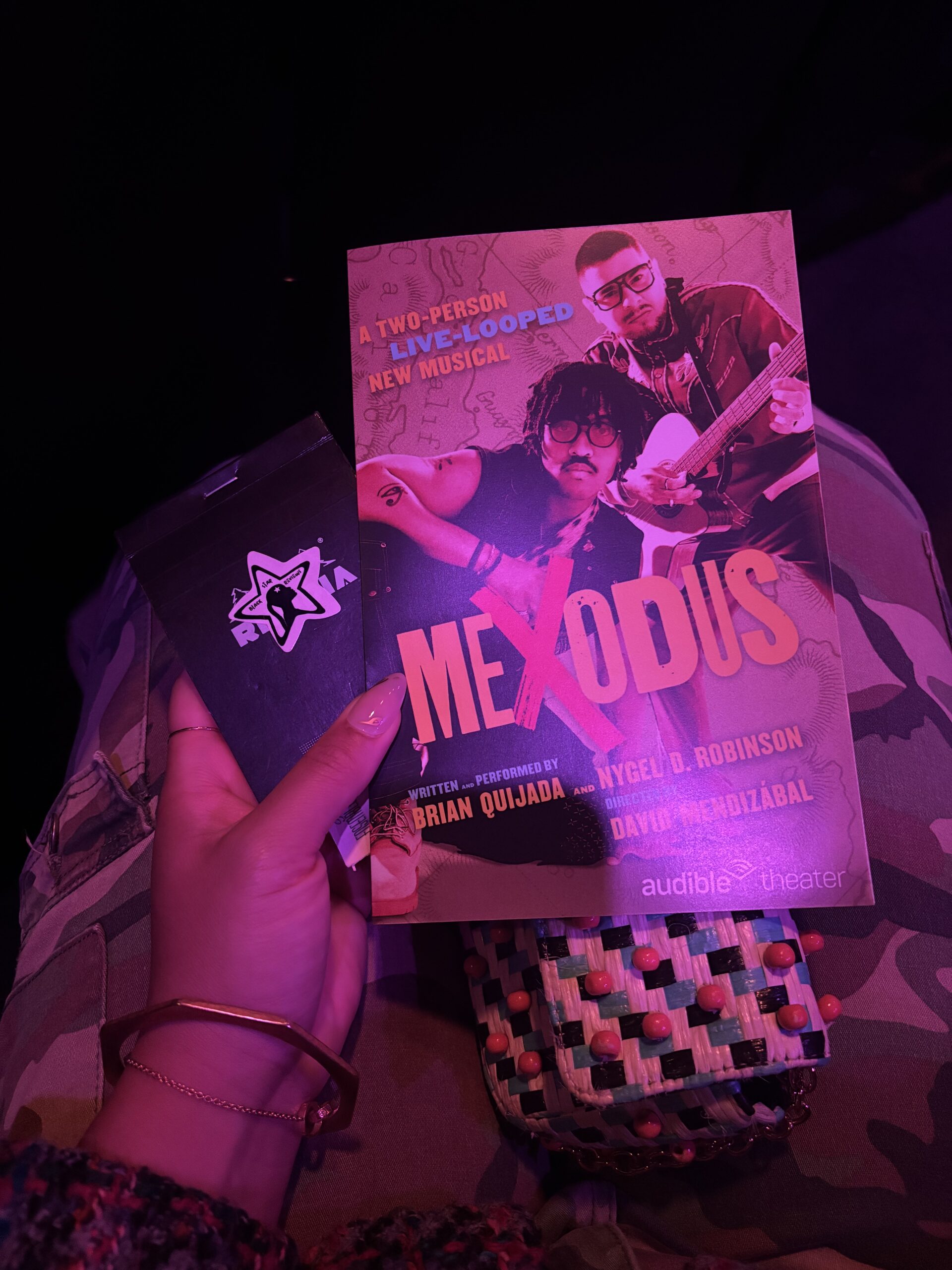
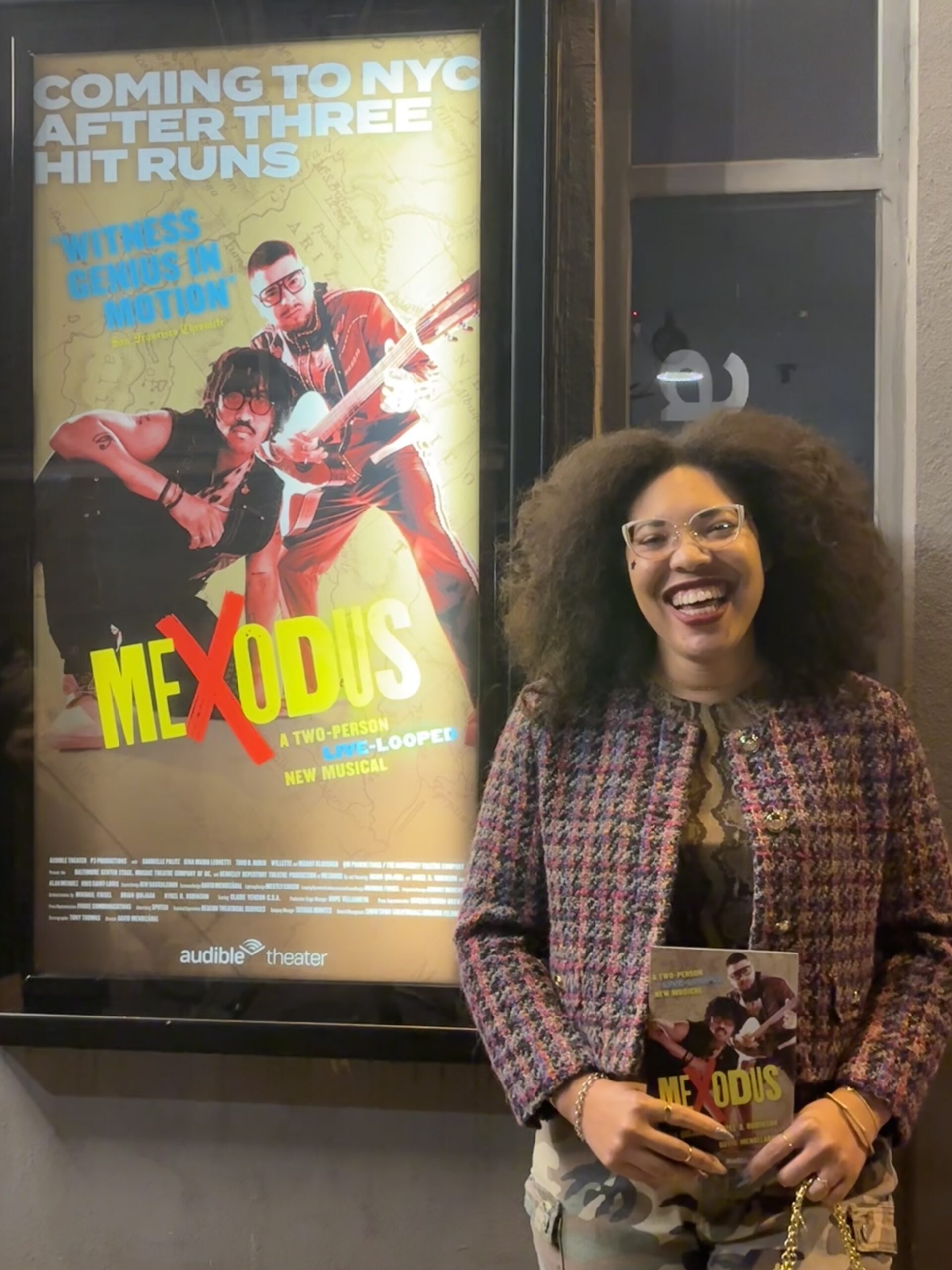
- photo: the Playbill for Mexodus
-
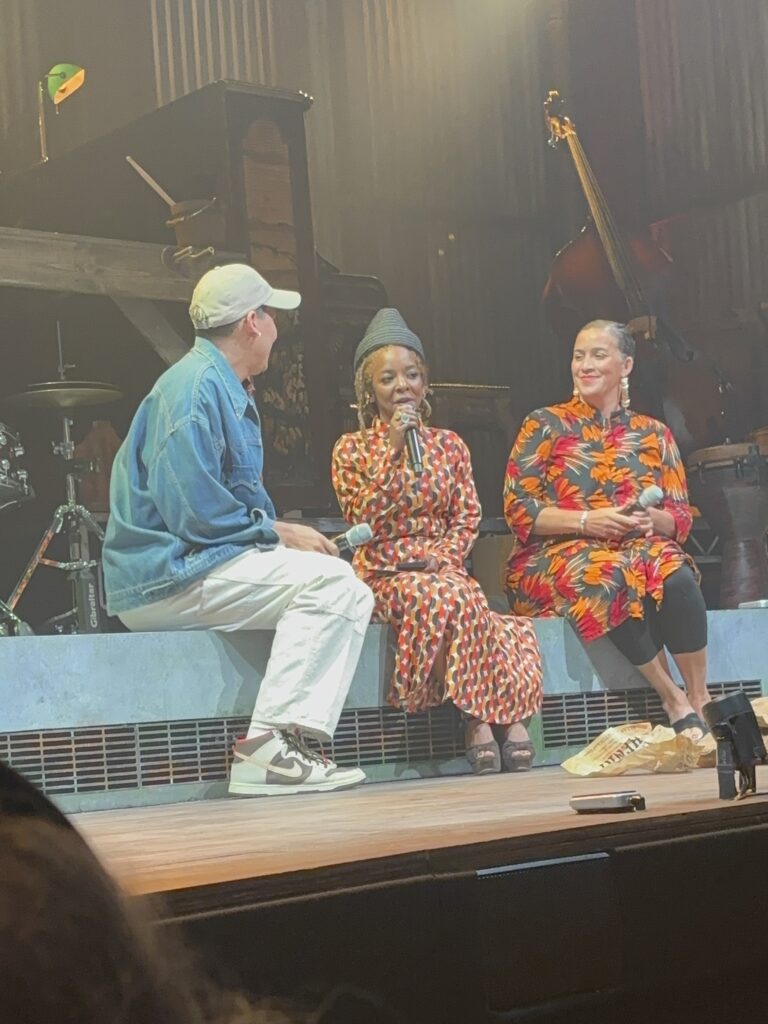
- photo: David Mendizábal, Kara Young, Patricia McGregor sit on stage during the post-show talkback