

Refuge Plays
A few months ago, a crossword clue read as follows:
Opening line of Anna Karenina ‘All happy families are______…’
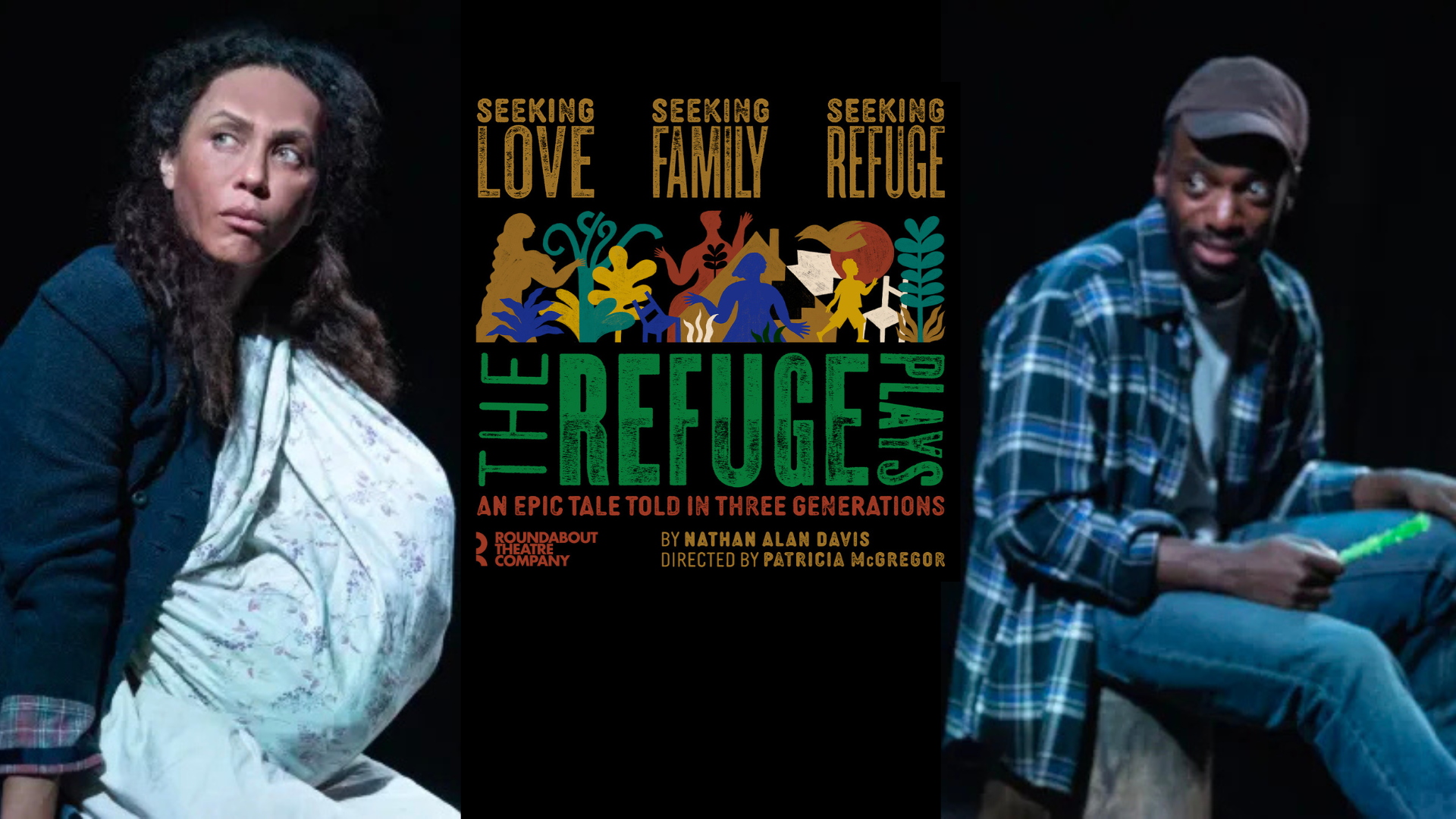
Without the context of Tolstoy’s novel the clue functions like a Rorsach ink blot test, revealing your own beliefs about family. All happy families are boring? loving? in denial? For Tolstoy, the answer is ‘alike’ and he continues with “…every unhappy family is unhappy in its own way.” I’d muse that Nathan Alan Davis, the playwright behind The Refuge Plays, has his own ideas because the Black family at the center of the story may be exactly like yours in its unhappiness. The story is told in 3 acts, each one going further back into the past than the one before. It’s not the only show open right now using reverse chronology as a storytelling device (see: Merrily We Roll Along), but what’s unique is that each act could very well stand on its own. In fact, one could argue that the order of the 3 parts could be rearranged for effect: start in the past and build suspense toward the ending, start in the middle and let the audience do the work of unraveling the connections, or start with the end and slowly turn back the clock to the moment of inertia for one black family in the woods of Southern Illinois. Davis and Patricia McGregor, the director, chose the latter.
While Nathan Alan Davis has his own clout in the theater space, the draw for many casual audience members at Roundabout’s Laura Pels Theater is Nicole Ari Parker in her second career Broadway appearance. (The first was Streetcar Named Desire in 2012, which I was present and accounted for.) Parker plays the family’s survivalist matriarch and appears in all 3 parts of the family’s story. Recent fans of Parker’s may not even recognize her as the upper-class Black woman on the Sex and the City reboot And Just Like That… based on real-life New Yorker, Crystal McCrary. Without a single wrinkle or jowl, Parker is somehow completely believable as an incomprehensible armchair grandma in her final years. It’s a pleasure to see an actress who always dazzles on screen up close and in complete control of her craft on stage and hopefully it won’t be her last theatrical turn. Lance Coadie Williams, who plays the family’s queer uncle passing through on his way to Paris, easily lends personhood to a role that could have slid into caricature and helps the family navigate the rip in the veil between spirit and flesh. Without giving away too much of Davis’s story, the play answers the questions your elders never answered about your parents and grandparents. While it closes a few weeks before families convene for the holidays, Davis’ work is an invitation to finally have conversations with the living and the dead about the generational trauma we carry in our DNA and that the rest of us marry into. All families, unhappy or otherwise, have stories to tell.
