
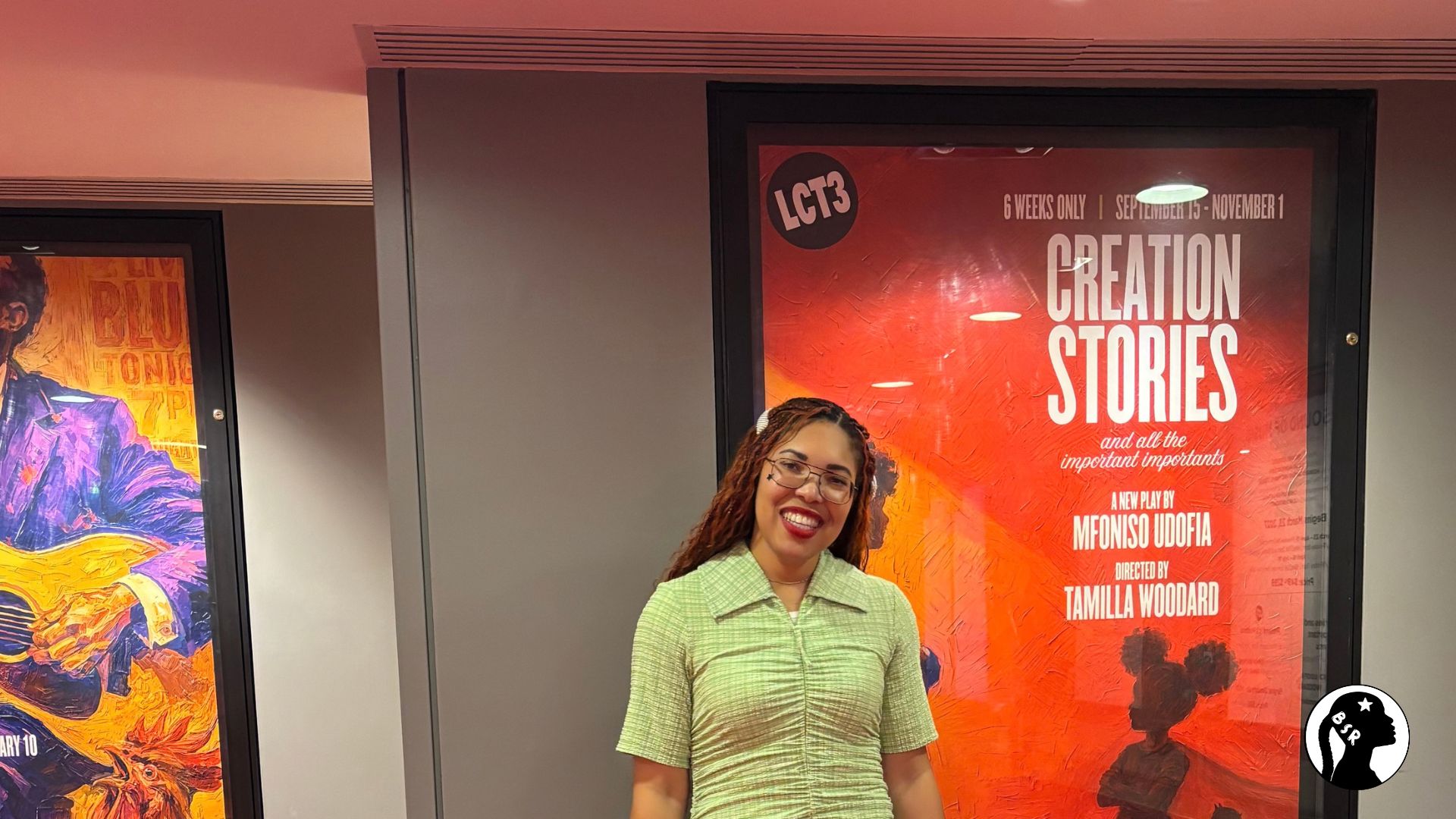
‘creation stories and all the important importants’ Review
Mfoniso Udofia’s world-premiere play is a cosmic affirmation (or a metabolic warning)
“They could’ve warned somebody to bring a tissue!” exclaimed a woman with closely cropped hair in the hallway outside the bathroom where I stood waiting for Rosa. I looked around and, seeing no one, deduced that the woman was speaking to me so I responded.
“Oh, I’d heard that it was a tearjerker.”
Rosa exited, drying off her hands with a paper towel. “Well, why didn’t you tell me?”
She had a point. I could’ve given her a heads up. While I didn’t cry during the show, I could see why anyone might. In fact, I told Rosa, if I’d seen creation stories before 2022 it might’ve triggered a psychic snap. Depending on how you (or anyone) have lived your life, the play is either a cosmic affirmation of your choices or a metabolic warning of what could happen. There was unmistakable overlap between my life and the main character’s. To quote my mom quoting her childhood pastor, this show was “stepping all on my good foot” which loosely translates to this is so close to your truth that it hurts.
The main character is named thegrownwoman stylized as one word, all lower case; chaotic, just like her. She has a lot going on, maybe too much. From the time she awakens from her nightmares, every moment is planned, timed, ordered, and set to music. The only time it’s quiet is when she sits down to write, though she doesn’t get further than regurgitated lines from Shakespeare and Hansberry. She narrates her actions, which reveals her uncertainty about everything, but her only audience is Alexa, Amazon’s home assistant device with a glowing blue ring. Like many people (not me!) she relies on it for the weather, the time, and turning the volume down, but in a move that may hint at over-reliance, she also consults the all-knowing glow for a yes/no verdict on whether she should complete a home workout on the day of her hormone testing for her fifth and final cycle of IVF. She decides that she will, kicking piles of laundry to the side to make space for half-assed curtsy lunges until an alarm sounds to indicate that it’s time to shower. She rushes off.
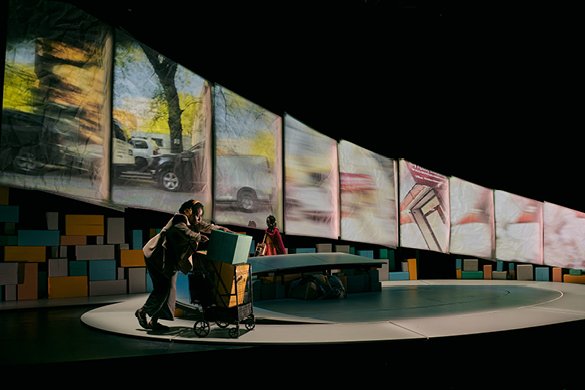
Abigail C. Onwunali as “thegrownwoman” • Photo: Valerie Terranova. Courtesy LCT3.
thegrownwoman is harried. Harried as she changes into a pink dressing gown in the doctor’s office. Harried as she teaches her college playwriting class (ouch, my foot!). Harried as she runs errands for her mother and stops by the pharmacy and dictates texts to her group chat and pushes a cart around New York with a bad ankle because the hormones make her clumsy. thegrownwoman moves so fast she doesn’t have time to eat or reflect or create (ouch, my foot!) It’s really self-absolvent to watch with judgment when you can’t remember your last glass of water or when it was just last week that you jogged to City Center from the Citibike dock to arrive narrowly in time for curtain. It’s only because you are set apart by the front edge of the proscenium that you can so clearly think THAT WOMAN SHOULD SLOW DOWN, SHE’S GOING TO GRIND HERSELF TO DUST AND THAT WOULD BE TRAGIC.
Luckily, thegrownwoman does not need your ‘for thee, not me’ advice. In addition to constant surveillance by Alexa, thegrownwoman is being shadowed by her inner and unborn child who is also a trombonist. (If this sounds absurd, think back to your childhood hobbies. Perhaps you were a ninja, an actor, a painter — perhaps you were Kobe!) little girl/the uncome pleads with thegrownwoman to slow down, listen, and have a little fun but it’s not until thegrownwoman watches her dream of motherhood slip like sand through her fingers that she 1) stops narrating her life in third person, and 2) can see and interact with the girl. When she sees her, she immediately sends her away. If you thought the trombone was strange, things only get weirder from here.
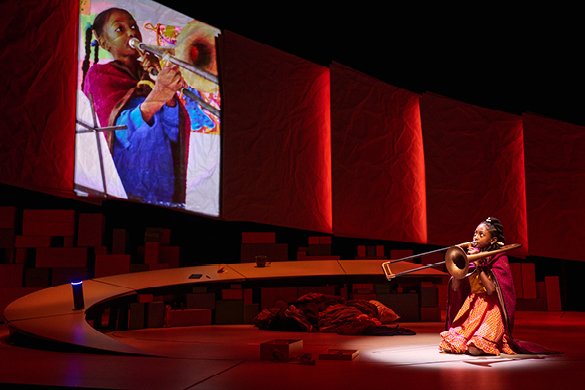
Savannah Commodore as “little girl/the uncome” • Photo: Valerie Terranova. Courtesy LCT3.
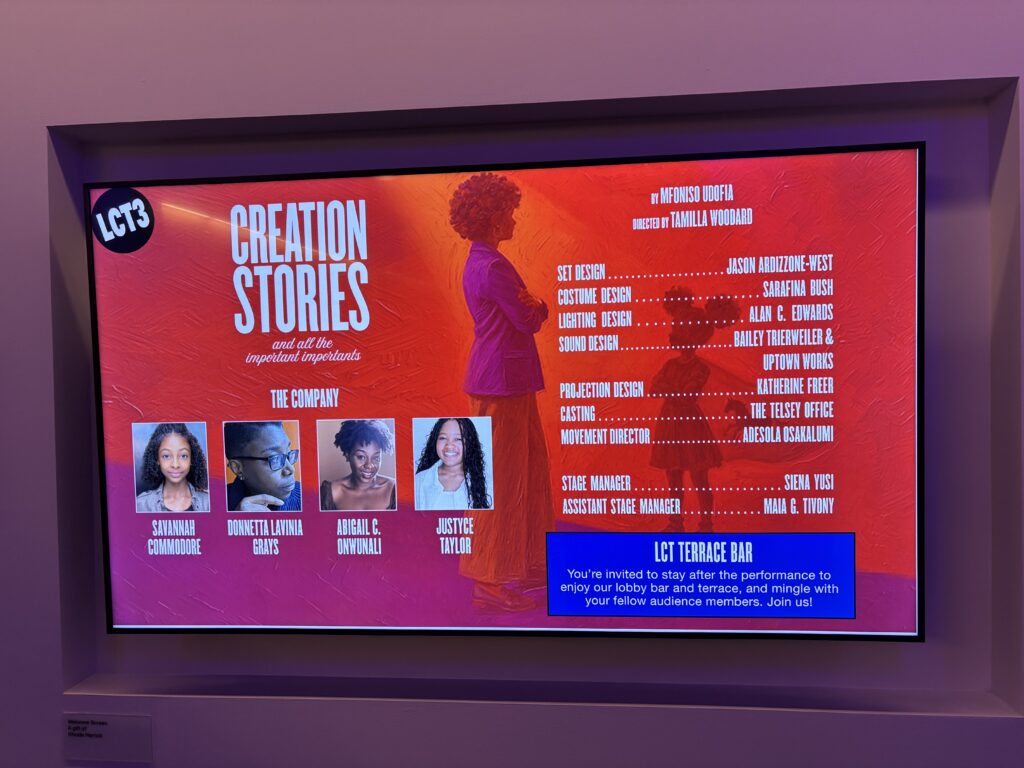
The playwright, Mfoniso Udofia, gives us a heads up that something strange might be coming all along the way. Before thegrownwoman awakens at the beginning of the show, she dreams of a figure that resembles a bundle of raffia come to life, masked like an Egungun and swishing like one of Nick Cave’s soundsuits. (This was my favorite of Sarafina Bush’s costumes for the show.) When little girl/the uncome arrives, she does so through the pile of laundry that’s been kicked under the bed. In the whimsical set design by Jason Ardizzone-West, everything is slightly askew, the same way that familiar places appear funhouse-style in our dreams. In thegrownwoman’s professorial job, a higher-up discourages her from teaching a play by a Nigerian woman author deeming it “too unruly”, too much of a detour from Western narrative structure in the class’s actual textbook, Simon & Simon’s A Dramatic Guide. (In trying to find The Perfectly Planned Woman Who Cuts The Path Toward Her Own Necessary Obliteration for my own reading pleasure, I found out that both texts are fictional.) From the beginning, the audience has one foot in each of two realities: the everyday/conventional and the mystical/cultural.
Here’s a spoiler-light version of the ending: little girl/the uncome and an imaginary rapping pony lull thegrownwoman into rest and then into play, and like magic, original ideas flutter around them. It’s a different approach to fertility than thegrownwoman had envisioned, another kind of mark-making and legacy.
The ending is as neat and uplifting as any bedtime story, the woman, the girl, and the pony could have hit us with an “…and they all lived happily ever after” before the curtain call. But based on the tears and tissues in the room, the audience didn’t mind the show’s hokey message and neither did I.
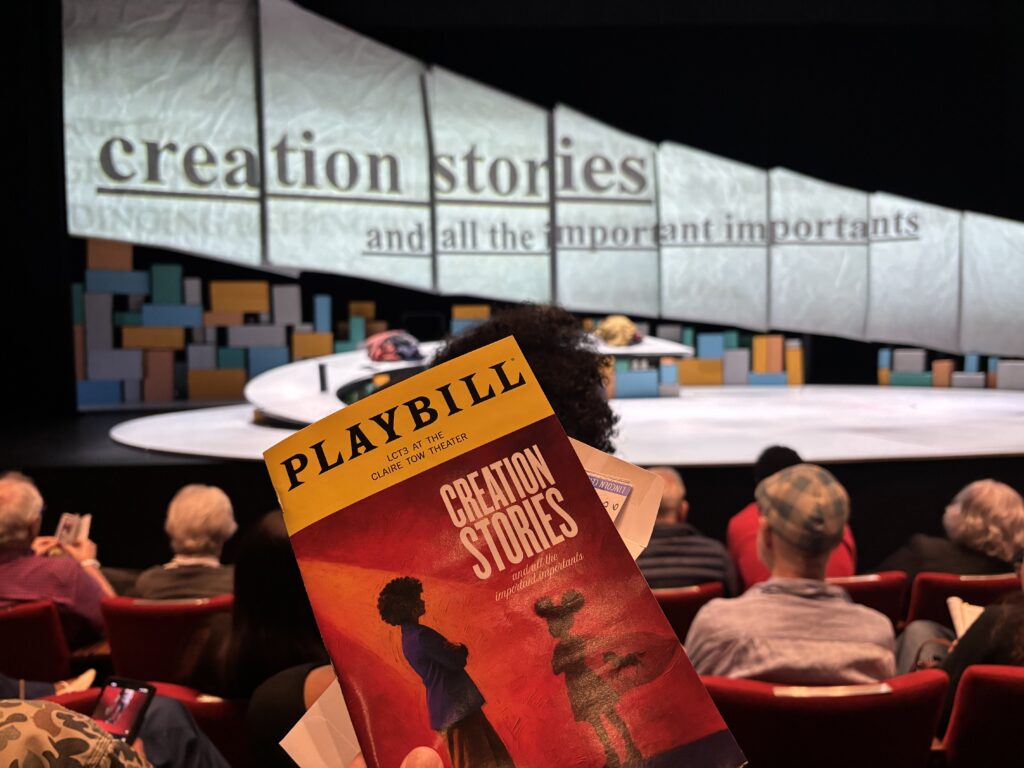
Mfoniso Udofia has written for television and film, but she’s best known for her 9-play Ufot Cycle. August Wilson’s Century Cycle is a series of 10 plays, each one representative of a decade of Black life. Udofia’s Ufot cycle follows a single Nigerian-American family across 3 generations. The final play in the cycle will be produced in Boston this fall. In profiles in the New York Times, writers are sure to remark that the Ufot plays are not autobiographical — this is not Udofia’s family story playing out on stage, but a representation of many Nigerian-American experiences. creation stories feels deeply personal and the playbill includes a note from the playwright about the 5-year process of writing this story, “i knew i wanted to write a fairy tale…i thought it would be sweet…then it became so unruly that, suddenly, i did not want to write it at all…. this piece is incongruently fashioned from everything i am…. what happens when an exceptional woman cannot exceptional her way through?”
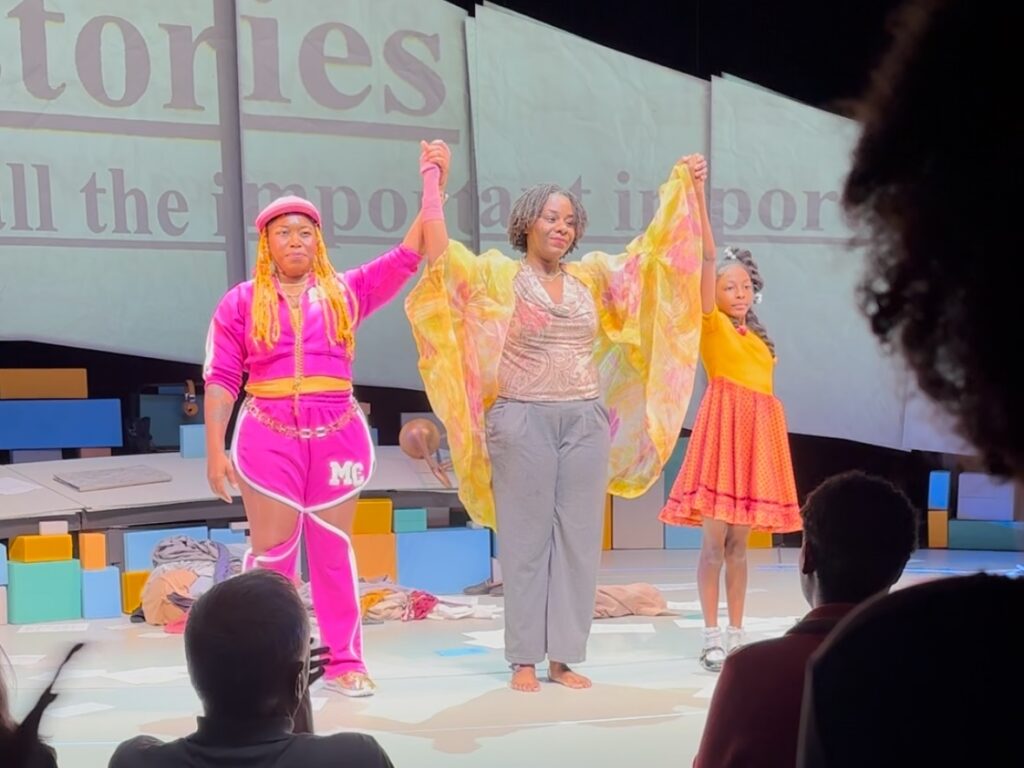
The depth of experience Udofia imparts into the story affords the players a deep emotional budget to work with. Abigail C. Onwunali and Savannah Commodore are united after working together on August Wilson’s Joe Turner’s Come and Gone, where Onwunali played Commodore’s estranged mother. Ms. Commodore is a supremely talented actor and student at Debbie Allen Middle School in Los Angeles. Though her role in Joe Turner called for youthful innocence, creation stories required wisdom. Commodore’s little girl knows what thegrownwoman needs and expresses endless patience and compassion as she watches her adult self run her spirit into the ground. Much of Commodore’s performance is silent observation of what’s happening in thegrownwoman’s life, but you never forget that Commodore is there and you’ll keep checking back for her reactions. The spotlight is on Ms. Onwunali the whole time and she has the presence to move through her day and the awkward third-person narration without apology or crumbling before the audience’s judging eyes. Onwunali is able to send two messages at once; thegrownwoman appears to move with confidence, but her eyes, dulled, reveal that she’s just going through the motions. In Joe Turner, Onwunali arrives like a flash flood disemboguing all of the emotional energy in the show’s final moments. In creation stories, Onwunali comes on like a drizzling rain cloud, strengthens her inner turmoil to a thunderstorm, and ends beaming like the sun on June Solstice. On the subject of range, Donnetta Lavinia Grays plays everyone else: the raffia dancer from thegrownwoman’s nightmare, the voice of Alexa, and an imaginary friend named mr. cornell. Ms. Grays’ talent for humor and timing elevate the exchanges with the faceless robot and keep her imaginary rapping from feeling corny. With its third person narration and its mystical themes, the show never stops tap-dancing at the edge of corniness but all three actors’ sincerity means it never falls over the edge.
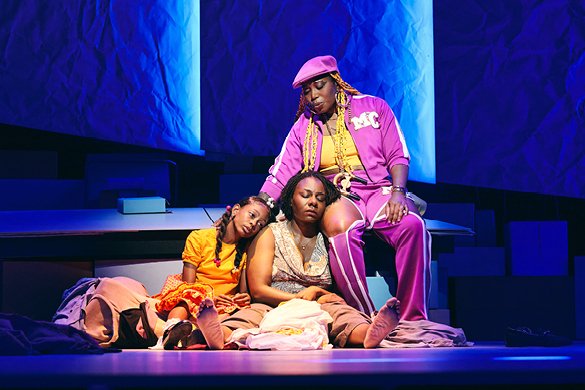
(L-R) Savannah Commodore, Abigail C. Onwunali, Donnetta Lavinia Grays • Photo: Valerie Terranova. Courtesy LCT3.
One could argue that the show glosses over the torture of infertility. Not everyone who wants a baby can have one and it can be crushing. thegrownwoman “fails” five rounds of IVF, relay runs to the CVS pharmacy on 125th Street to exhaust her savings in $1800 intervals, ruminates on how to optimize her body’s womb potential and when she finds out there will be no more chances, she takes a nap, horses around, and then decides it’ll all be okay if she just focuses on her writing? I cannot imagine that giving up on a baby is as easy as the show makes it look by the end, but I also do not think that is Udofia’s point. “if you have ever had to wonder” Udofia writes in her note, “who you might be when the old way of making a life no longer works — then perhaps there is something here for you, too.” It is crushing to be blocked from your dreams, but it is a relief to be freed from a dream that was never yours in the first place. After all, this is a different kind of fairy tale — one where happily ever after doesn’t look the same for every princess, priestess, or hero.
Everyone who cried in the audience of creation stories did so for their own reasons. If I’d seen it before Black Star Reviews, before I left full-time work, before I ended a relationship I shouldn’t have been in in the first place, I imagine I would’ve seen myself as thegrownwoman and cried out of frustration that I didn’t know how to embrace the freedom she’d found by the end and from the pain of having my feet stepped on for 75 minutes with no intermission. But in this moment, I see myself in the little girl, wearing a blanket cape, dragging around a box of knickknacks, tooting her trombone for anyone who will listen and believing, however naively, that play and not work will be Black women’s happiest ending.
blacklove 🖤 and starlight 🌟
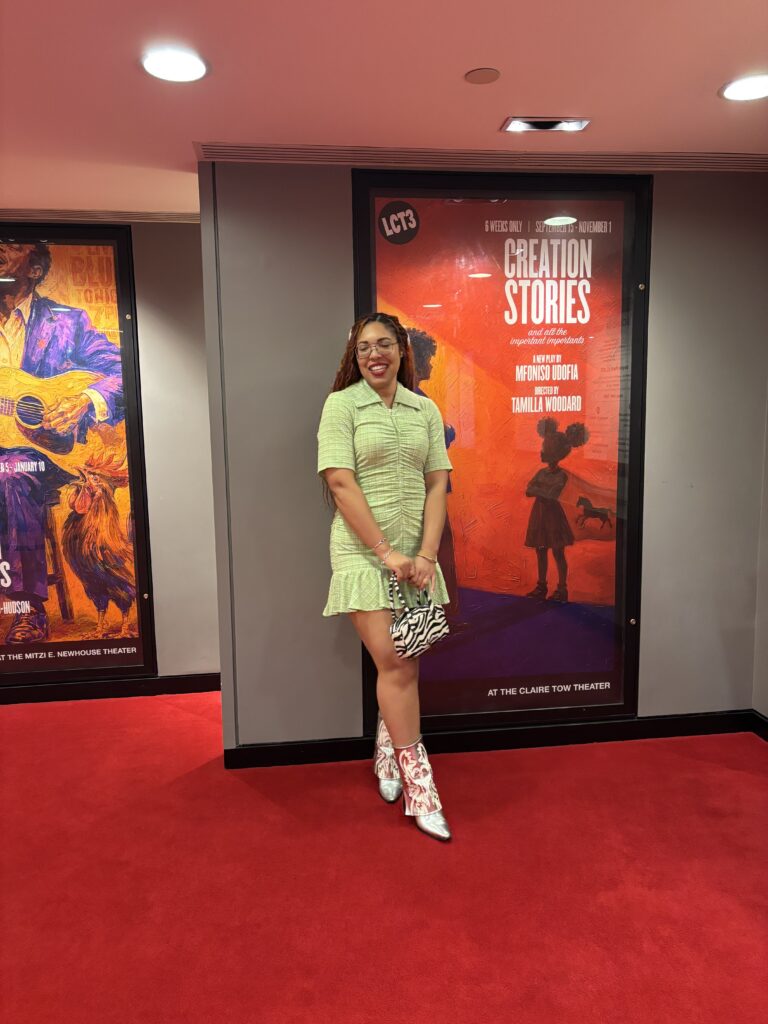
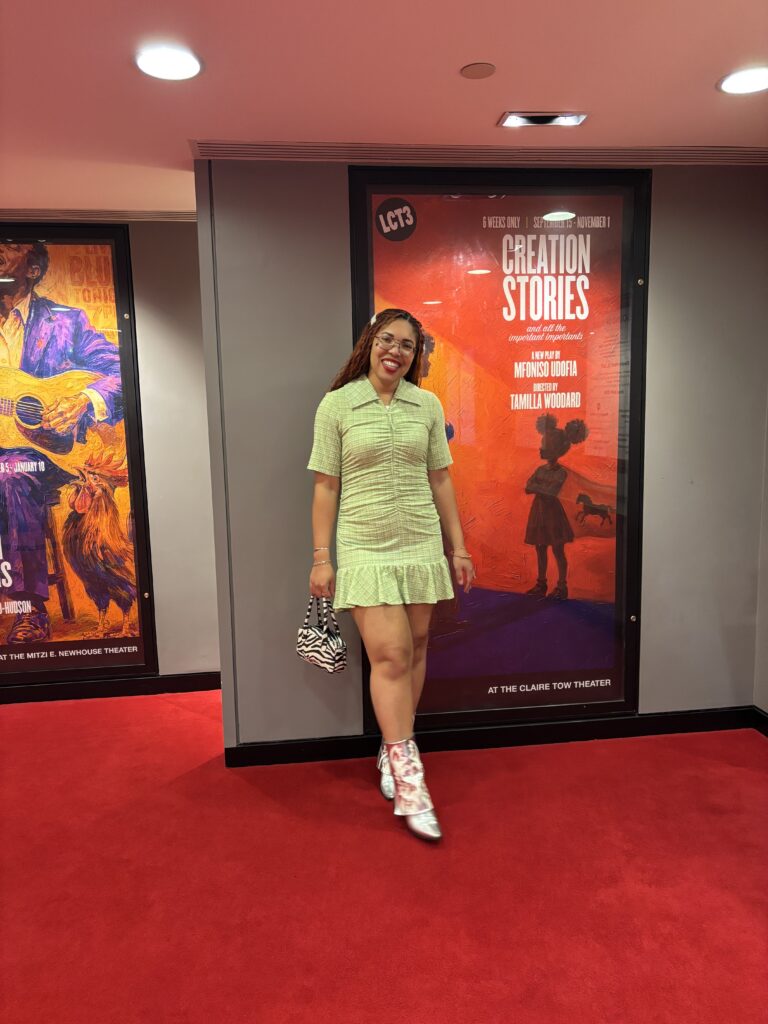
The world-premiere of creation stories and all the important importants was produced by LCT3 at the Claire Tow Theater. The play was written by Mfoniso Udofia, directed by Tamilla Woodard, and stars Savannah Commodore, Donnetta Lavinia Grays, and Abigail C. Onwunali. Justyce Taylor understudies for Savannah Commodore. The production began previews on September 15th and opened on October 1st. I attended the performance on September 30th and offer my thanks to DKCO&M.
The production will run through November 1, 2026. A ticket for any seat in the theater is $38.50.