Escape from Planet Brooklyn: Getting Duped By A Fort Greene Music Festival
The first time Planet Brooklyn festival is part of a billion dollar vision for the neighborhood, with Black music and culture as the unspoken draw
I generally like to stay on my side of the line between reporting and writing, but it seems important to share what I’ve found so far since no one else seems to have covered the weird gaps where the dots just don’t connect.
It wasn’t until I did some light digging to get the facts for what was going to be a brief write-up that my shovel hit something hard and unexpected. It all started on Bluesky, the platform that’s been billed, and largely written off, as an anti-Twitter and echo chamber for liberals and leftists. (Which, if that is the case, what does that make Twitter?) I saw a ‘skeet’, the Bluesky equivalent of a tweet or post, about a new music festival by the founders of Afropunk. I haven’t been able to find the skeet since I clicked the link it shared or any wide-spread press, which should’ve been the first indication that there was something strange about the Planet Brooklyn festival.
Wait, People Still Go To That?: A Brief Look at Co-Opting Culturally-Black Festivals
From what I can remember about the now-deleted skeet I saw, Planet Brooklyn was the latest festival offering from Multiply Creative, the founders of the AfroPunk festival. Once legendary, the festival was already facing accusations of losing its edge by the time I moved to New York in 2012. Afropunk’s ideological founder James Spooner, who created the 2003 documentary film about being a Black punk rock fan that inspired the concert event, sold his rights and ended his involvement by 2008. When Spooner departed, remaining partner and music manager Matthew Morgan joined up with Jocelyn A. Cooper, a former A&R executive at Universal Records to continue producing the event. Audience demographics shifted from the sort of people Spooner featured in his documentary, to people who simply dress up in quirky Afrocentric attire for concert days. Once Afropunk went global with a year-round lineup of festivals in Paris, London, Johannesburg, and Salvador (Brazil) there was no beating the allegations that Afropunk was a business: profits came first, authenticity and community came last, if at all. The 2019 lineup included Jill Scott — extremely talented and a sure-fire draw, but assuredly not punk. By 2020, the brand was acquired by entrepreneur Richelieu Dennis whose name tolls like a death knell for anything you’ve ever loved: SheaMoisture (which Dennis founded and sold to Unilever for $1.6 billion), Afropunk and Essence Fest.
Essence Festival of Culture, which started as Essence Festival of Music in 1995, made news this year for starting a Lauryn Hill performance at 2:30am. Since Ms. Hill is renown for starting her shows on ultra-CPT, the newsworthy element of the timing was that it wasn’t her fault, it was Essence’s. The festival was so poorly produced that Stephanie Mills wrote an open letter and numerous attendees shared concerns and complaints online. It seemed tone-deaf to flout Target as a major sponsor during the Black community’s months-long boycott in response to the retail giant’s cancellation of their DEI policies. A lawsuit aimed at a Black-owned bookstore in New Orleans, the city where the festival is held, and reporting from the Chicago Crusader that the festival has been produced by a white team of executives at the Solomon Group also didn’t bode well for optics. All of these factors have the Essence community pointing fingers and threatening to stay home next year. Mr. Dennis has launched an apology tour, visiting the Breakfast Club radio show to explain that he’s “listening” and reiterating those sentiments in a somber slideshow on Essence’s Instagram that feels reminiscent of the “listening and learning” apologies that were popular after George Floyd’s murder in 2020. New Orleans-based news organizations have published op-eds about how it feels to have their culture and home marketed as a backdrop for a commercial influx that doesn’t seem to trickle down.
From my perspective, the worst part of the Essence Fest saga is that there seem to be few Black-owned publications equipped to offer a critical perspective of what’s really going on here. Essence Magazine can’t do it since it’s owned by Dennis. Jet Magazine is digital, but rarely updated. Ebony’s only 2025 festival-related article was about a hair care brand activation. Panama Jackson comes the closest to a critical take but mostly reiterates Essence’s IG press release in an article for The Grio, which was bought from NBC/MSNBC by Black entrepreneur Byron Allen in 2016. Jackson was a co-founder of the early aughts blog Very Smart Brothas that was acquired by now-withering digital site, The Root. The Root, which was co-founded by Henry Louis Gates, Jr., is now owned by private equity and on the chopping block. Countless Root alum, including Michael Harriott, have declared the publication dead and the editorial direction strange. Case in point, The Root’s take on Essence Fest 2025 describes how the festival’s new “Pan-African” lean, which the writer blames on Kenyan-born CEO Caroline A. Wanga, is alienating Black Americans — an opinion that does not seem to be echoed at-large. In other words, it feels there is no home to critique our cultural institutions without inadvertently serving ulterior, anti-Black motives while doing so. (Note: there would be no BSR if I hadn’t spent years inhaling VSB, so I congratulate the brothers for securing the bag but if ever we needed their unbought perspective, it’s now.)
Dawn of the Planet Brooklyn: Finding and Arriving at the Festival
I admit: seeing Afropunk flame and fizzle before I had a chance to participate and watching the year over year dissolution of Essence’s cultural flavor had primed me for the promise of a festival that celebrated Black culture in Brooklyn helmed by event producers who had the social cachet to make it happen. This is how Planet Brooklyn was billed and promoted and experienced, but this is not what it actually was.
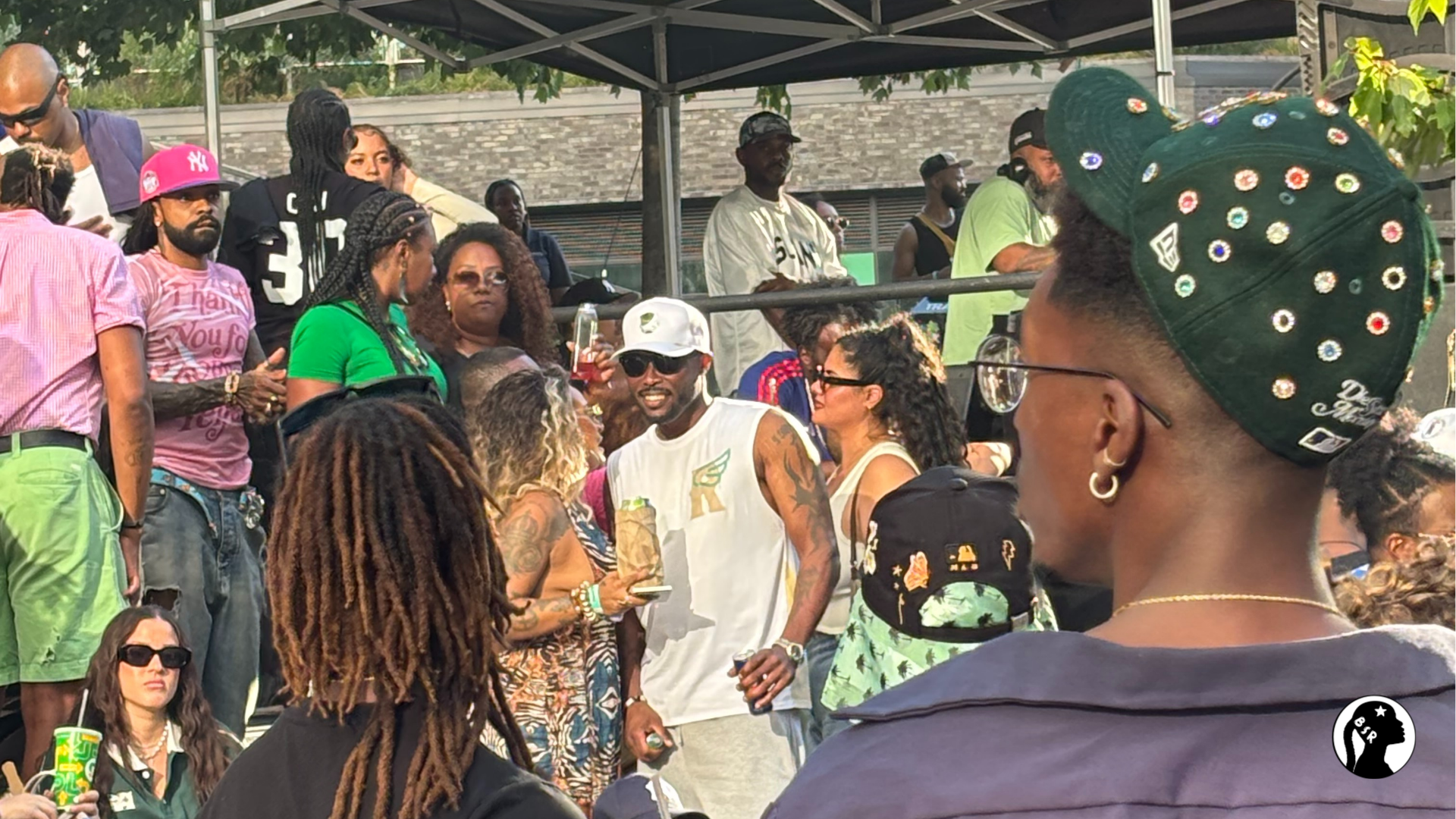
Onlookers dance and socialize at the Everyday People DJ set
From the start, the Planet Brooklyn website was attractive, but lacking information. The line-up tab listed artists and performers without any specific times or days. There were links to purchase tickets for paid and free performances at BAM, Barclays Center, and Brooklyn Paramount followed by a vague description of free block parties and a shopping village at the streets connecting the three venues.
It seemed like an ambitious vision for a first time festival — multiple street closures and permits, corralling vendors, and setting up disparate sound stages. I was disgruntled (but undeterred) by the lack of information and RSVP’d to see Grammy-nominated Afro-Cuban singer Daymé Arocena at BAM on Saturday, August 23 at 5pm. Since the performance was free my RSVP didn’t guarantee entry but offered seating on a first come, first serve basis. I hoped that my RSVP would also yield emails with event updates regarding the schedule and exact location of the outdoor events as the date got closer. Those details never came.
I checked the website about once a week and it stayed the same up until the day before the festival. I texted Rosa who’d agreed to come with me suggesting that we have a back-up plan for the day, since I was beginning to wonder if the too-ambitious festival plans had been abandoned and cancelled a la Fyre Festival. Rosa responded with a TikTok by user @SuzyfromBK, who lives in the area, which showed festival staff setting up facilities and tents for vendors. When I checked again the morning of the festival, the schedule and map were finally posted on the website, so Rosa, Reggie and I linked up to make the trek.
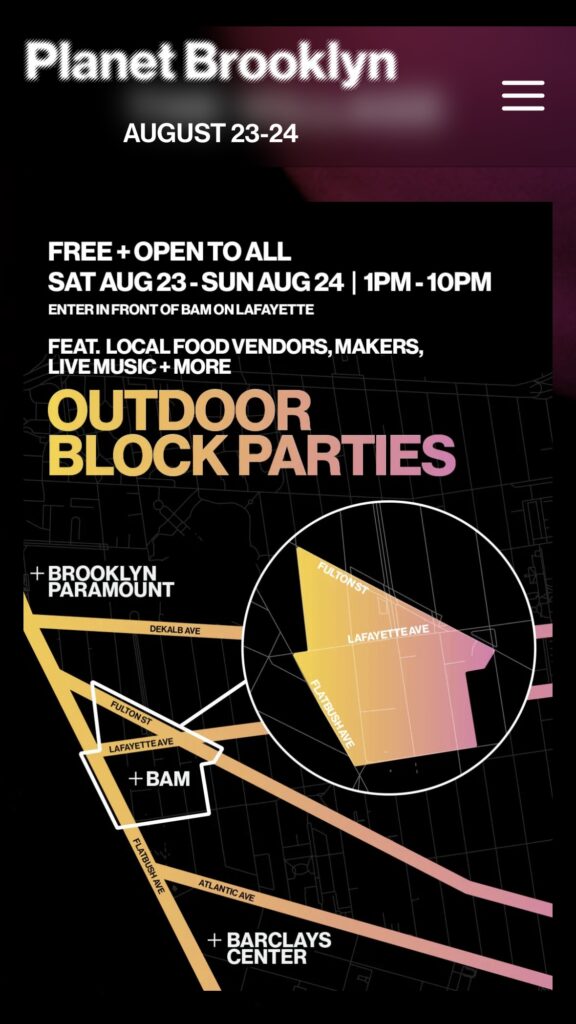
A map of the block parties in the event’s dark gradient aesthetic was posted on the website, but has since been taken down
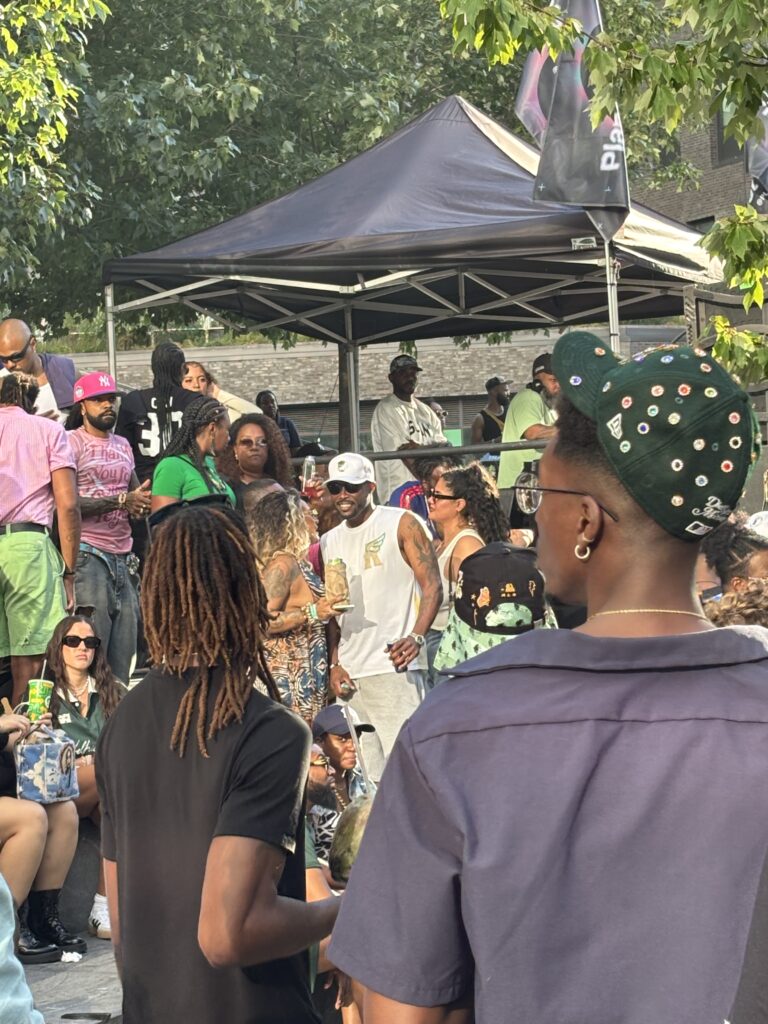
We arrived on the corner near the Apple Store on Ashland, walking through a tunnel of purple porta-johns and into a sea of vendors selling standard festival wares: wooden earrings shaped like the African continent, handmade Kente-patterned pants, shea butter and black soap, candles, tea blends and handbags made of wicker. Brooklyn Pop-Up, which “emphasizes local craftspeople, sustainable design, and handmade wares” and hosts pop-ups at Brooklyn Museum, Fort Greene, and Dekalb Market, curated the vendors. A crowd was gathered on the steps of Ashland Plaza out front of the Brooklyn Public Library’s branch for Arts & Culture bordered by barricades that were manned by private security guards who checked ID’s for 21+ wristbands or just let you in to dance. Everyday People — a party which has had its own evolutionary journey from new to niche to cool to played to overhyped like Grits & Biscuits, South & the City, and Must Love Beards — delivered DJs who played a house-adjacent mix of Luther Vandross and Beyoncé to a crowd of Gen X, Millenial, and Gen Z partiers bobbing and weaving to the beat and dressed in fantastic expressions of personal style. We moved through the party, made a pitstop for Cutwaters and ice cups, and toasted to feeling young, Black, and free during one of the final weekends of summer. And that last paragraph would’ve been the entirety of my review, if it hadn’t been for that deleted skeet.
Whose Mans Is This?: BSE Global’s Billion Dollar Empire
Since I couldn’t find the skeet, I needed a source to link for the claim that Planet Brooklyn was produced by the makers of Afropunk. I expected to find an interview or article about how Matthew Morgan or Jocelyn A. Cooper were back with a new festival concept and returning to their roots in Brooklyn after taking Afropunk all over the world. But my search returned only two articles about the festival at all: one from Westchester News 12 about Soca artist Machel Montano headlining the weekend with a show at Barclays Center for a festival “that celebrates the unique culture the borough represents” and another from BKMAG, the official festival media partner, with no credited author as “a first-of-its-kind music festival…which was founded by BSE Global”.
Over on the BSE Global About Us page I expected to see Morgan and Cooper (or even Spooner!), but instead was greeted by the smiling face of Joe Tsai, the Alibaba billionaire and owner of the Brooklyn Nets MNBA team. I remembered Tsai from when he surfaced to quell the outcry following Kyrie Irving’s tweets about Black Israelites in 2022. Tsai is a board member of BSE Global, which is the parent company of the Brooklyn Nets, the New York Liberty, Barclays Center, and BKMAG, the official media partner for Planet Brooklyn. There was no mention of Afropunk or any Afropunk founders.
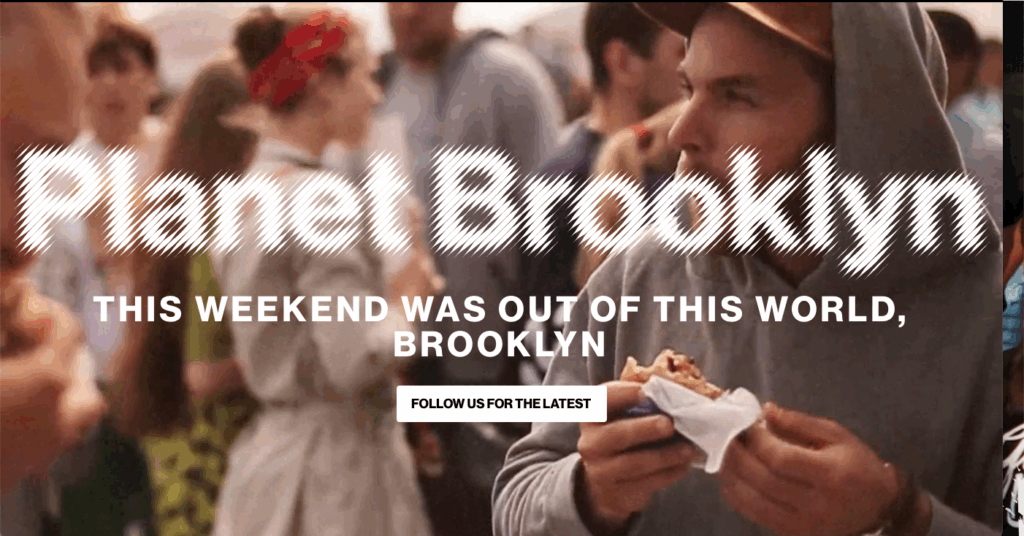
After the event, the Planet Brooklyn website featured stock footage of white people eating tacos on a rooftop
Back on the Planet Brooklyn website, the schedule, line-up, and FAQs had been replaced with the proclamation “THIS WEEKEND WAS OUT OF THIS WORLD, BROOKLYN” stretched across a stock video montage of concert footage, the Brooklyn Bridge, and tacos that featured more white people than I saw at the actual festival. While it’s common to update an event website after an event, I thought it strange that the information from the 2025 festival had been scrubbed. Plus, there was no collection of press about the event, which is the kind of information a festival producer would typically use to prove impact for potential sponsors the next year. Planet Brooklyn, however, won’t need a pitch deck since it’s basically being hosted by its own sponsor, BSE Global. It makes sense now how a first-time music festival can coordinate multiple street closures and three venues across two days. They hosted the festival at their own venues, announced it through their own magazine, and outsourced vibe creation to DJs and vendors. They only worked within their own holdings, making this no harder than throwing a birthday party at your own apartment and hiring a caterer.
As Norman Oder — local reporter and founder of the watchdog blog Atlantic Yards/Pacific Park Report — has found, it goes deeper than this first-time festival. In 2024, BSE Global announced their intention to create an “ecosystem” of assets in Brooklyn centered around the Brooklyn Nets. This ecosystem includes the purchase of Brooklyn Magazine, BKMAG, to write about and publicize the Brooklyn “arts and culture scene” as well as advertise other BSE Global holdings. In June 2024, Oder reported that “the family of Julia Koch, the widow of notorious right-wing funder David Koch, would be buying 15% of BSE Global, the parent company of the Brooklyn Nets and Barclays Center operating company, at a valuation of $6 billion”. If Planet Brooklyn is an attempt at fortifying the Brooklyn-Barclays ecosystem, what is the music festival’s role in BSE Global’s aims?
The question is even more urgent with the disappearance of the Afropunk partnership. BSE’s June press release announced that, “Planet Brooklyn is produced alongside Multiply Creative [Morgan’s brand], a cultural marketing and experiential agency founded in Brooklyn with a mission to create meaning and evoke emotion through narrative and creative expression, designing moments that have a profound cultural impact,” but there’s no mention of the partnership after June. If a guest attended to support an offshoot of Afropunk (like I did) they may feel that they have been tricked (like I do) into participating in whatever corporate show of impact BSE Global just pulled off.
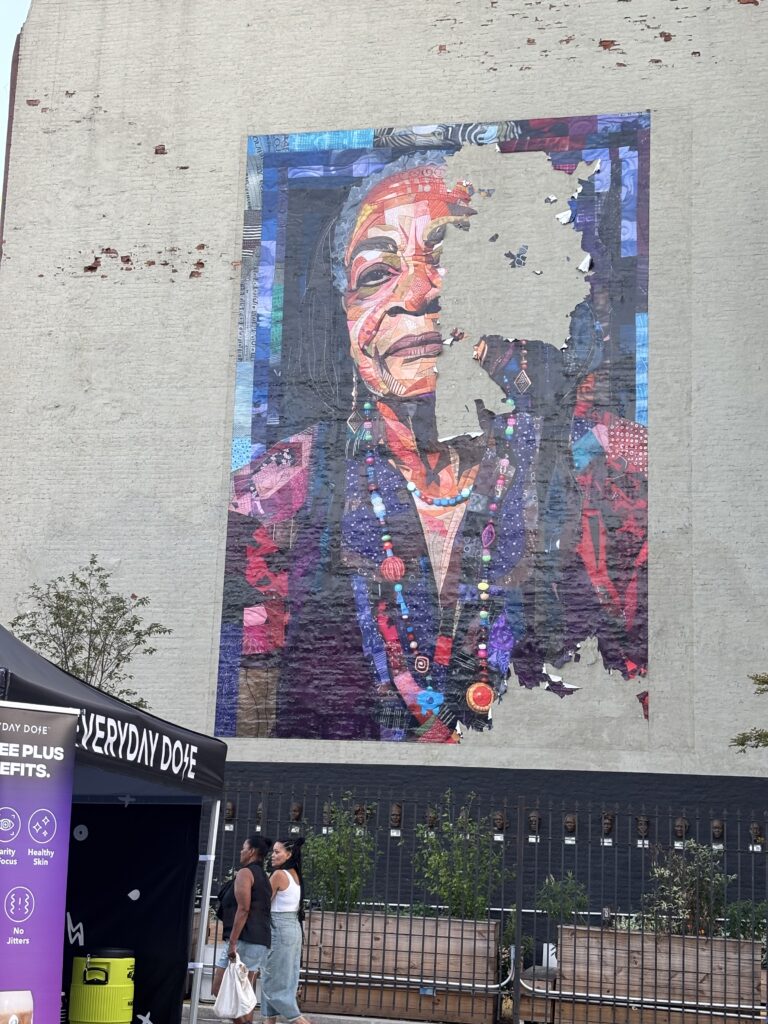
Street art was visible from the vendor booths on Lafayette Avenue
Since BSE and BKMAG are the only sources of information about the event, the same press release quote from DeJuan Wilson, Chief Products and Experiences Officer at BSE, continues to appear. “When putting together the lineup for Planet Brooklyn, it was paramount that our performers reflected the incredible diversity of Brooklyn itself — a true mosaic of cultures, sounds, and stories,” said Wilson. “Our goal is that Planet Brooklyn will further elevate and celebrate those unique voices, bringing together artists who represent the heartbeat of this borough, and we are excited for everyone to experience a festival that’s as vibrant and dynamic as Brooklyn itself.”
The emphasis on Brooklyn’s culture, diversity, sounds, stories, and voices feels akin to when organizers removed the punk from Afropunk; something important is missing. The line-up and headlining acts of Planet Brooklyn are Black, Caribbean, and Afro-Latino; the vendors were nearly all Black-owned; the attendees, however they heard about the event, were Black and Brown — but the theme of the event is Brooklyn? What happened to the partnership with Multiply Creative? Why not brand the event as a block party for the Nets/Liberty/Barclays community? Contrary to what festival organizers would have us believe, there are other people and cultures in Brooklyn so why insist on crediting the borough instead of naming the subcultures that have been forged by Black and Brown people? Whose Brooklyn? Who is Brooklyn?
The South Bronx became SoBro when realtors felt the neighborhood needed a fresh start, same for SpaHa in el barrio. Soul food became American food when restauranteurs wanted to sell collard greens, fried chicken, and baked macaroni and cheese in new neighborhoods. Natural and ethnic hair care (like Shea Moisture) became curly hair products when “wash and gos” went mainstream. What’s the product at Planet Brooklyn? Who’s buying and who’s on sale?
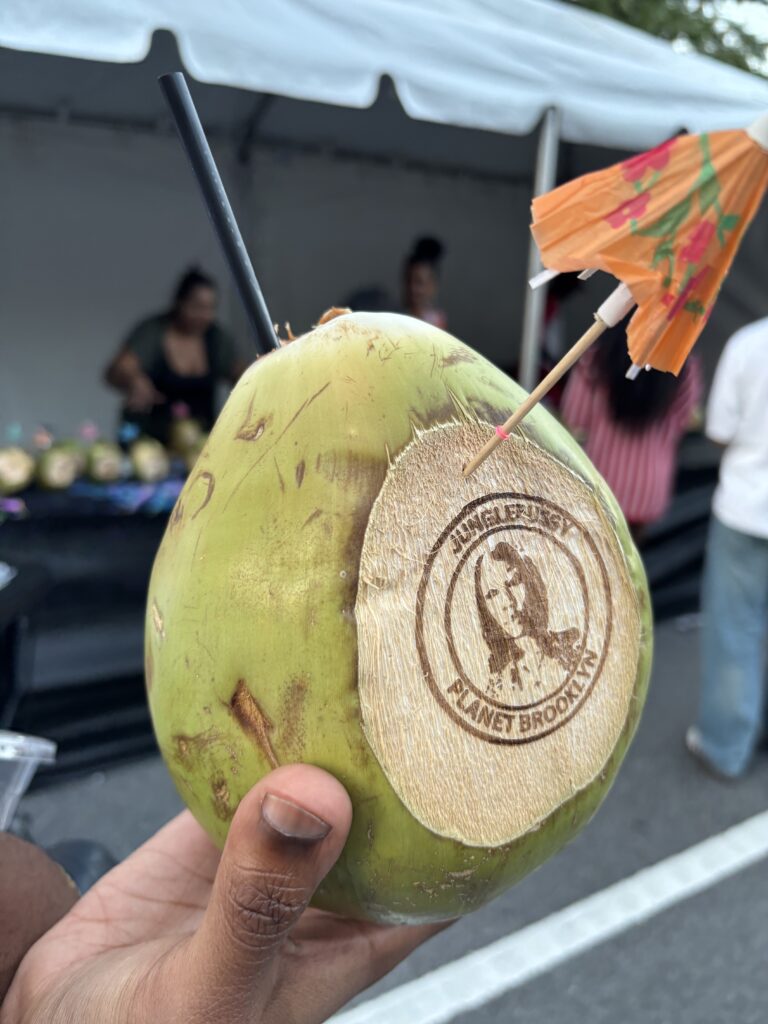
A coconut water served in its shell branded with the artist JunglePussy’s likeness, she performed at the Brooklyn Paramount as part of the festival
A Dark Planet: If You Mean Black, Just Say That
Based on its track record and stated intentions, BSE’s goal is money. In a capitalist setting, there’s technically nothing wrong with that.
When Shawn “Jay-Z” Carter announced the Made In America festival in 2012, he said it would “encompass every genre of music, creating and showcasing the only genre that matters, ‘great music.’ Budweiser and Live Nation are going to produce an amazing two days of performances, and it’s great to partner with United Way again to support all of the positive work they do in the community.” Carter also announced that he would headline the show, which made his intentions clear.
When Afrochella, which is now such a big deal that it’s been sued by Coachella for copyright infringement and renamed AfroFuture, was founded in 2017 it had the expressed mission of “celebrating Black innovation, culture, and community” on both sides of the Atlantic. It’s clear who it’s for and what it’s about. Culture Management Group founded the festival to connect the global diaspora. Broccoli City, an annual music festival in Washington, D.C., brands itself as a “social enterprise” with the philanthropic receipts to back it up.
The festivals, parties, and events that succeed are those that are clear on their audience and their product. As Essence has learned through partnering with The Solomon Group, it helps if you’re clear about who’s pulling the levers behind the curtain.
I’ll be frank: the lack of clarity about sponsors, the lack of effort to partner with press, and the lack of ability to articulate what they mean by “Brooklyn culture” gives me the heebie-jeebies when it comes to Planet Brooklyn. But why does it matter, anastazia, if this multi-billion dollar corporation threw a lively block party without telling you why as long as you had a good time? Because while not all of the dots connect, we can clearly see the ones that do.
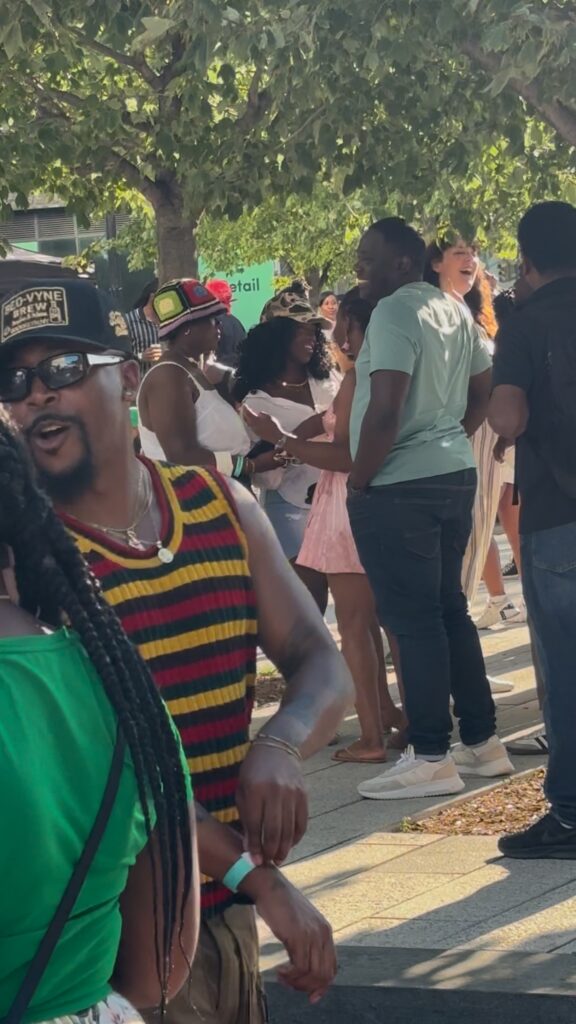
Onlookers dance and socialize at the Everyday People DJ set
When something is free, you are probably the product. Chances are strong that I, my friends, and every other guest who showed up unknowingly attended the beta test for a soon-to-come paid version of the same event. At the very least, we’ve been recorded for some promotional effort. But why us and not any other segment of “Brooklyn culture”?
We’re an ideal test audience because we are the culture — we catalyzed and invented the modern day Super Bowl halftime show, we dictate nail and makeup trends decades in advance, we popularize events, slang, dance moves, products and more without compensation. That said, dishonest actors have attempted to package and resell our culture to us before, but if any of the festivals that have come and gone indicate, we can sense the difference and we will attend (or not attend) accordingly.
blacklove 🖤 and starlight 🌟
Planet Brooklyn was a music festival that took place on August 23-24, 2025 in the Fort Greene area of Brooklyn.
