


Uptown Shakespeare: Classical Theatre of Harlem’s ‘Memnon’
An inclusive approach to the classics centers a Black hero called to fight in a Greek war
Who do you call when the losses have stacked up for far too long and you’re desperate for a pivot? Your ex, which in the case of the Portland Trailblazers is Damian Lillard. Lillard, who joined the team out of college in 2012 and played for the Blazers until 2023, was the ‘franchise player’, the anchor of the team, and The Man in Stumptown. Now, he’s coming back a little less agile considering the Achilles injury he’ll be healing for the 25-26 season but he’s coming back nonetheless, with both the team and city hopeful that his contributions in the locker room — of direction, camaraderie, and leadership — will help the team improve their recent 28-win seasons.
Lillard, whose family has stayed in Portland during his 2 year ringless jaunt to the Milwaukee Bucks, seems to be going happily. But across the ocean in the distant past, our hero Memnon returns to Troy with a chip on his shoulder. Memnon, like Lillard, has a well-earned reputation that precedes him in the Greek city of Troy. He’s an absolute warrior, a beast on the warfield, and — as he’s repeatedly reminded — he’s an Ethiope. He feels a bittersweet allegiance to the Trojan plight. Memnon’s never been thought of and accepted as a Trojan until now because they need him. And they need him bad.

‘Memnon’ in Marcus Garvey Park
The Trojan War (yes, the one with the horse) finds Troy at war with all of Greece over a dame. Helen, commonly referred to as Helen of Troy, didn’t start out that way. Described as the most beautiful woman in all of Greece, she spends much of her life being courted and kidnapped, with the earliest abduction by Theseus taking place when she was 7. When Prince Paris of Troy steals her from her Spartan husband it sets off a war because if there’s one thing important about Spartans, it’s that they be fighting. So when Troy has been beaten to a near pulp by Sparta and Greece, Memnon gets the call.
Memnon is a warrior, but his preference is peace and he describes the battles he’s won simply by sparing lives and opening negotiations. The Trojans aren’t interested in his zero casualty approach and Helen in particular begs him to fight, availing to their shared identity as outsiders. Memnon points out that it’s an easy ask that he give his life while she sits in royal safety turning a blind eye to the war that she caused. Helen counters that she didn’t ask to be born beautiful, nor with a conscience and he has no idea how hard it has been to exist as a human conquest. Memnon concedes.
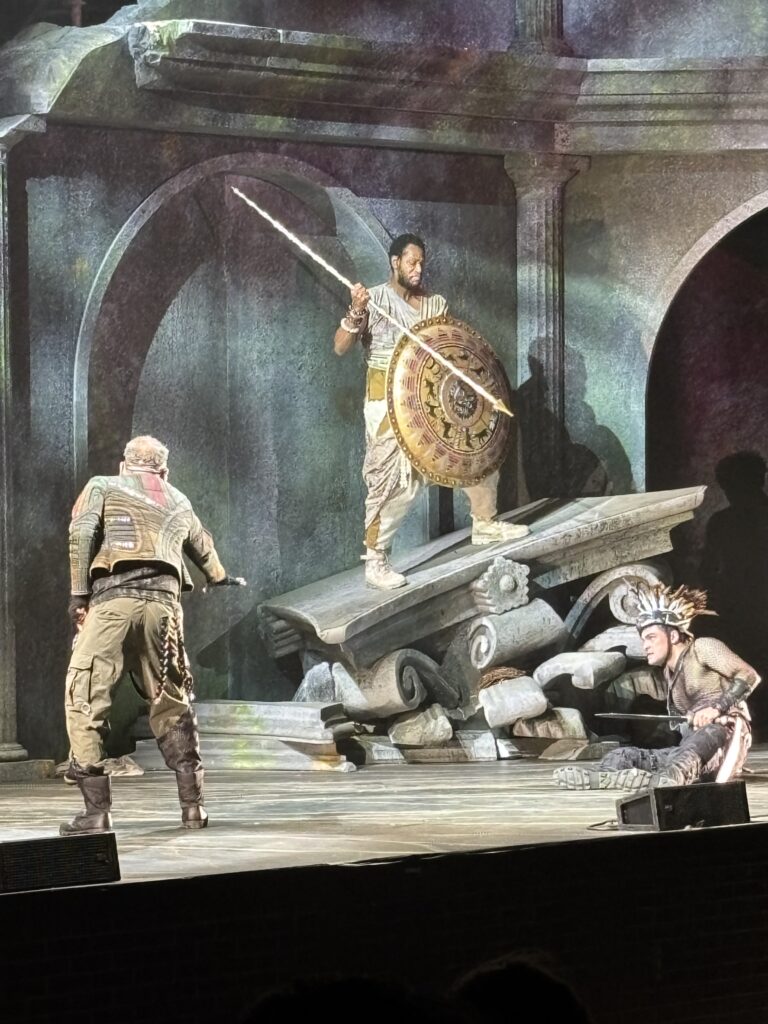
Eric Berryman performs in ‘Memnon’ in Marcus Garvey Park
Our Ethiopian hero comes face to face with the legendary Achilles in the final scene. Even though Achilles is a demi-god, he’s shaking at the thought of Memnon’s might, as well he should. Memnon is a menace with his spear and shield and has killed Antilochus, Achilles’ dear friend, which makes this contest both political and personal. The two battle as the fate of Troy and fair Helen hang in the balance.
This story is lifted from Homer’s Iliad by Will Power, but I would’ve thought this play was older than I was if I hadn’t done any digging. All the usual suspects are there — Greek mythology, period language, and arcing monologues — but Memnon only premiered in 2024. If you can endure the long speeches in the first twenty minutes, you’ll be glad you stayed. It’s a fitting choice for the Classical Theatre of Harlem’s aims to “nurture a diverse audience for the classics” and it makes me wonder what message Power aimed to encode by fleshing out this particular story line and character from the larger Trojan universe.
Eric Berryman, who holds a special place in my heart as the leading man in Get Yo Ass In the Water and Swim Like Me (the first play I ever Black Star Review-ed!), carries the title role with regal poise and surprising athleticism. While the choreography doesn’t require any acrobatics, he spins his spear with enough command to be believable as an ancient Ethiopian warrior. Perhaps we’ll see him in the next installment of Marvel’s Black Panther; he’s stirring when impassioned.
Andrea Patterson has the burdensome task of outshining resplendent costumes by Celeste Jennings and Jasmine Lewis, and she’s up to the challenge. In her first scene, she wears a quilted blue dress with a militaristic collar to urge Priam to call in reinforcements. She appeals to Memnon in a gown that tops a luscious ruffle of kente cloth with a wine-colored taffeta bodice, echoing her plight as a woman caught between two worlds. In both cases, she won me over alluding to her character’s historic ability to cause and quell wars.
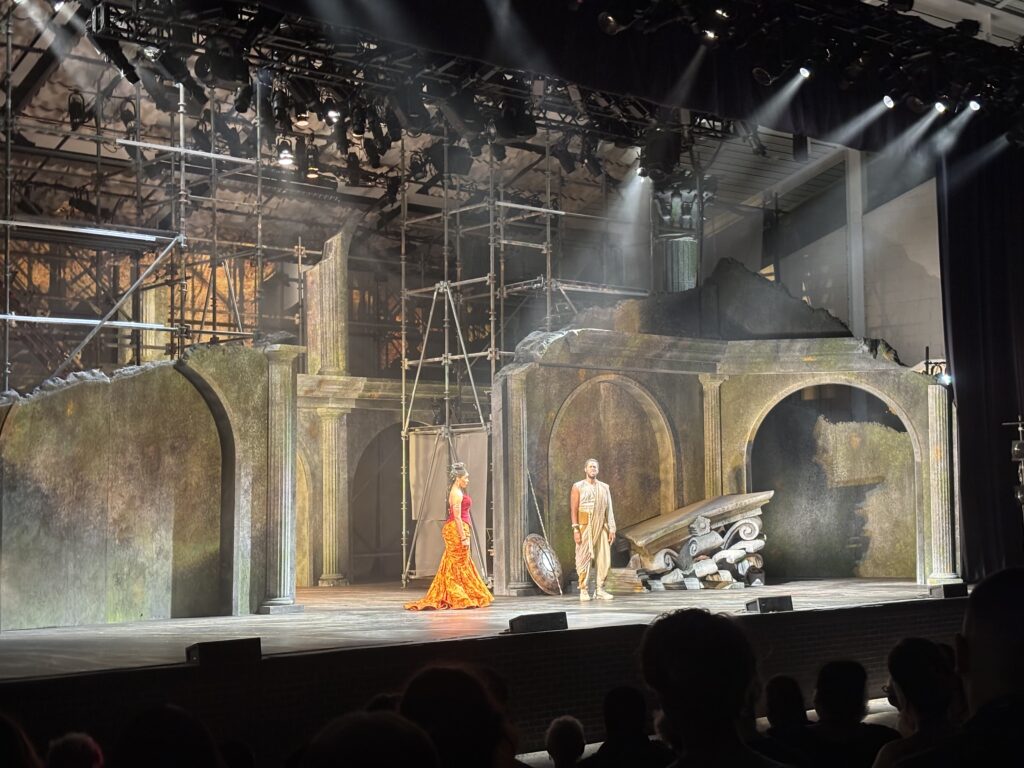
Andrea Patterson and Eric Berryman perform in ‘Memnon’ in Marcus Garvey Park
Memnon clears the way for two overlooked characters in the legend of the Trojan War to tell their sides of the story and lay bare their own motivations. Helen’s highest hope is that the killing and the war being fought in her name will swiftly end. In doing a favor for Troy, Memnon aims to honor the part of himself that is Trojan despite the way they’ve treated him for being geographically Southern. He recalls and then disregards his mother’s warning to “fight not for heathens whose hearts beat not for you as you for them” choosing to “not rest until [Troy] lives as it says.”
Plenty of people on the Internet have opinions on whether Lillard’s return to Portland is triumphant or a bad trade, especially considering that he’s coming home injured. But without giving away too much about the ending of Memnon, you never know when a hometown hero might muster up a second wind.
blacklove 🖤 and starlight 🌟
The Classical Theatre of Harlem’s production of Memnon opened at Richard Rodgers Amphitheater in Marcus Garvey Park on July 5th and will run until July 27th, 2025. Memnon was written by Will Power, directed by Carl Cofield, and choreographed by Tiffany Rea-Fisher. Shows from Tuesday to Sunday begin at 8:30pm and Friday shows begin at 9:00pm. There are pre-shows on select performance days as well as a night market featuring local vendors. The performance is free to attend, but RSVPs are encouraged. The Classical Theatre of Harlem welcomes public, organizational and individual support and you can make a contribution here.