
‘Chiaroscuro’ at The Flea
In Chiaroscuro, six Black singles cruise for love on a bizzaro nautical adventure that’s just shy of a shipwreck
The only photo I can find of the playwright Aishah Rahman shows her head tilted and hands gently opened. She wears the beginnings of a smirk. It looks as if she’s just made a point (that’s just how I see it) and shrugged for emphasis (but you’re entitled to your own opinion). Her hair and blouse look black, but I wonder about the color of her nail polish and the gems on the rings she’s turned inwards toward her palms. You can’t extract details like these, or complexion, from a black and white photo and maybe that’s the way she wanted it. In her play, subtitled “a light and dark skin comedy”, skin color is a theme for sure, but the comedy is harder to find.
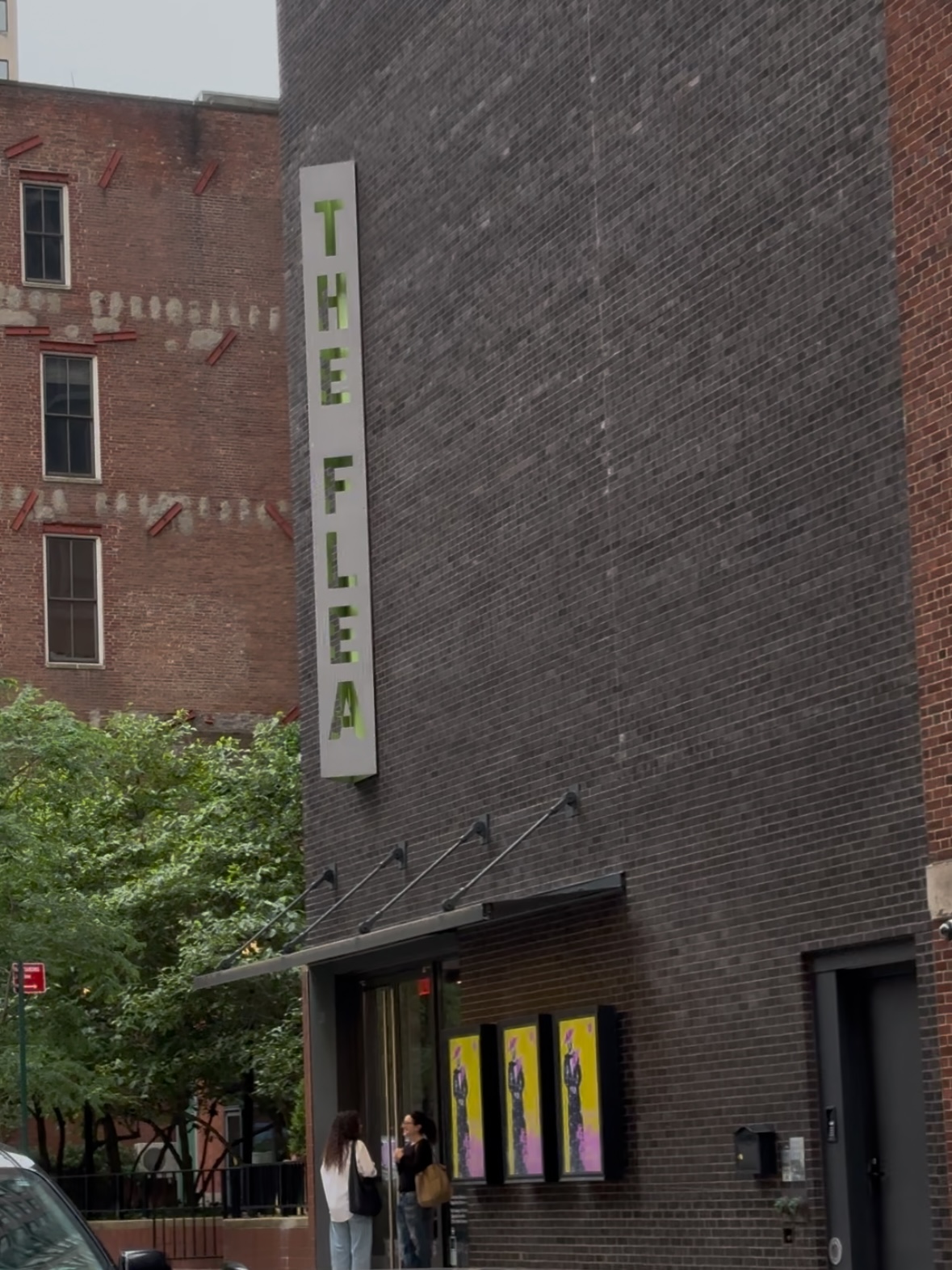
Aishah Rahman, a contributor to the Black Arts Movement who passed away in 2014, wrote Chiaroscuro in 2010. National Black Theatre excavated it from their decades-deep archives to stage the show The Flea, a 74-seat theater downtown in TriBeCa. It’s been a fun scavenger hunt to visit theaters around the city while NBT continues construction on their new home uptown.
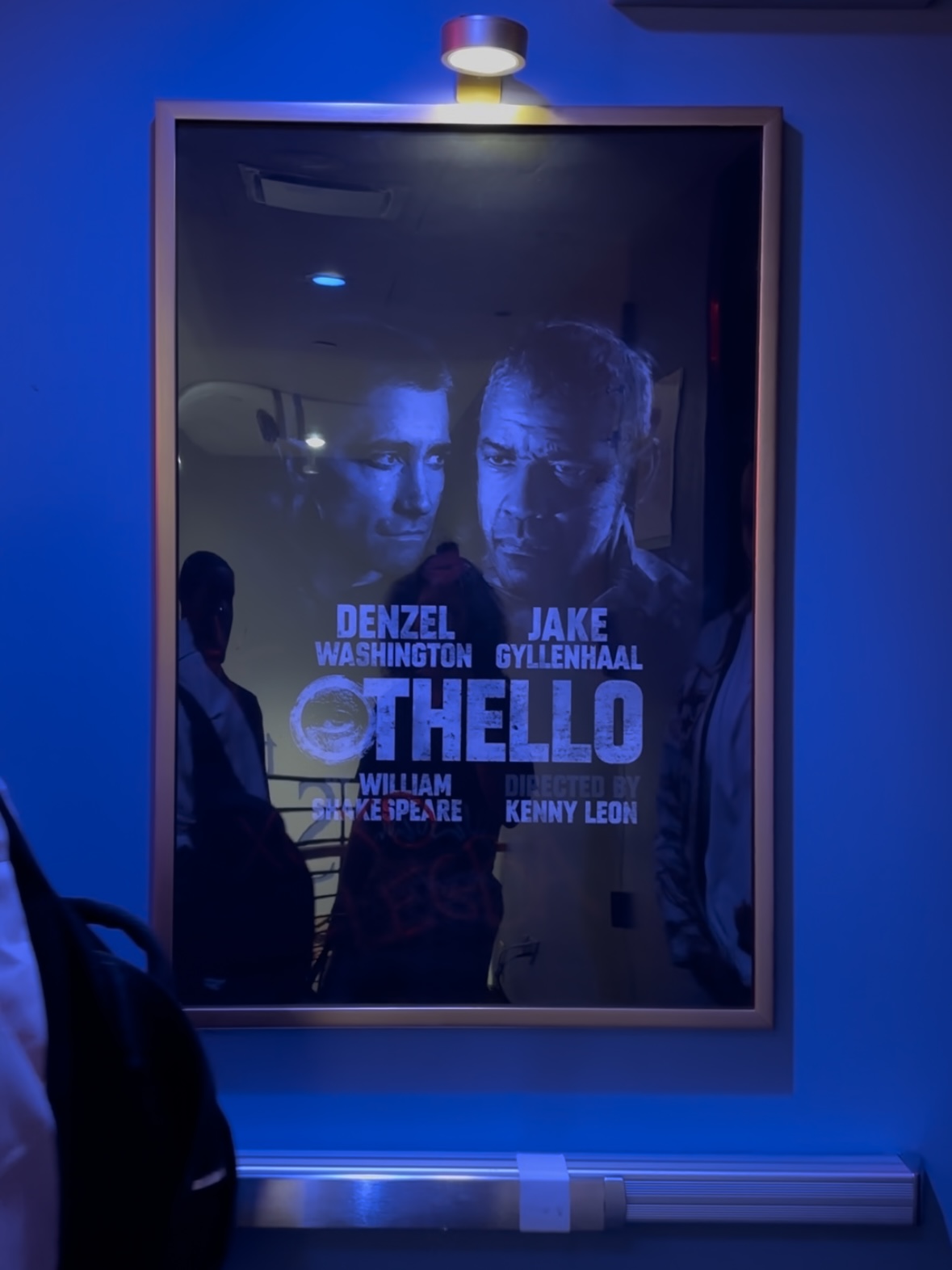
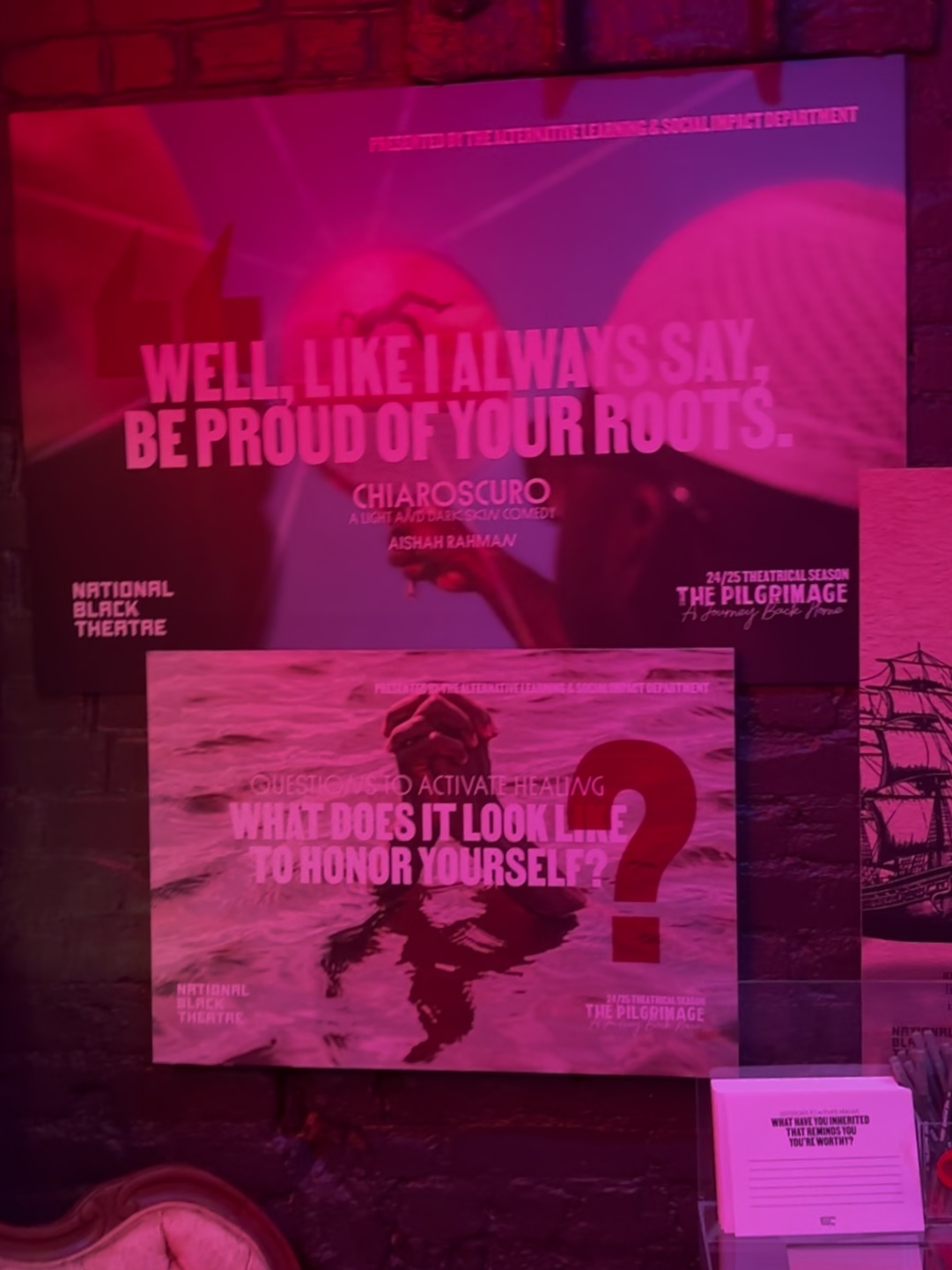
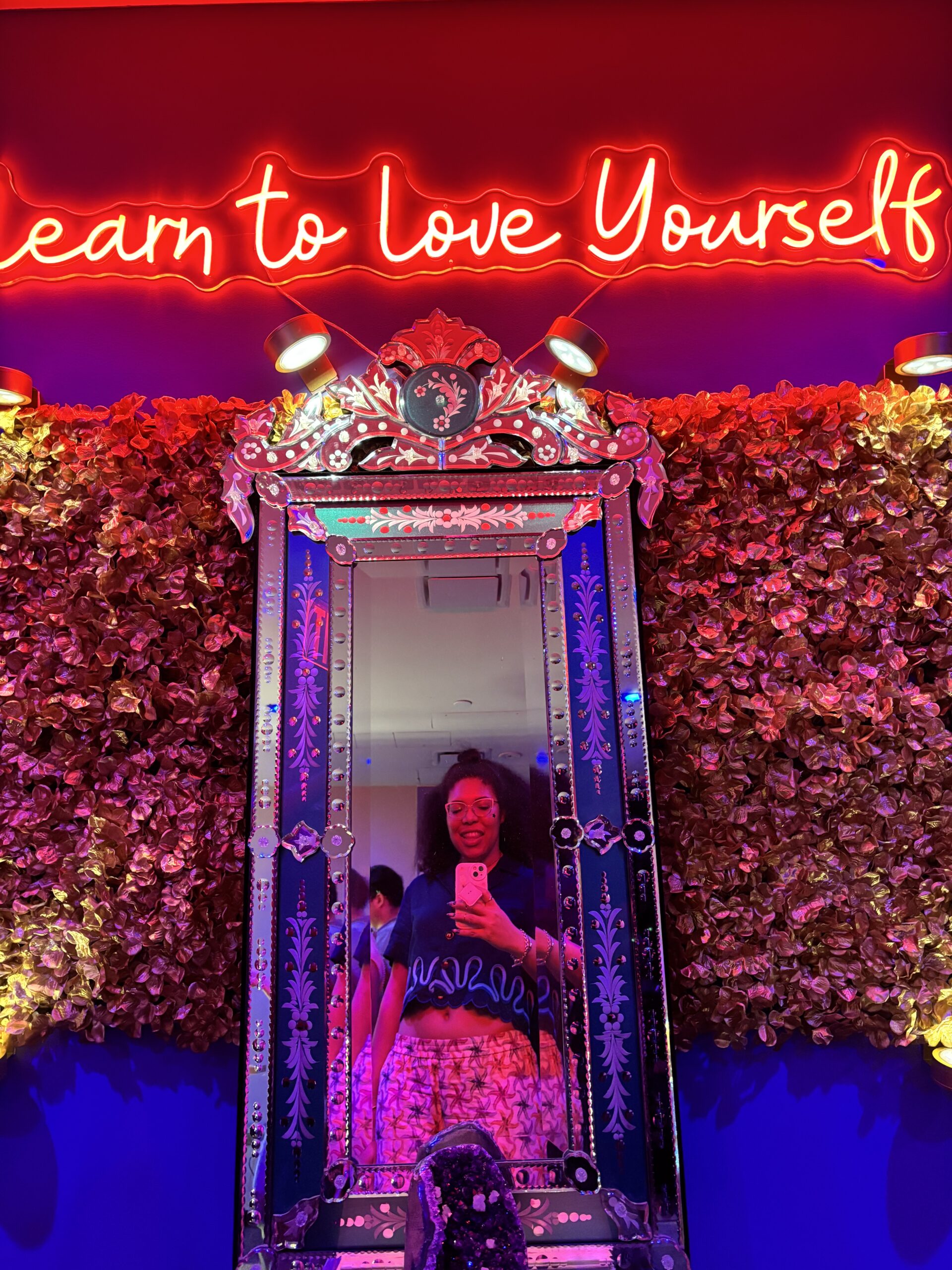
As is usually the case with NBT, there’s a dramaturgical installation that invites the audience to interact with the themes in the show. For Kings… Come Home, there were suitcases. For The Divining…, there were altars. For Chiaroscuro, there were sultry red lights and a mirror framed by fluffy gold shrubbery. Above the mirror, neon cursive letters implored: Learn to Love Yourself. A poster of Denzel Washington and Jake Gyllenhaal in Othello hung nearby. I thought was just a coincidence since both shows were in production at the time, but it turned out to be a mischievous bit of foreshadowing.
-
- ‘Chiaroscuro’ was staged at The Flea
-
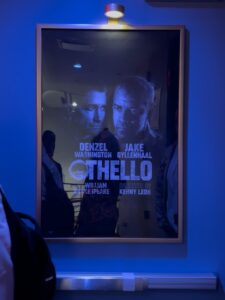
- A poster from the 2025 Broadway production of ‘Othello’ hung in the entrance to ‘Chiaroscuro’
Chiaroscuro begins with six “chocolate” singles on a love cruise, but with only three men and three women aboard, the pairing combinations are limited. The older man, Tilman (Lance Coadie Williams), and older woman, Sienna (Gayle Samuels) have already dated, so they quickly rule each other out as options. Of the remaining men, Russ (TL Thompson) is wealthy and bourgeois while Nayron (Sidney DuPont) is young and rough around the edges. Of the remaining women, La Honda (Abena Quïïn) is full-figured and preoccupied with her appearance while Gina Rose (Ebony Marshall-Oliver) is light-skinned, but doesn’t say much.
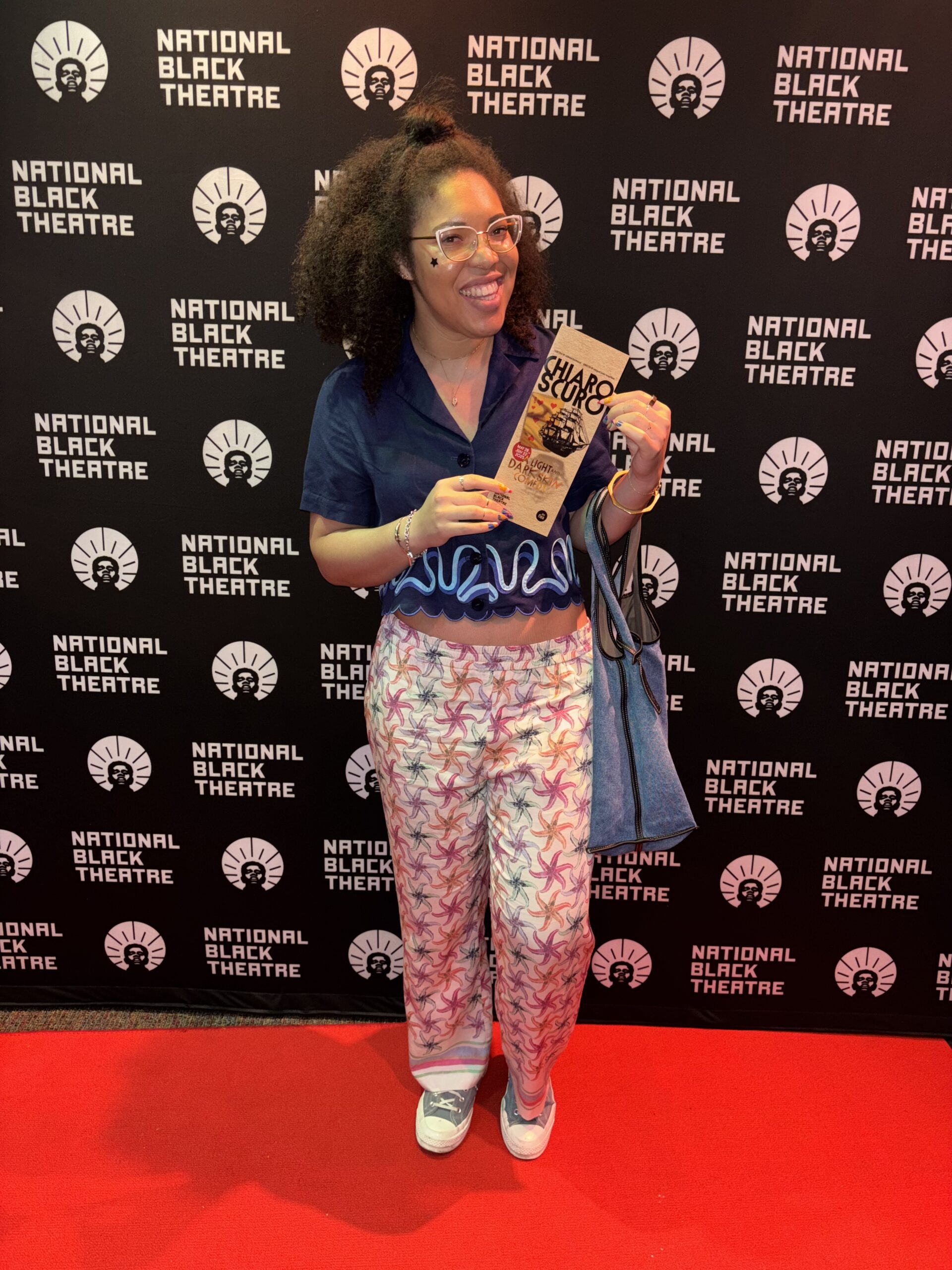
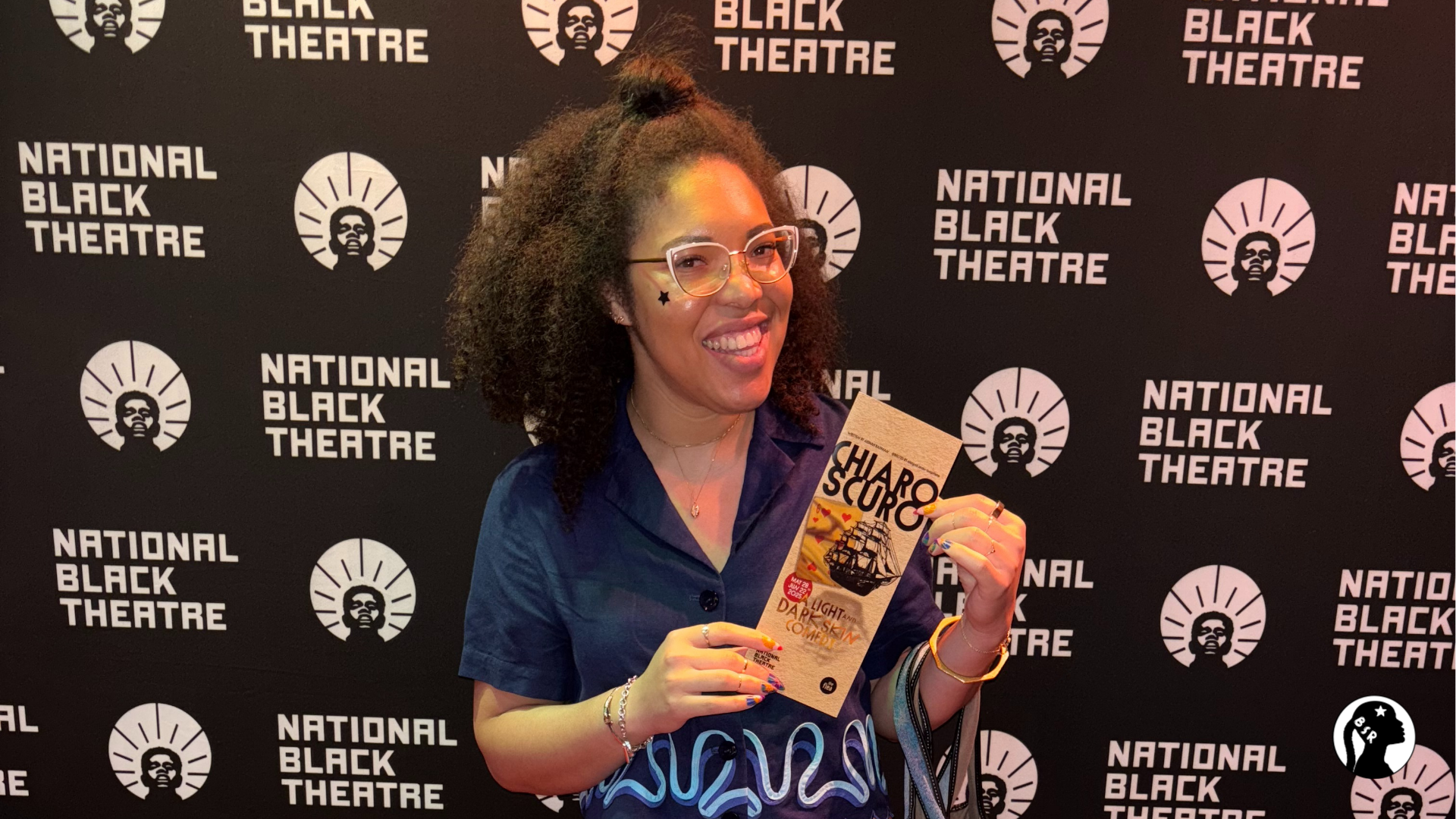
I’m light-skinned, which you may have noticed from the thumbnail of this review, but not like Gina Rose. No one is. Even in a room where your eyes could betray you — the walls were covered in a reflective gold surface that felt like being inside of a foil chocolate bar wrapper — the audience could see that this character was not light-skinned like anyone you know. Her peachy cheeks looked goopy and thick; her beige arms did not have the texture of skin. We could see that she was hiding something, but her sailing companions could not.
Pale Gina Rose and moneyed Russ quickly paired off, to La Honda’s vocal dismay. La Honda was upset to be stuck with the older man Tilman, then excited when she found out he was a musician, then upset again when she found out that he wasn’t very famous and had no money. Nayron set his sights on Sienna and disregarded her suggestions about pursuing someone his own age until she began to take him seriously. None of the couples appear fully satisfied with their matches, even Russ and Gina Rose seem to be talking past one another, but everyone is distracted by the peculiarities of the voyage.
-
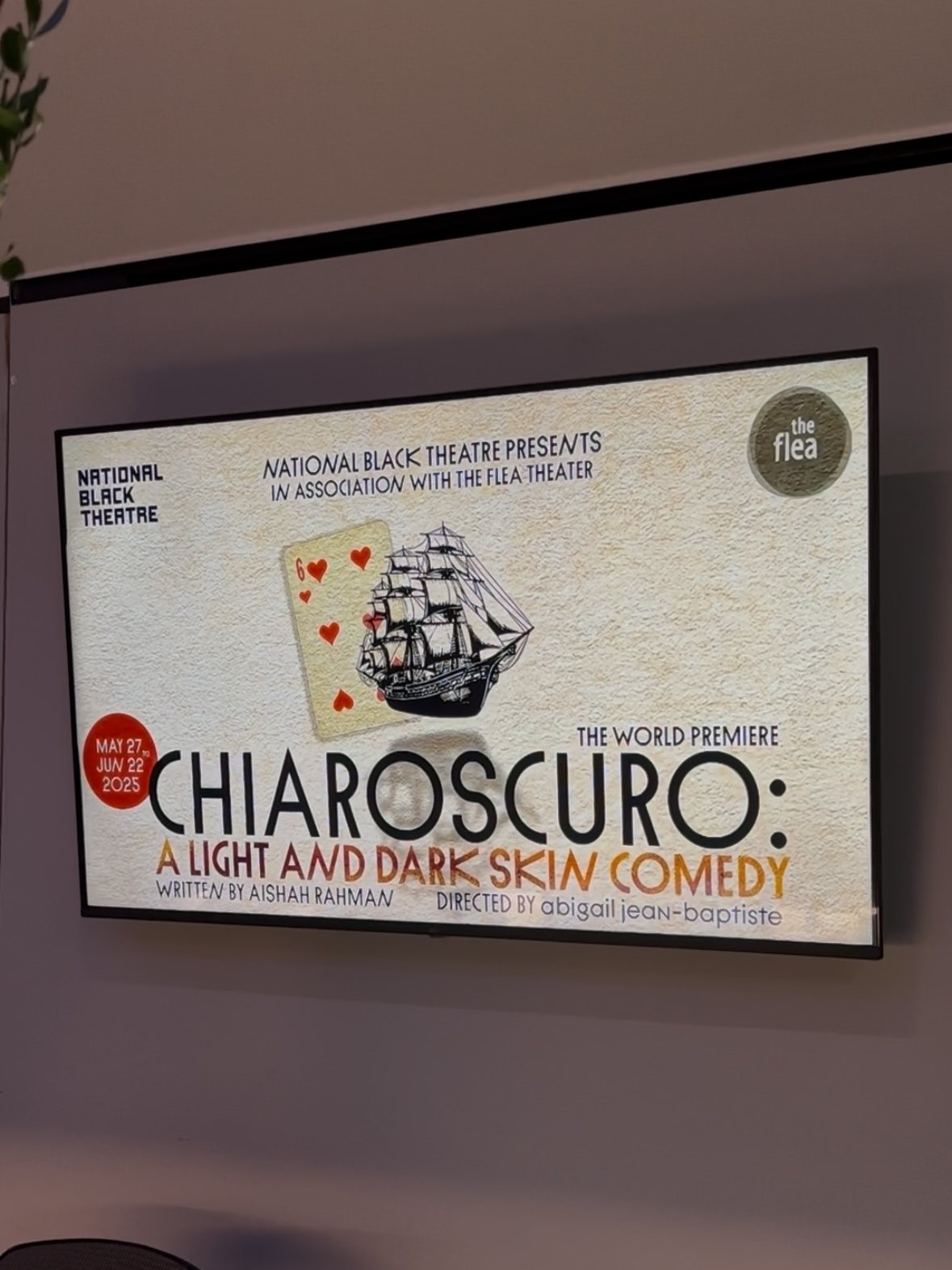
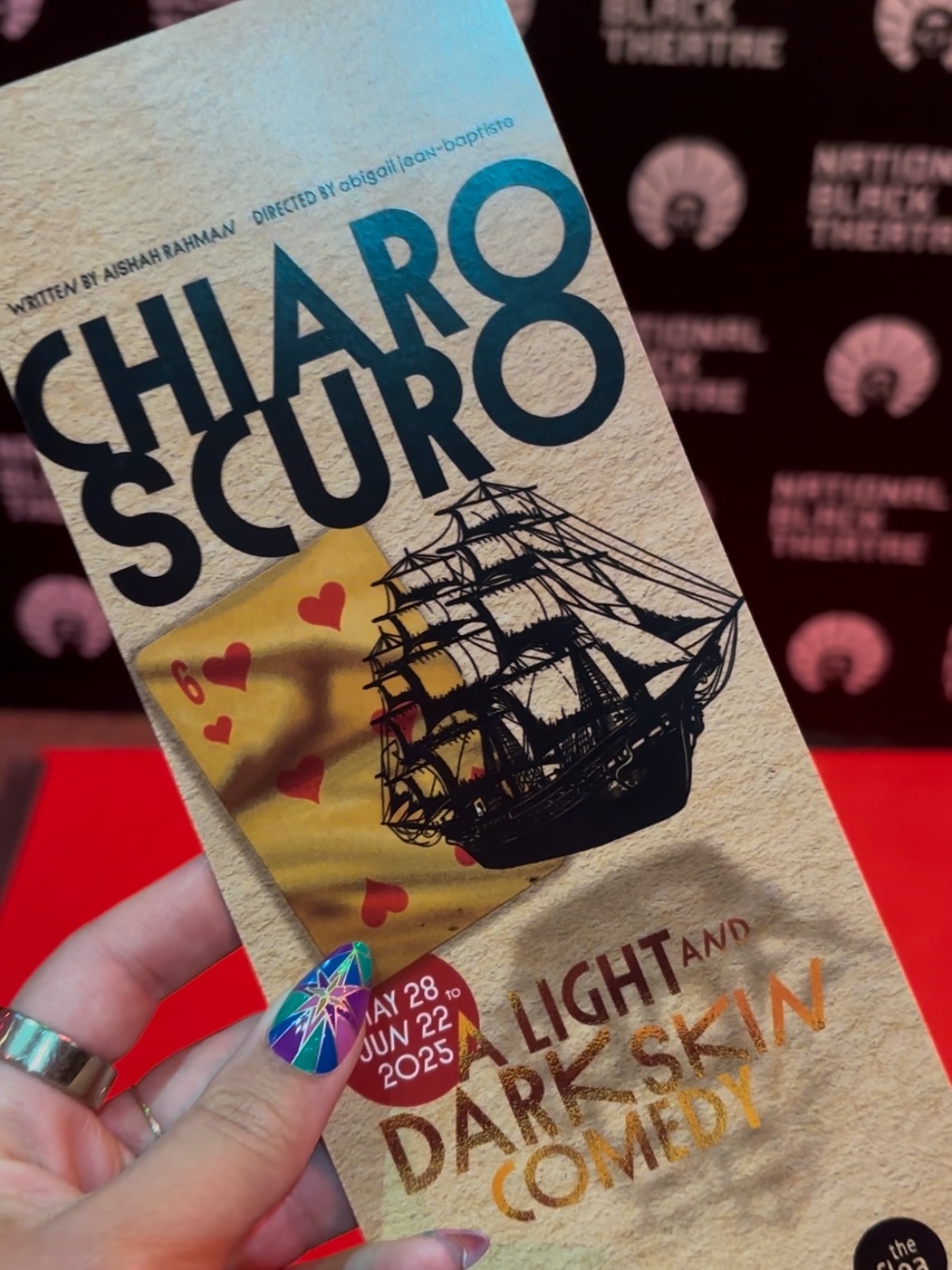
- The playbill for ‘Chiaroscuro’ depicts a ship and a 6 of hearts playing card
-
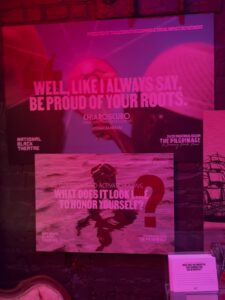
- Posters in the dramaturgical installation read “Well, like I always say be proud of your roots” and “What does it look like to honor yourself?”
There are strange things happening on the ship. Gina Rose suspects that they’re sailing in a circle. Worse still, no one has been able to speak to the captain. The steward, Paul Paul Legba (Paige Gilbert), announces that the men are competing for an opal cameo brooch and that to “hold something so small and pale, it feels like flying.” There is no prize for which the women can compete, Legba says they are the prize. The emphasis on lightness and whiteness crescendoes at the formal dinner. The menu is white fish with white vinegar, white potatoes, white bread and white onions. Dessert is vanilla ice cream and whip cream. Perhaps you’ve guessed the beverage? White wine.
After dinner, the passengers are unwillingly cast as players in a scene from Shakespeare’s Othello. Gina Rose protests having to play Desdemona and she grows ever more uncomfortable as the other players, in character, draw attention to her light and fair skin. She explodes with an admission when she reaches her breaking point. She’s not really light skinned, she doesn’t really have silky hair that flows down her back. It’s all a costume, one she hoped would give her a chance to find love. Russ, sensing what his preferences indicate about his values, begins to offer compliments and platitudes when she reveals her locks and brown skin, “you’re beautiful the way you are.”
Both the ship and the show sail in circles, revealing themselves to be more of a thought exercise than a journey. What began as a play about six main characters is downsized to one woman’s story; everyone revolves around Gina Rose and it’s possible that all of this has been a dream she’s having. But she’s no better off by the end of the cruise than she was at the beginning. Being chosen may feel like a step up from being invisible, but it isn’t a substitute for being loved. The play shares its name with an art technique that contrasts light and dark to create a three-dimensional effect, as if the subject is standing in a spotlight. When Gina Rose explains her motivations for changing her appearance she tries to explain her experiences with colorism, passed down from the women in her family, finally landing on her deepest desire, “because I need love, because I am lonely.” Gina Rose leaves the quiet part in the shadows, she sees who’s loved and became that.
-
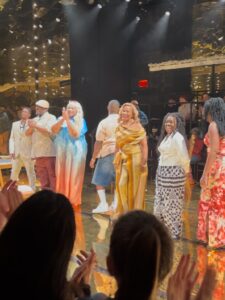
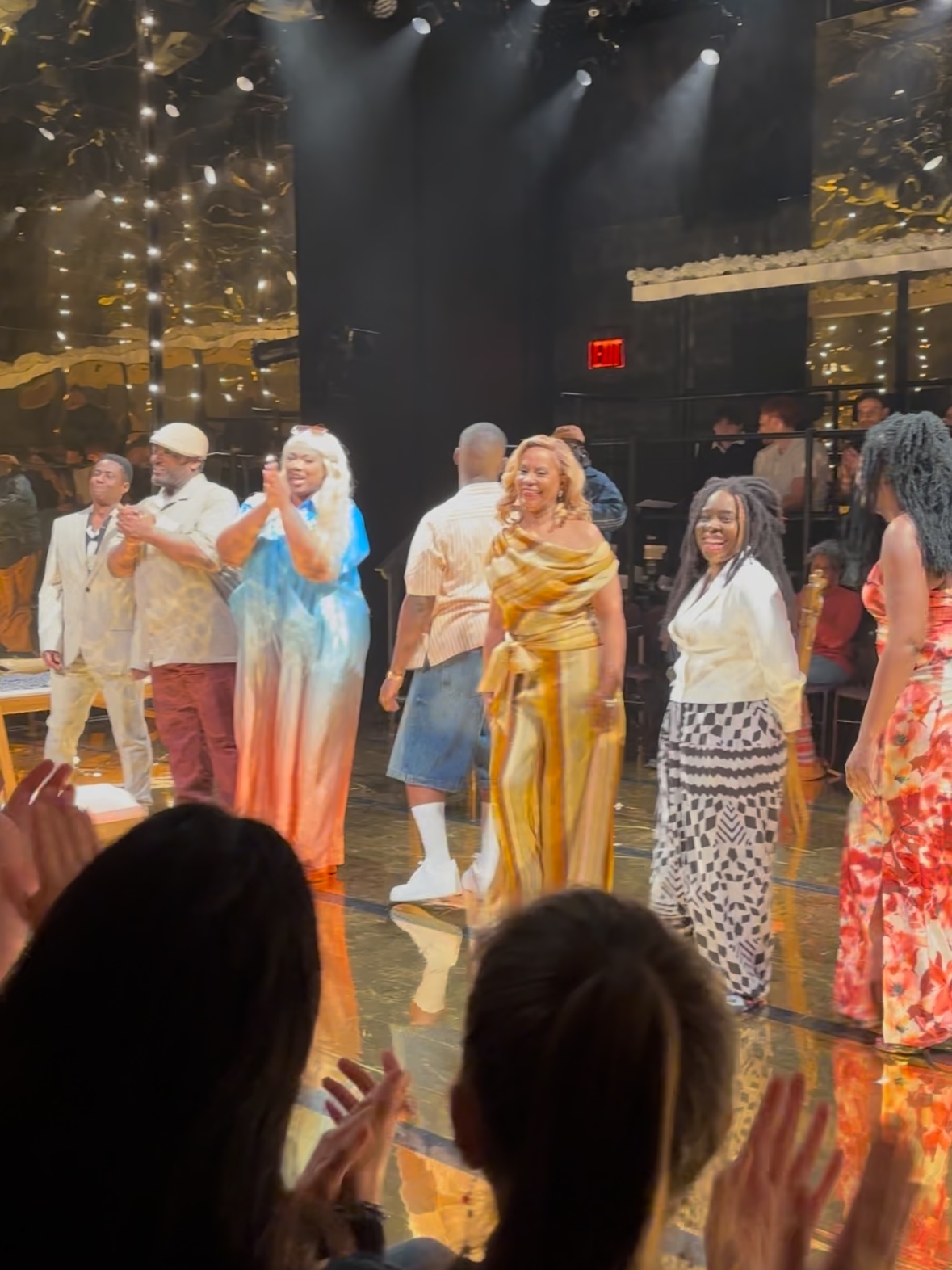
- The cast of ‘Chiaroscuro’ at curtain call
-
- The mirror in the dramaturgical installation, the neon sign above reads “Learn to Love Yourself”
I didn’t see Othello — I blamed the the ticket prices when really it was because I don’t usually enjoy Shakespeare — but I read the reviews. More than one review remarked about the ‘race’ aspect of the revival. In the original text, Othello is insulted as a “Moor”, “thicklips” and an “old black ram”. His union with the young, white Desdemona is the cause of major friction and fuel for his enemies. Critics expected Kenny Leon, the director of the production, and Denzel Washington, both Black men, to deliver more nuance. By tucking a scene from Othello into Chiaroscuro, the two plays are inextricably linked.
Othello kills Desdemona because he thinks she’s having an affair. Gina Rose survives Chiaroscuro, but kills a version of herself to do so. I imagine Aishah Rahman looking in the mirror below the glowing dictum Learn to Love Yourself, smirking at the simplicity of that advice, exhausted at the suggestion that self-love will solve all of her problems. One of the closing lines Rahman wrote for the play is, “The mirror is the root of all comedy.” I took a selfie in the mirror on the way out, but I still couldn’t find the punchline.
blacklove 🖤 and starlight 🌟
Chiaroscuro was written by Aishah Rahman and directed by abigail jean-baptiste as part of National Black Theatre’s Soul Directing Residency Program. This production was staged at the Flea Theater in TriBeCa and ran from May 28 to June 22, 2025.
-
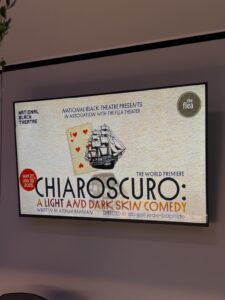
- The poster for ‘Chiaroscuro’ depicts a ship and a 6 of hearts playing card