
Hank Willis Thomas ‘I Am Many’
The provocative artist presents a toothy combination of public sculpture and two-in-one works, but a short swing softens his legacy as an iron jaw conceptual artist
Admittedly, I hadn’t committed the name Hank Willis Thomas to memory until 2022 when his bronze conception of Dr. Martin Luther King, Jr. and Coretta Scott King titled “The Embrace” became a trending topic. If the goal of the monument was no deeper than to get the public talking about public art, Thomas and the King Boston team succeeded, ginning up comments from news reporter Karen Attiah, comedian Leslie Jones (start at 5:01), and anyone with two thumbs and a Twitter account. The loudest wing of armchair art critics argued that the fault lie with the commissioning jury for selecting Thomas’s proposal in the first place. A less-informed faction insisted that fault lie with the artist — that Thomas lacked the esteem, ability, and connection to the subject matter to pull off a King-dedicated monument — a position that negated itself by making it clear that the disputants were not familiar with Hank Willis Thomas’s game.
In addition to The Embrace (2022), Thomas has created instantly recognizable conceptual art like Branded Head (2003), a side view of a Black bald head with a Nike swoosh, and textiles made from decommissioned prison uniforms like We The People (2015). He’s attracted the attention of famous collectors like Alicia Keys and Swizz Beatz, who featured another of the textiles in Giants at the Brooklyn Museum in 2024. In short, Thomas is not just disembodied arms. For the uninitiated, the companion book to the Portland Museum of Art’s 2018 survey of Thomas’s career All Things Being Equal lay open at the Jack Shainman reception desk. Hank Willis Thomas’s eighth exhibition for the gallery I Am Many hints at impossibility, and the works in the show feel like a play on themes of distance and disconnection between what you get and what you see in Thomas’s work.
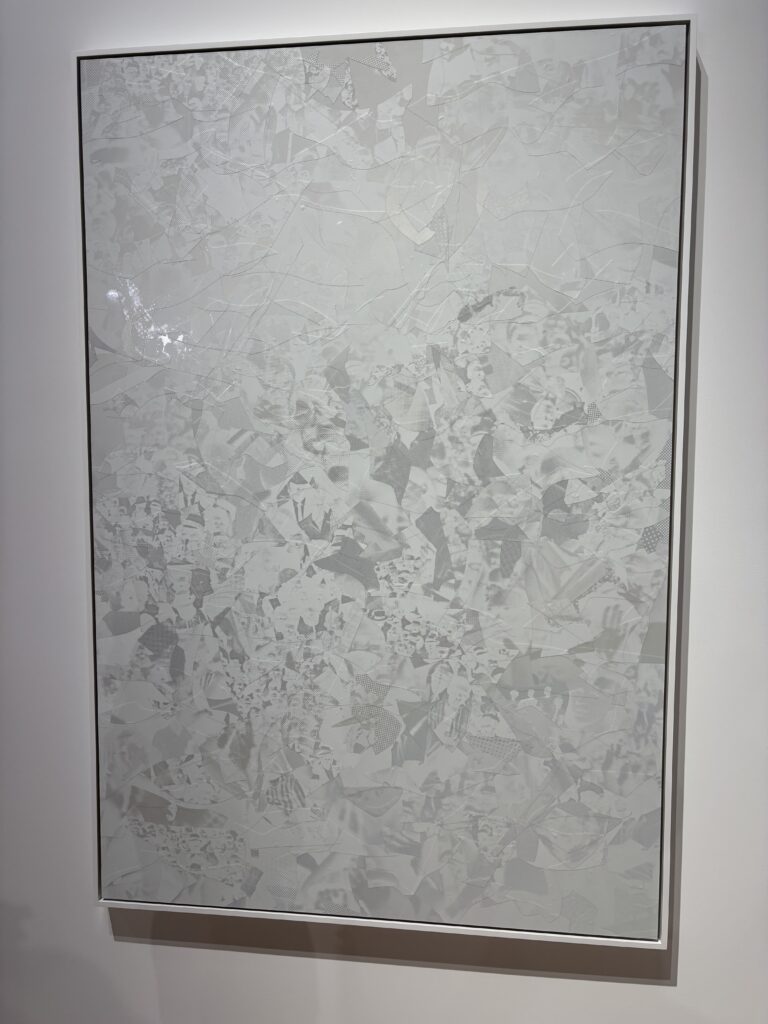
photo: “History (White Abstraction)” (2025) by Hank Willis Thomas, photographed without flash
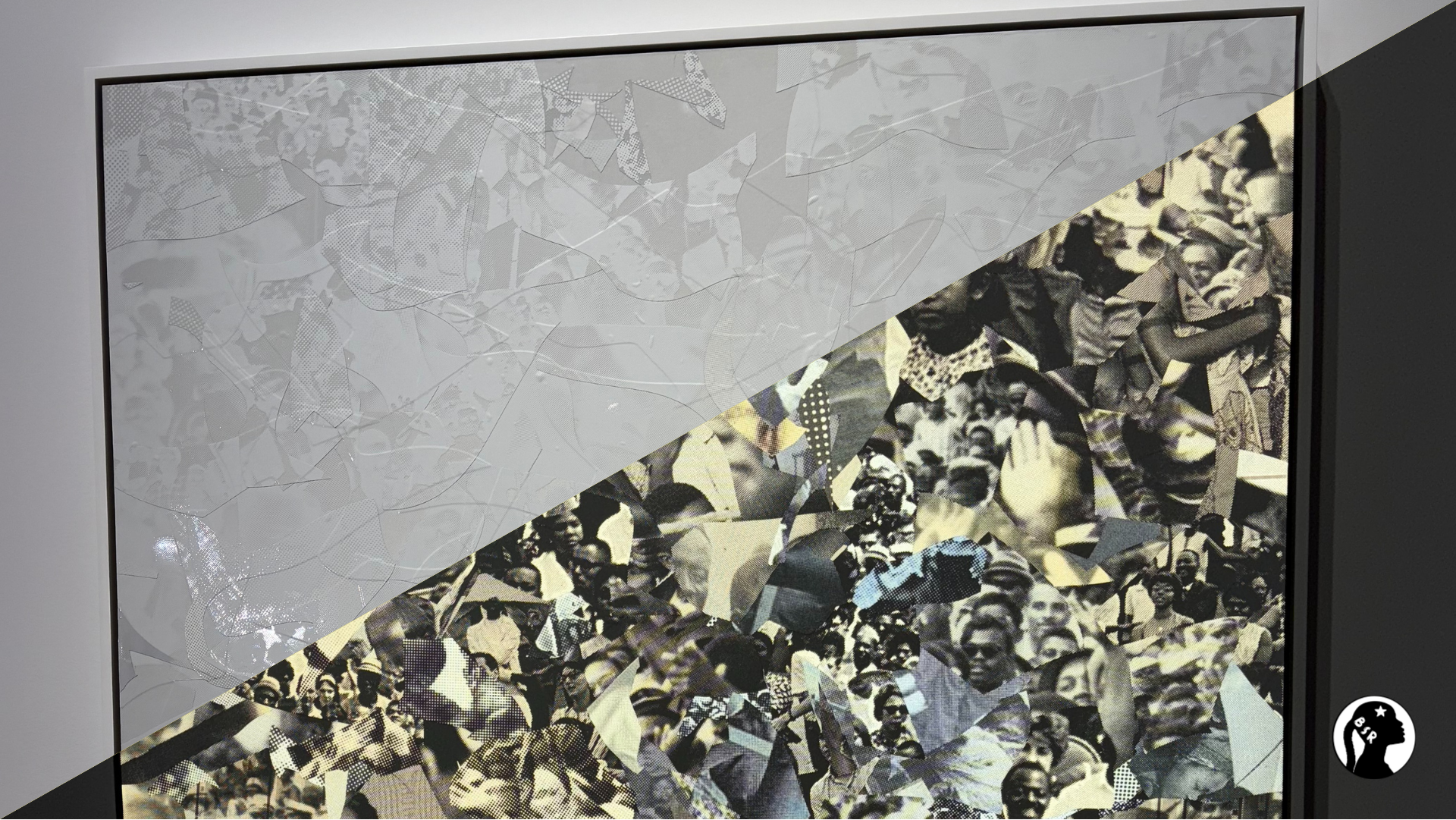
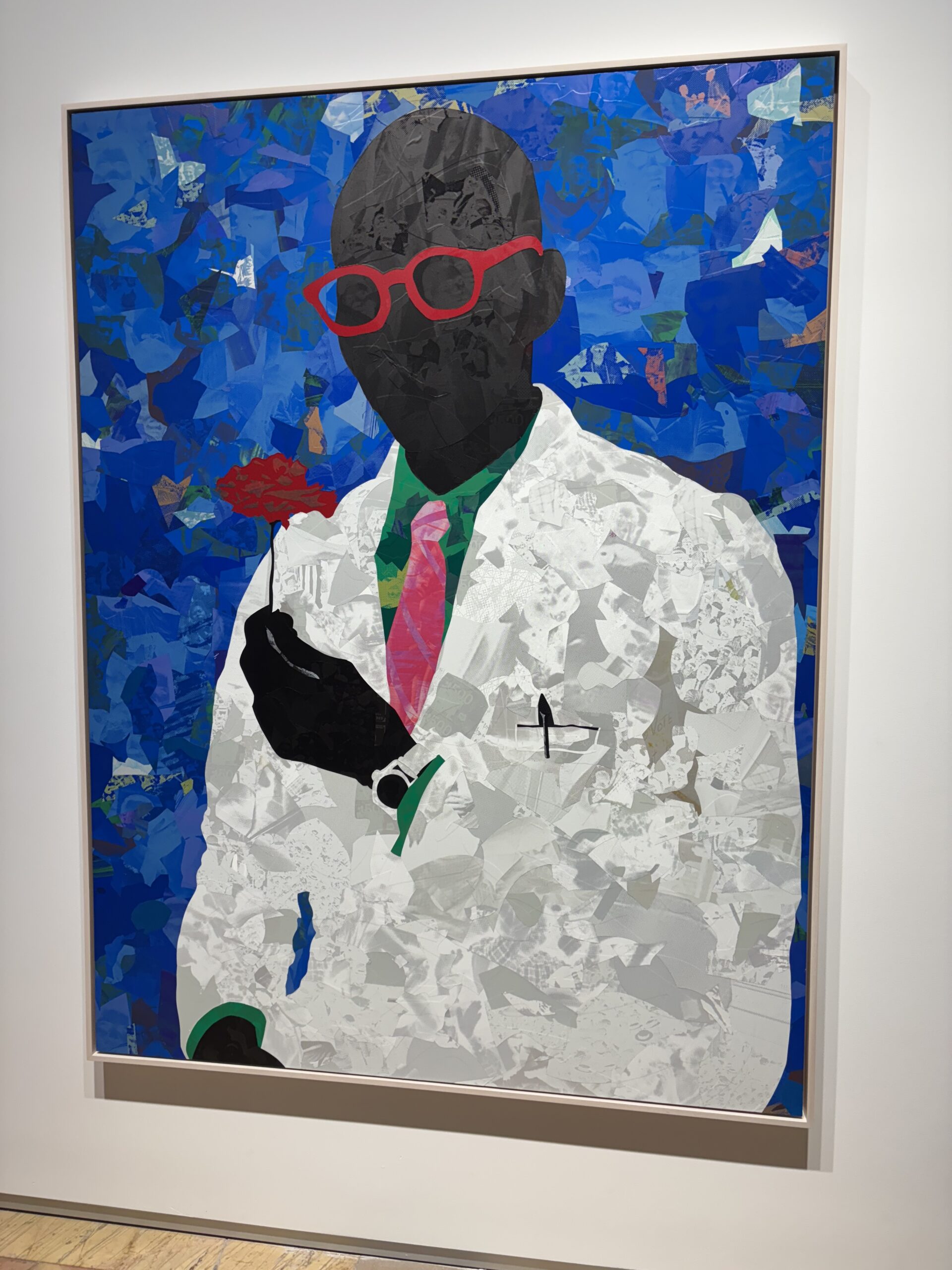
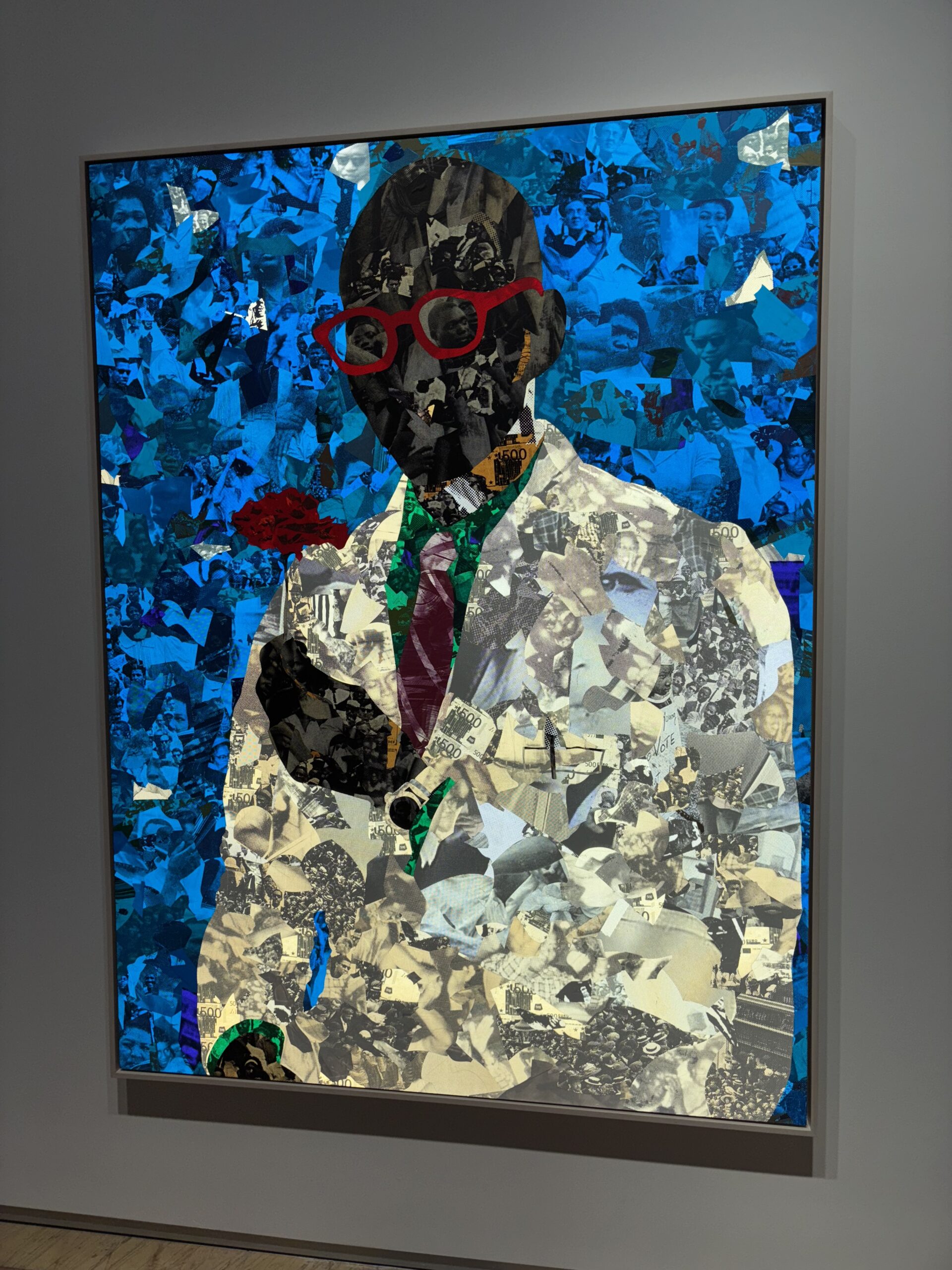
Here, Thomas continues his experimentation with retroreflective works that reveal two images in one. The first version is visible to the naked eye while the other is only visible in your photos app after you’ve captured the work with flash. History (White Abstraction) (2025) appears as decoupage in shades of white, the layers of irregular shapes like a monotone scrapbook. Flash reveals throngs of people trapped in time, with cuttings of crowds from marches and movements overlapping all the way to the edge like a cutting room floor covered in newspaper. I can’t think of another time I’ve been encouraged to use flash photography on artwork, but you’ll need it here unless the black light magnifying glasses provided by the gallery are not already in use. Most people opted to use their phones. Dense crowds at the Friday evening opening reception compounded with erratic flashes across the vault-ceilinged room had a paparazzi-like effect and lent an air of spectacle.
Adding to the see-and-be-seen vibe was the artist himself; Mr. Thomas was there posing for photos. Friends and family took turns sitting beside him in the well of Ernest and Ruth (2015) a bench disguised as a hollow black speech bubble named for his great grandfather and grandmother. The North Carolina Museum of Art, which commissioned the work and serves as the sculpture’s permanent home writes that “Thomas created these speech bubbles — made from steel plate and pipe — in hopes that Park-goers would sit and contemplate what it means to, quote, “inhabit their own speech and beliefs.””
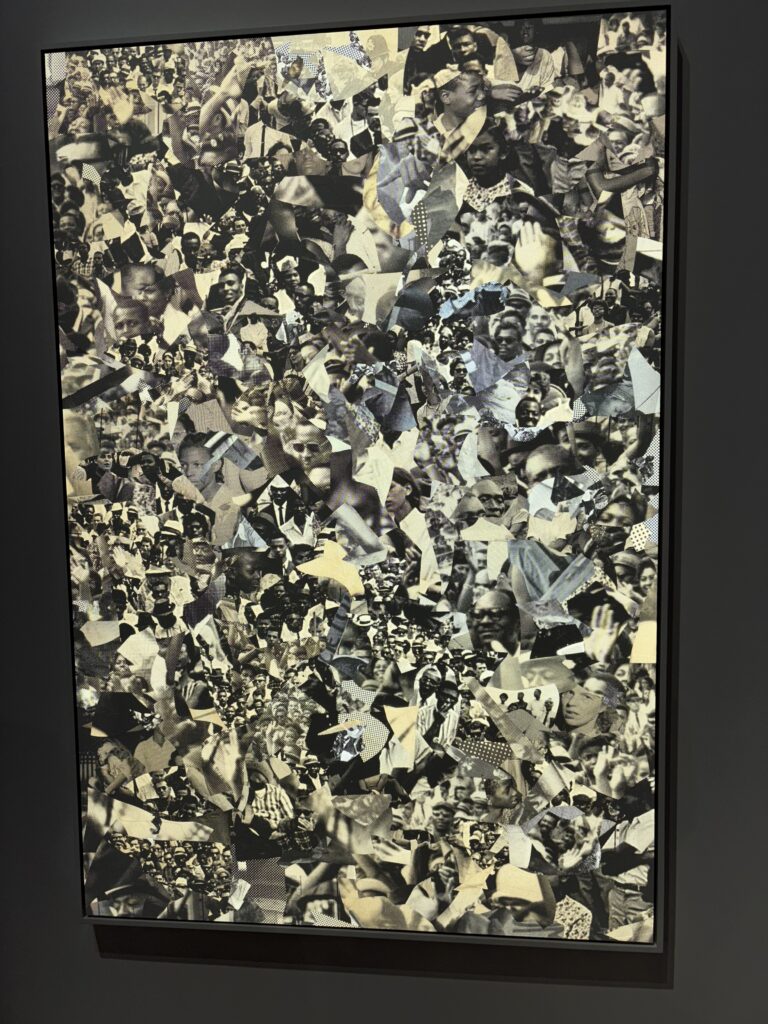
photo: “History (White Abstraction)” (2025) by Hank Willis Thomas, photographed with flash
Most of the works in I Am Many make clear Thomas’s own beliefs about love and justice and, if nothing else, it was convenient to see so many of Thomas’s artistic statements in one place, even the ones I’d seen before. A vertical version of the neon sign reading LOVERULES was on display here, cousin to the horizontal one that’s hung in the foyer of Brooklyn Museum since 2018. The sign’s familiar flicker blinks in the background of nearly all my photos of visits there. Raise Up (2016) which I’ve had the pleasure of seeing in person at the Equal Justice Initiative’s National Memorial for Peace and Justice (sometimes referred to as the “lynching museum”) is in the gallery, too, and likely to be a first-time sight for many New Yorkers, a long way from its home in the Civil Rights capital Montgomery, Alabama. In the 25-foot long sculpture, the heads and raised hands of 10 men emerge from a concrete block built on a slope. Each head has the same bald shine (Thomas is also bald) but the expressions range from resolved to resigned. Without the title the direction is unclear, the men could be sinking down into the gray layer or stretching their legs upwards to break the surface. When I interpret the gray as water, the sculpture evokes riverside baptism or the Middle Passage. I’d observed the sculpture from a distance in Montgomery, where it’s just one of many in a memorial park, but here in the tight space of the Tribeca gallery, you’re forced to get up close with the men, looking each in the eye save those for whom only the brows have risen out of the block.
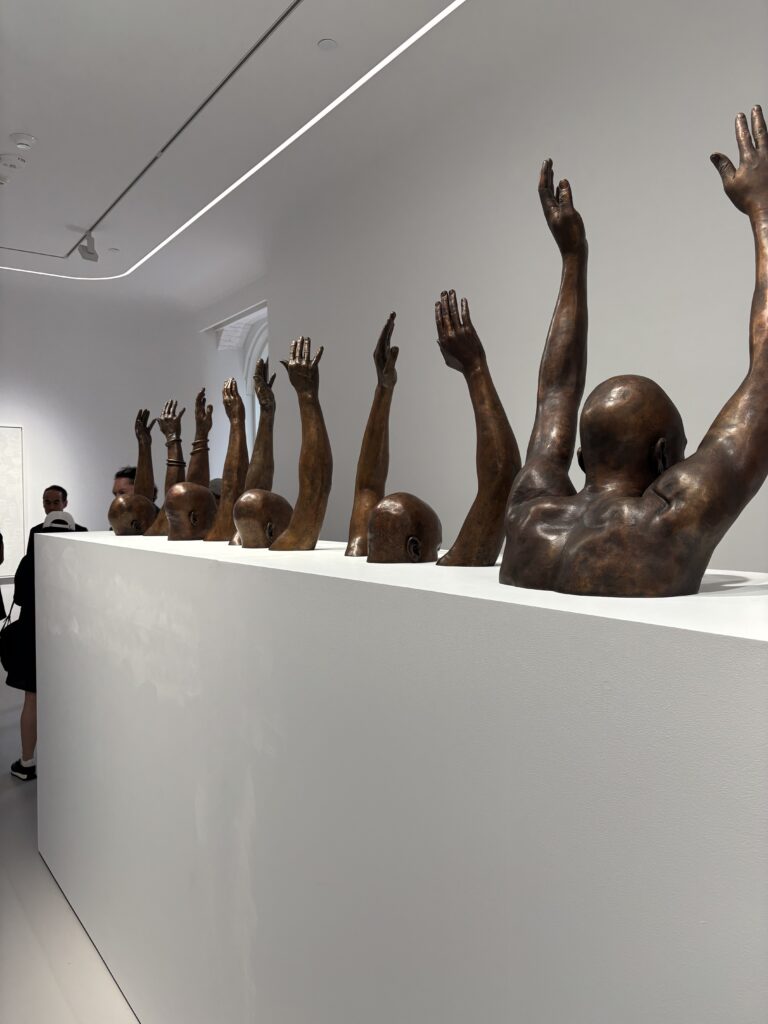
photo: “Raise Up” (2016) by Hank Willis Thomas
Each of the works in I Am Many were rich and provocative, but I left with one question about Thomas’s “speech and beliefs” regarding public engagement. In the 2023 Hyperallergic article “Are We Asking Too Much of Public Art?”, Seph Rodney teases out Thomas’s response to the criticism surrounding The Embrace.
[Hank Willis] Thomas more subtly points to what most viewers likely do not know about the work in Time magazine. He says, in an interview with Janell Ross: “I think most of us are not familiar with how intimacy played a role in social justice and civil rights.” Thus, he gently suggests to readers that they may simply not know enough, given their limited point of view on the work. He continues, “I would encourage others to reserve judgment until they experience it, just as I must reserve judgment on their responses.”
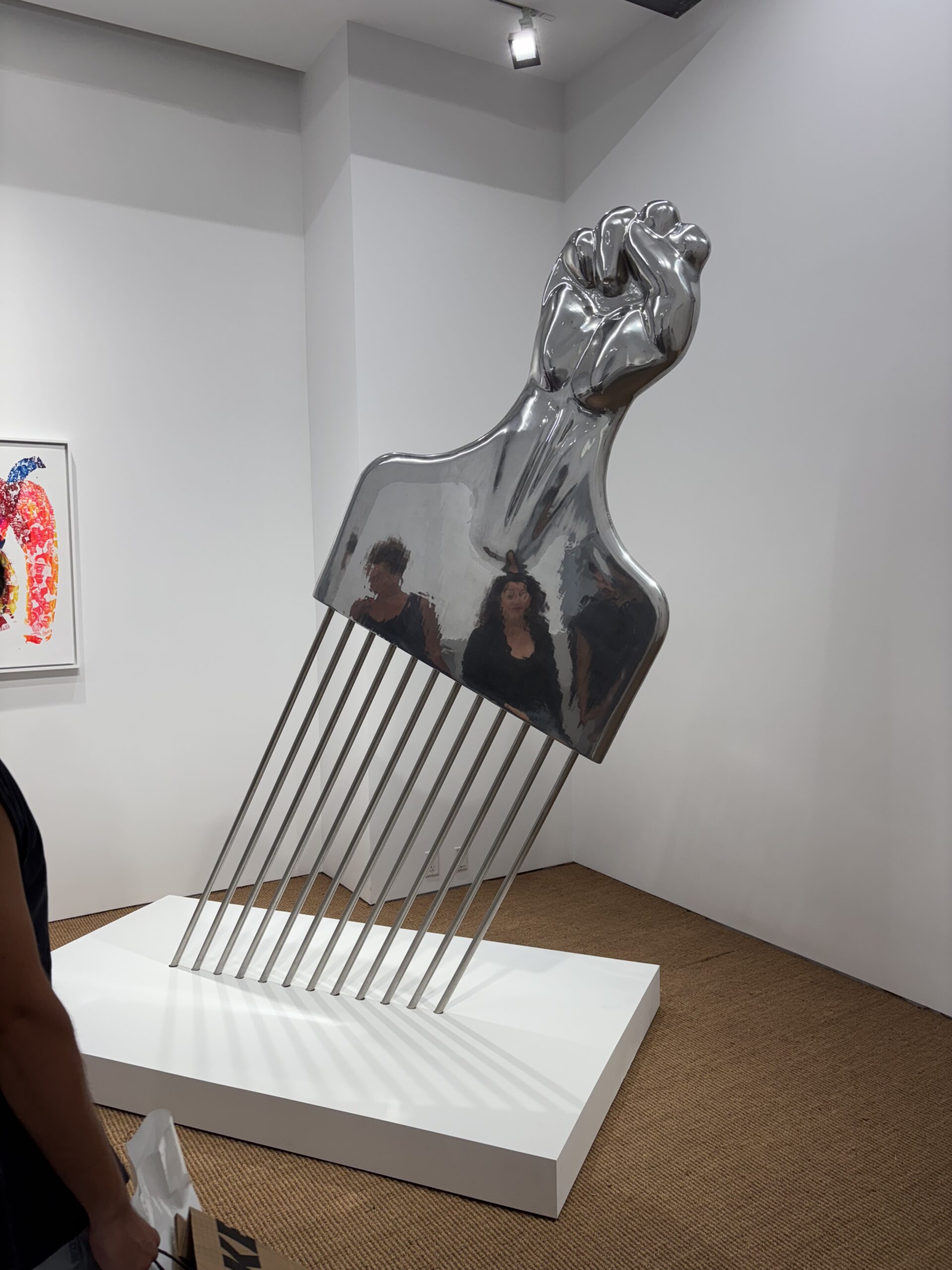
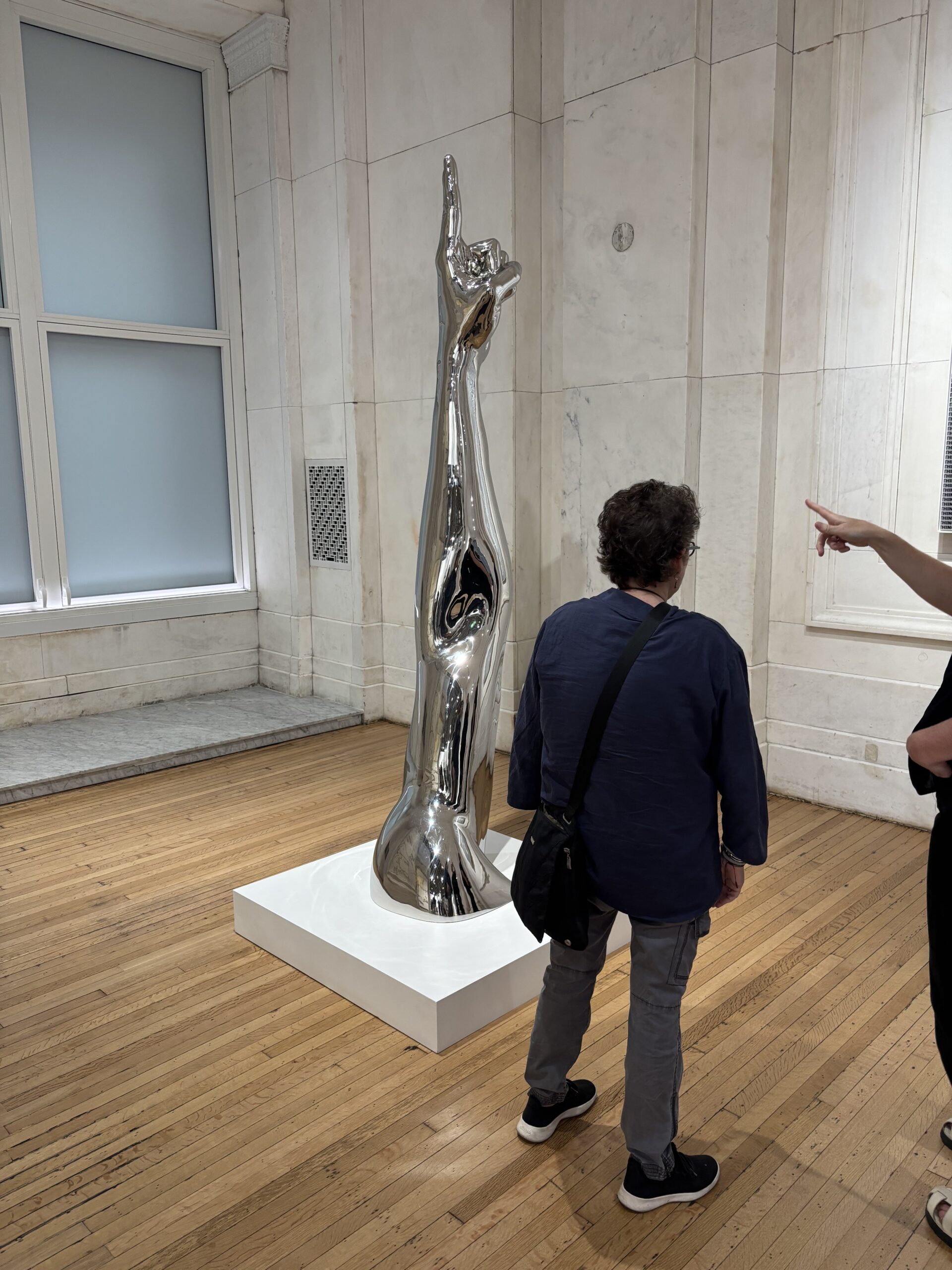
That I Am Many offered no opportunity to experience The Embrace like Thomas suggests feels like a pulled punch, a short swing to disinvite the wrong kind of buzz. At least five of the works on view were partner to public sculpture (Love Over Rules (Horizon Blue), Ernest and Ruth, Raise Up, E Pluribus Unum/Unity, All Power to All People) and three explicitly reference Dr. King and his legacy (Black Survival Guide, or How to Live Through a Police Riot, I Am Many, I am. Amen.) which make this curation the perfect company for Thomas’s most controversial piece but it’s nowhere to be found. Personally, I would have appreciated having a chance to draw my own conclusion, like when I saw Amy Sherald’s portrait of First Lady Michelle Obama in real life at the Whitney this spring.
What are we to make of a rather obvious absence? It’s possible that the unending criticism has been uncomfortable and the artist, as well as his representatives, would prefer to draw attention to the breadth of other recent, less talked about works. It’s also possible that all editions of The Embrace, which appeared in his 2022 show at Jack Shainman and listed as 1 of 5 editions, have been purchased and there is no inventory to show. After all, if the goal is to own art that stirs conversation, there’s no better buy than Thomas’s Embrace.
blacklove 🖤 and starlight 🌟
I Am Many was a solo exhibition of “large-scale sculptures, retroreflective, lenticular and textile works along with a group of mixed-media assemblages” by Hank Willis Thomas at Jack Shainman Gallery at 46 Lafayette St in Tribeca. It was on view from September 5 – November 1, 2025.
-
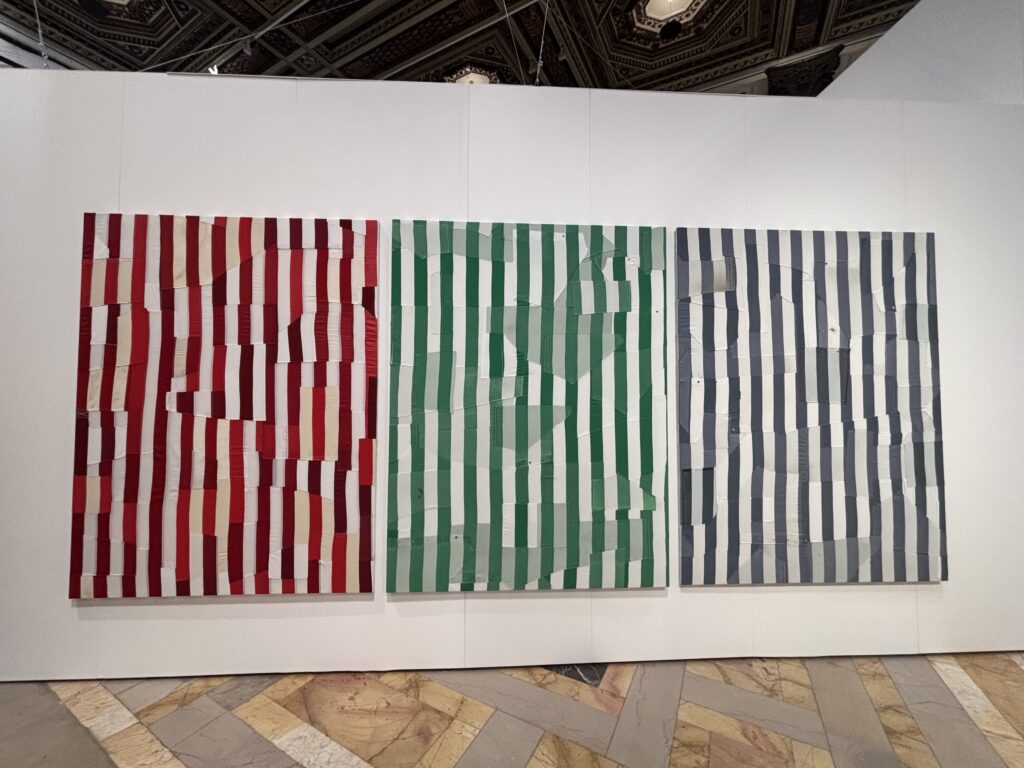
- photo: “RGB” (2023) by Hank Willis Thomas
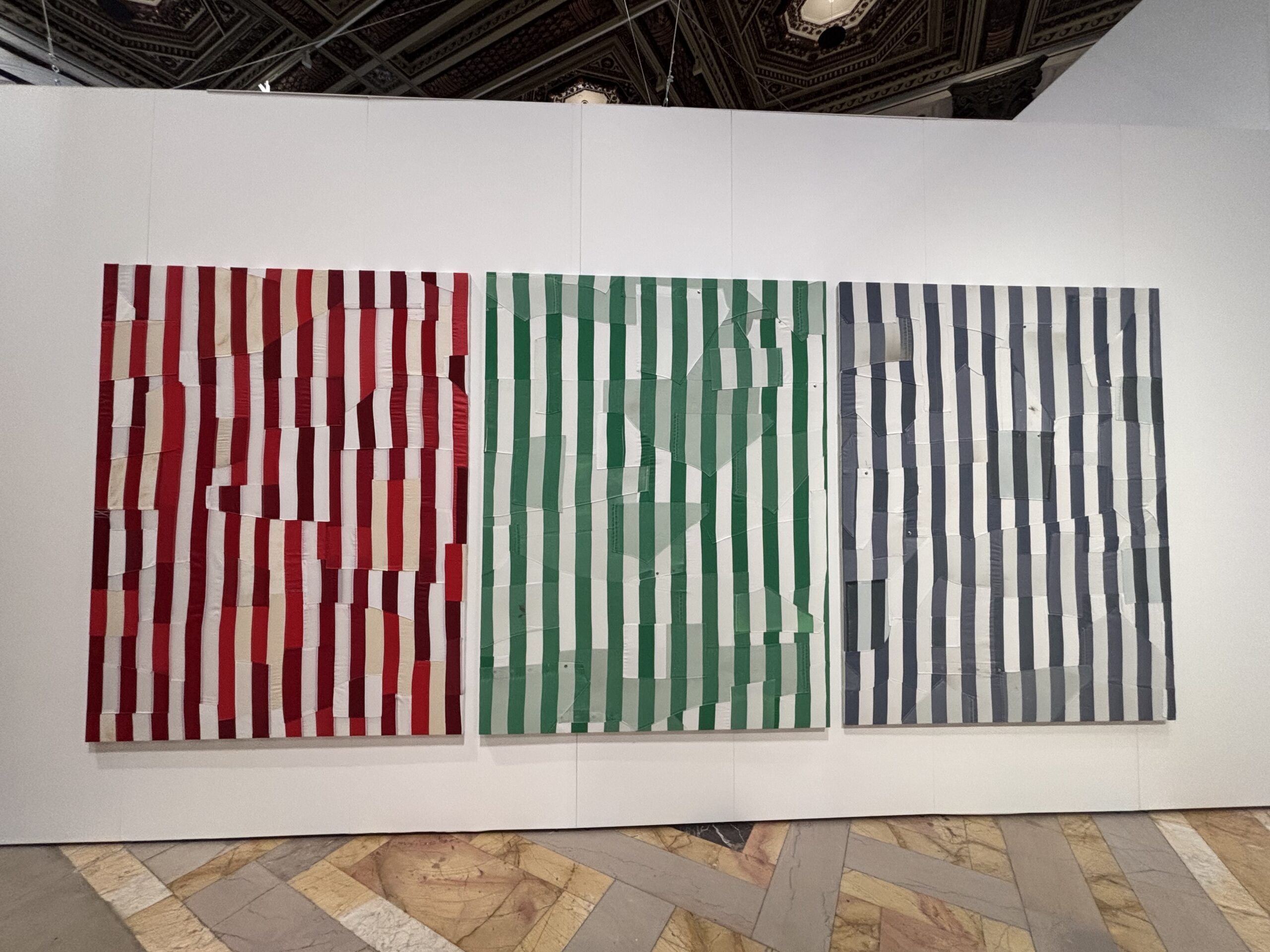
-
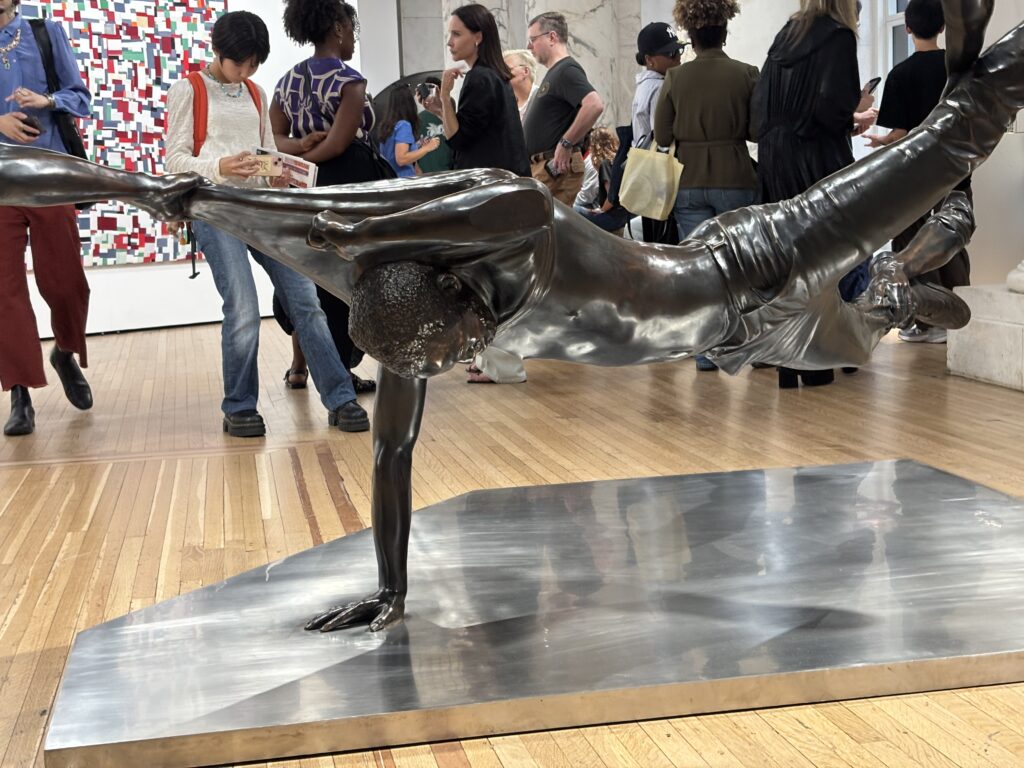
- photo: “Looking For America” (2018) by Hank Willis Thomas
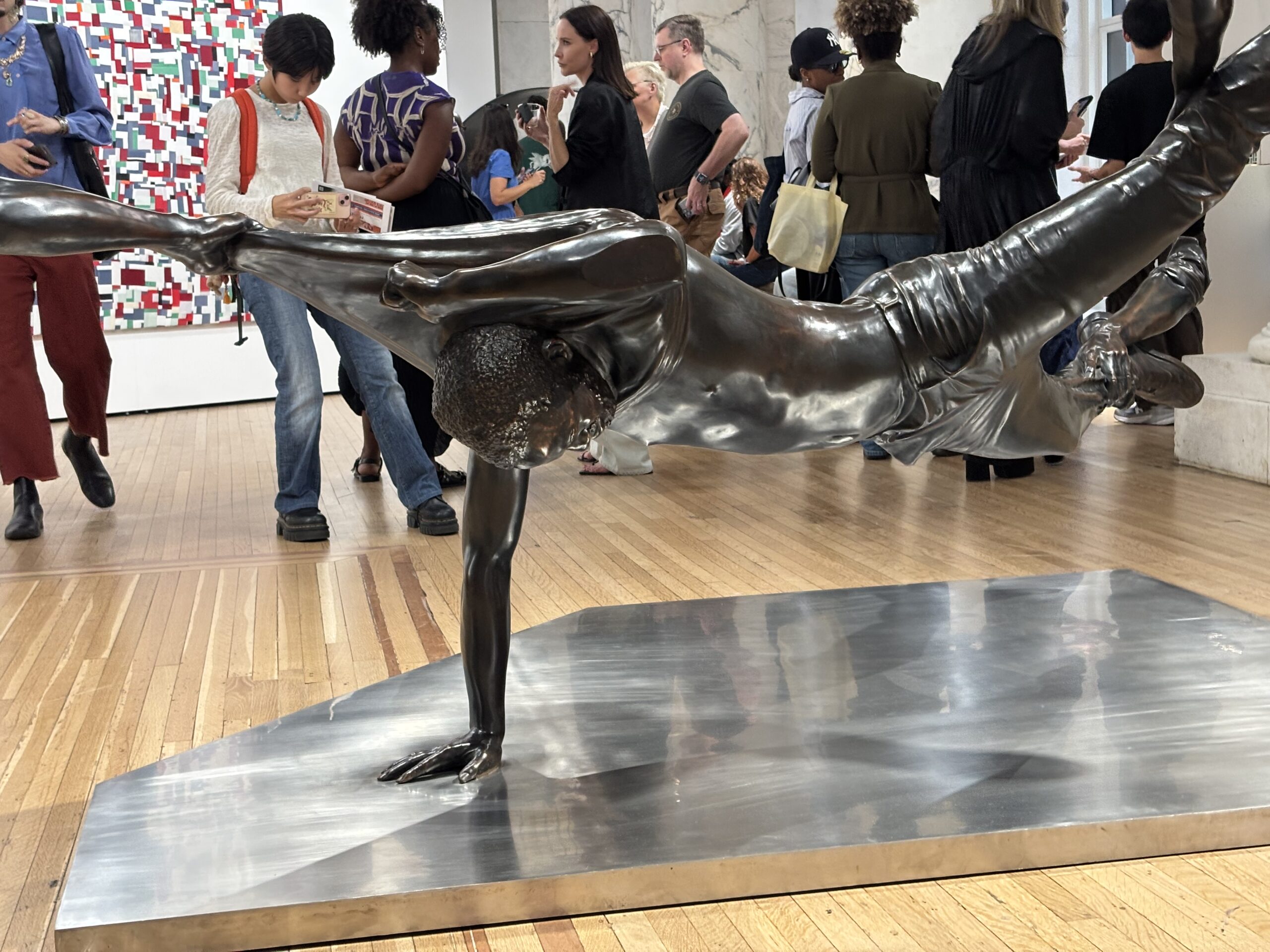
-
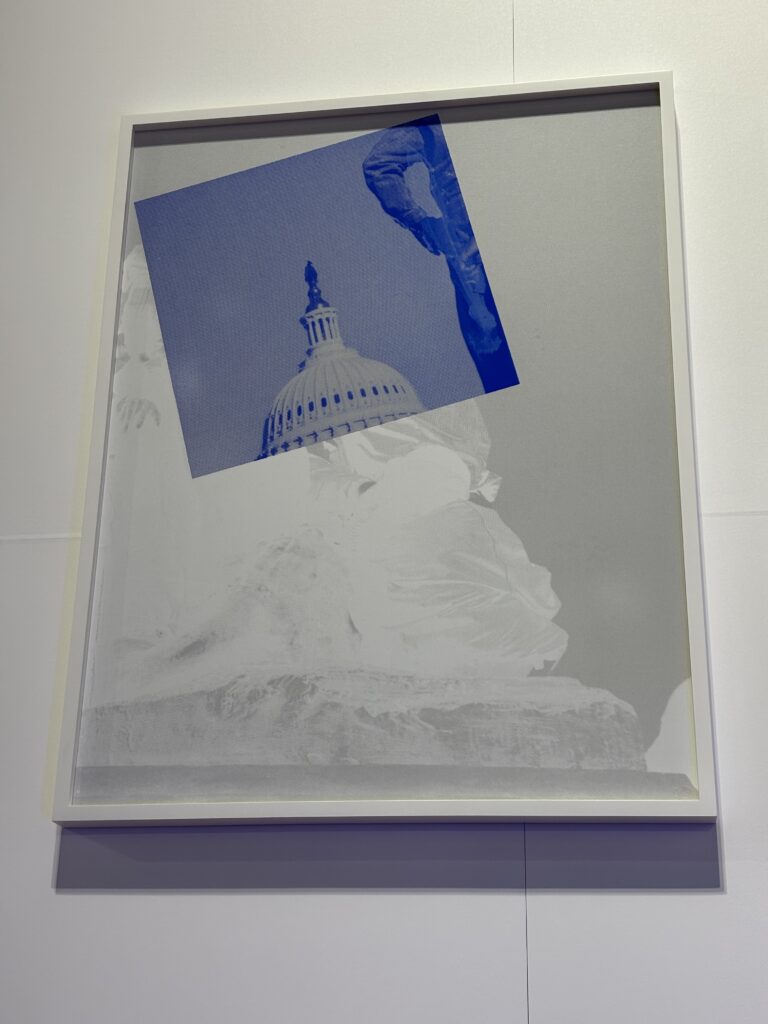
- photo: “Capital Square” (2018) by Hank Willis Thomas
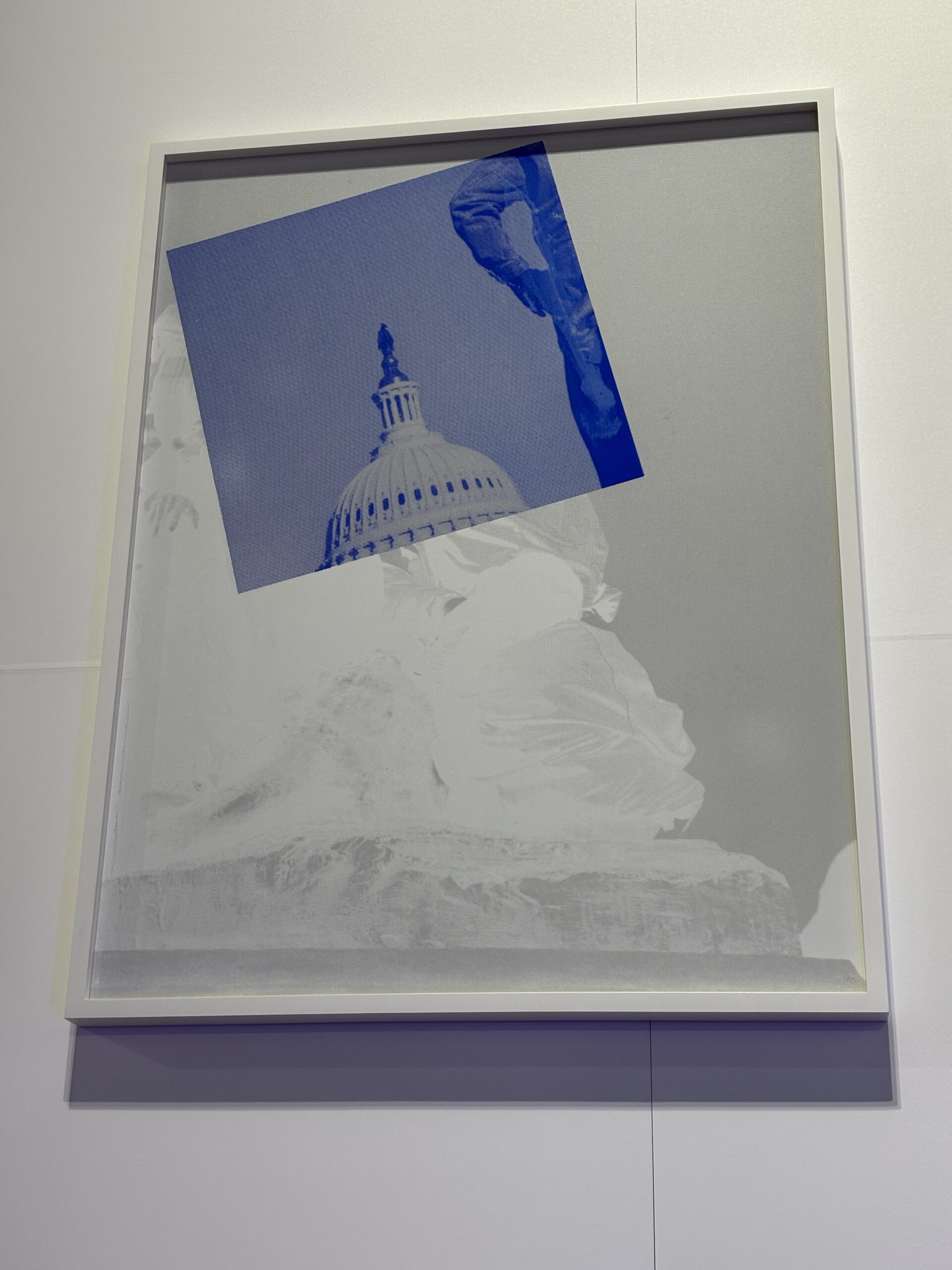
-
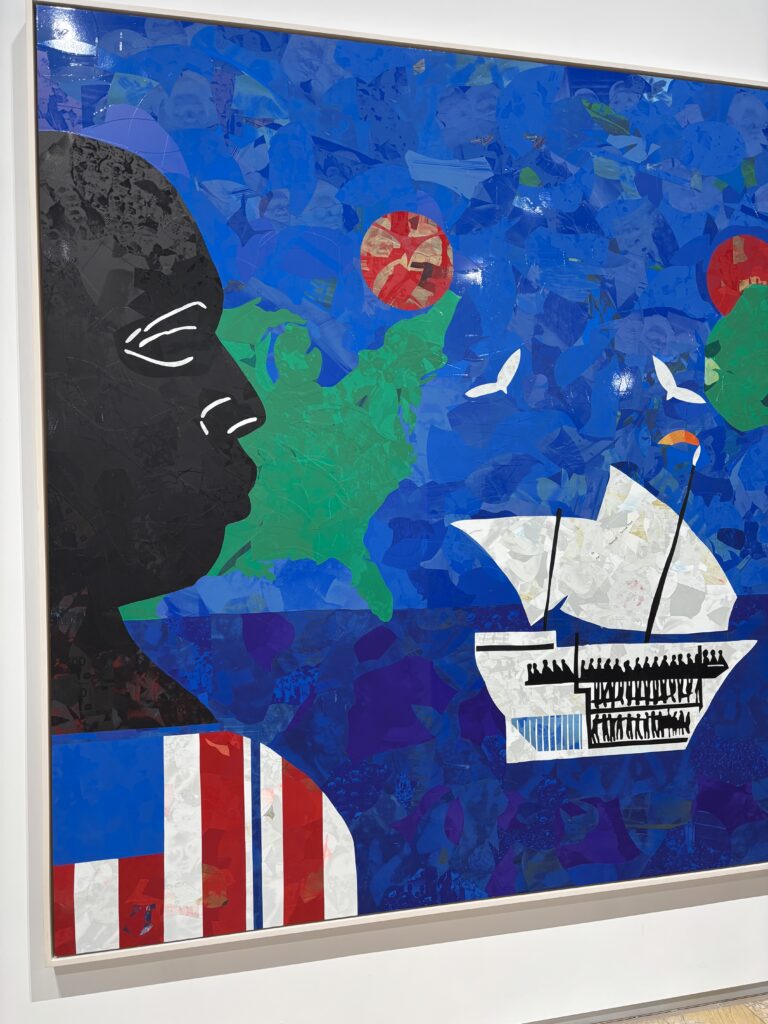
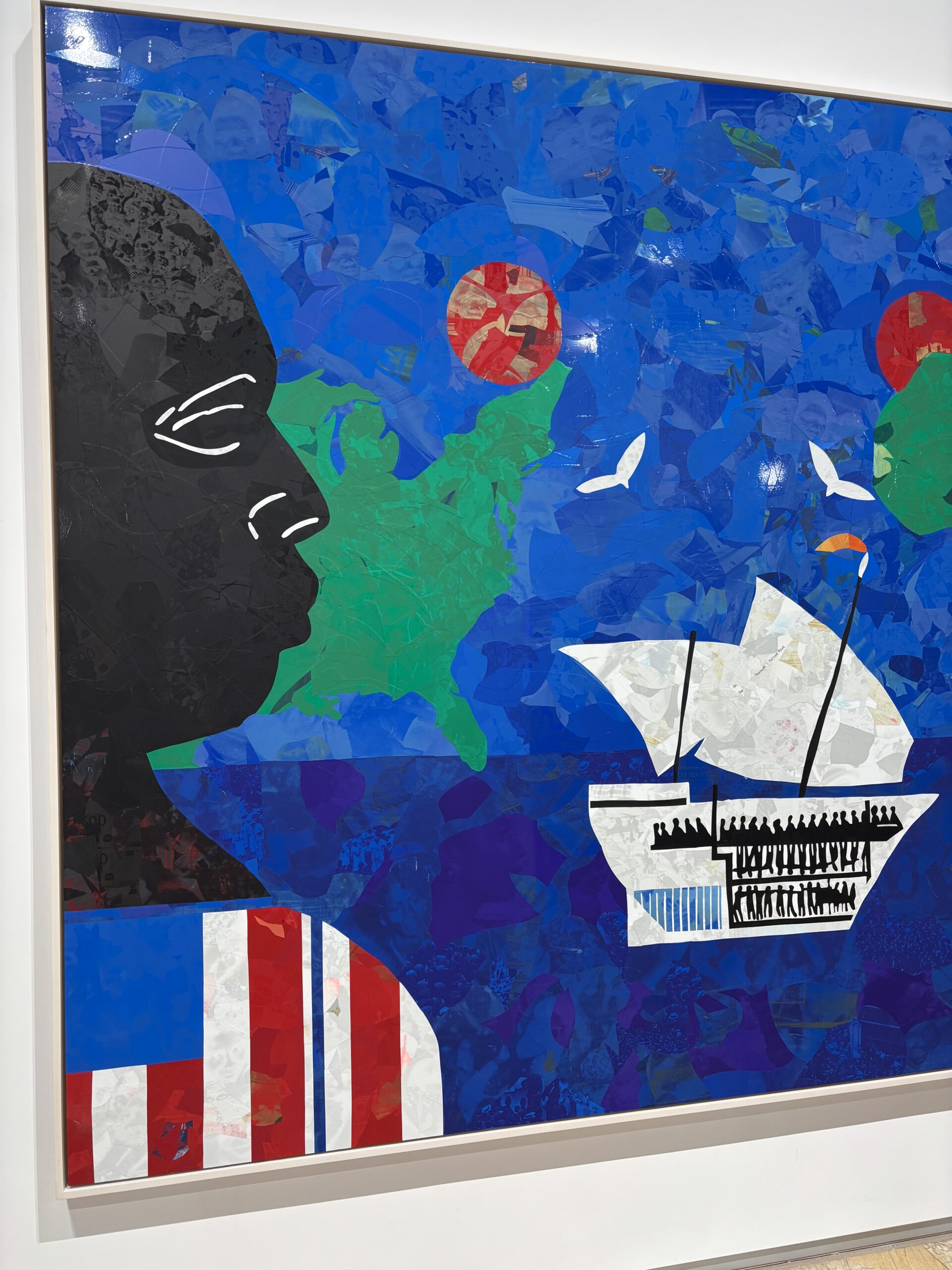
- photo: [detail, left side] “Roots (after Bearden)” (2023) by Hank Willis Thomas
-
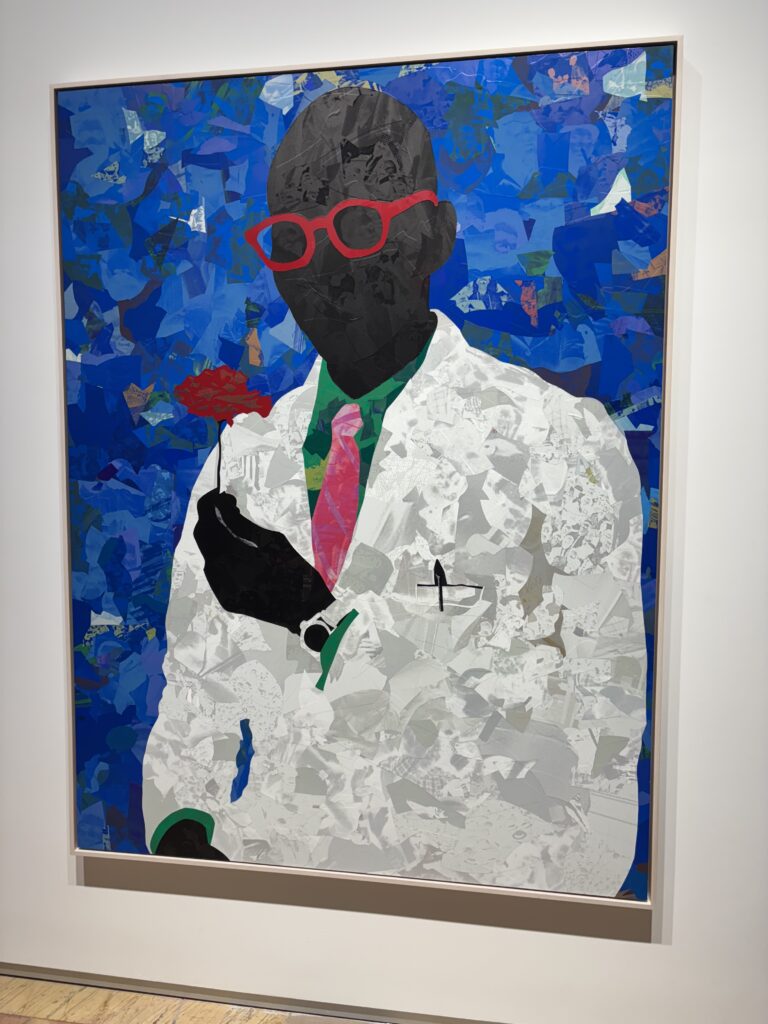
- photo: “Man with the Red Rose (after Keïta)” (2023) by Hank Willis Thomas, photographed without flash
-
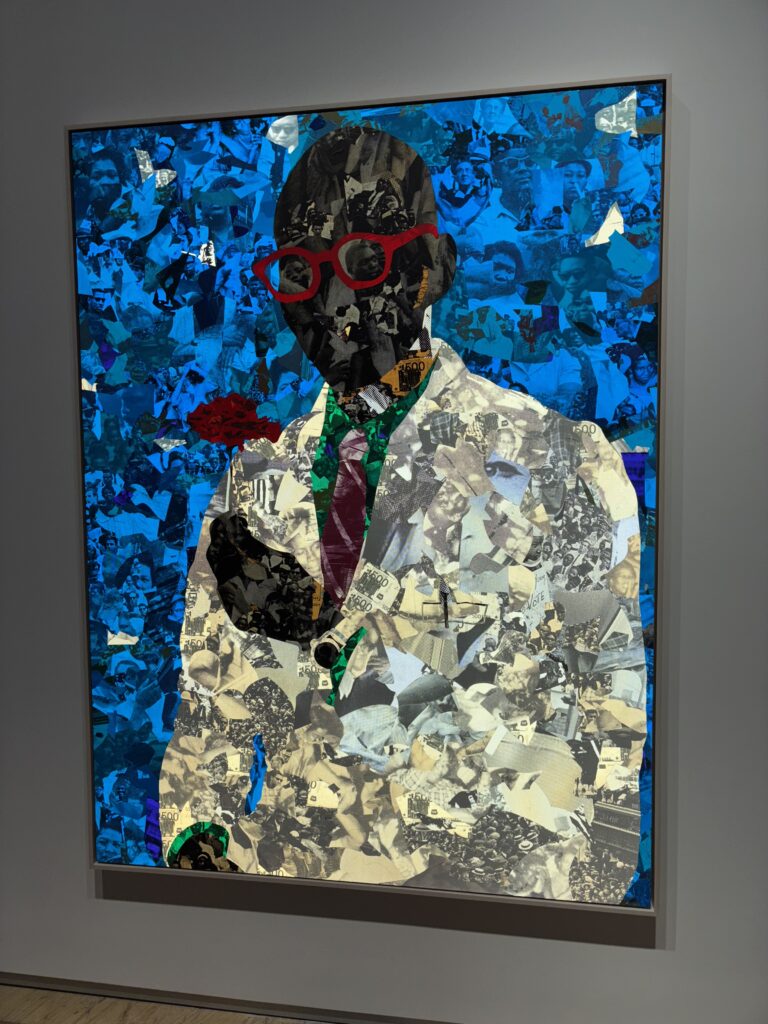
- photo: “Man with the Red Rose (after Keïta)” (2023) by Hank Willis Thomas, photographed with flash
-
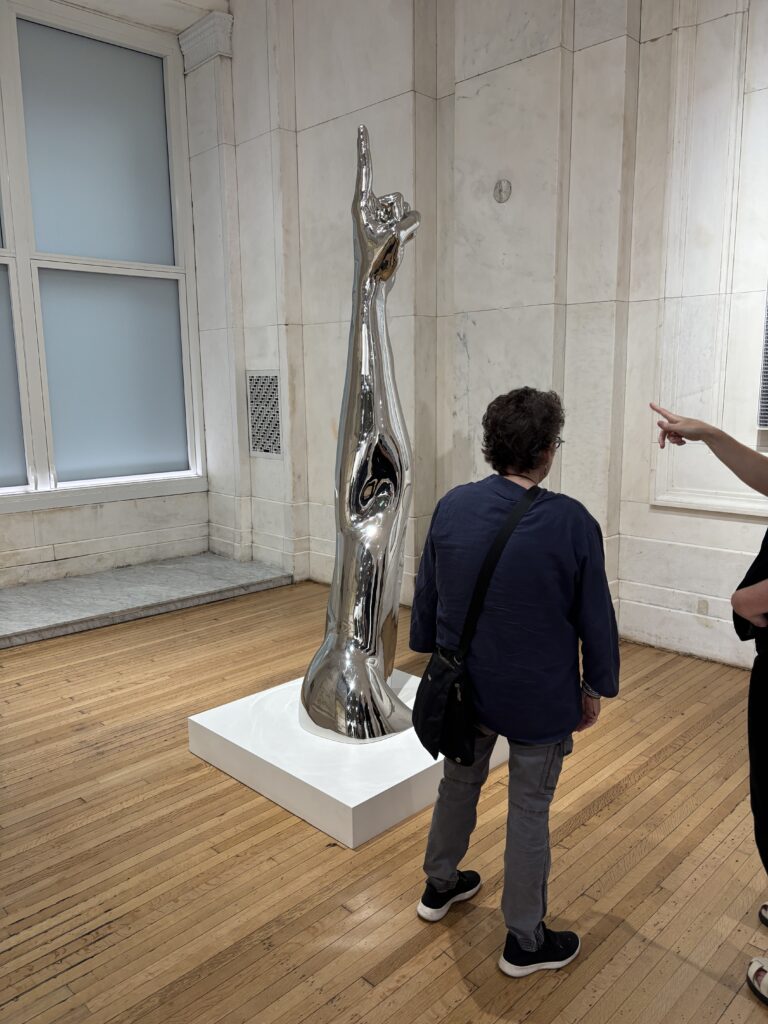
- photo: “E Pluribus Unum” (2020) by Hank Willis Thomas
-
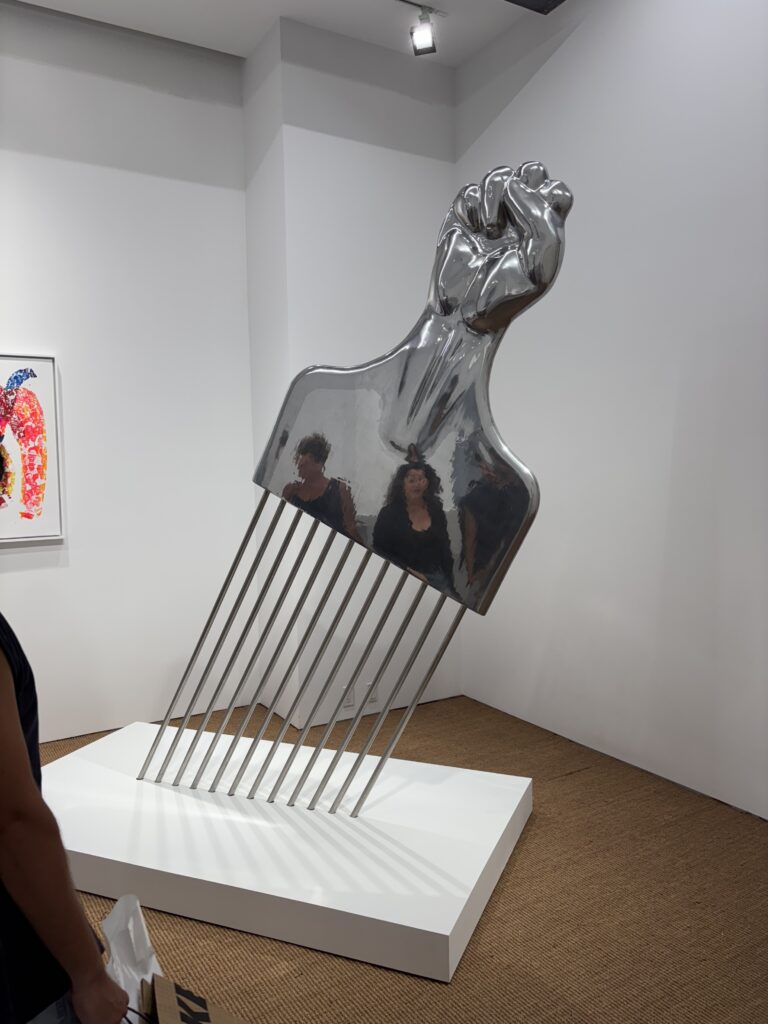
- photo: “All Power to All People (Reflection)” (2021) by Hank Willis Thomas