

Tony Nominated ‘Best Play’: The Balusters
Finally, a play for the multi-million-dollar homeowners struggling to communicate with their cross-racial neighbors
“Exercising my free will” is the internet’s latest catch phrase. While I wouldn’t consider myself to be old per se, I am old enough to remember its predecessors: “do it for the plot” and Drake’s rhythmic motto YOLO (you only live once). Seeing these ideas rebranded feels like perching in a rocking chair out front, clucking at adolescents passing by.
This time around, the sentiment is far less glamorous than a last minute flight to Miami or sending a “you up” text to your Humanities class crush. If TikTok is any indicator, “exercising our free will” means eating tinned fish (aka canned sardines) for dinner and paying for yet another ‘holy grail’ face serum with Klarna. Is it a cause or symptom of heterofatalism that single young women are “exercising their free will” by decorating their apartments like Barbie dream homes, complete with flamingo wall paper and lip-shaped hot pink couches, as dating stalls and marriage rates dip? It’s tough to be sure, but all of these scenarios seem like neon green recession indicators affixed to the bottom half of our current K-shaped economy.
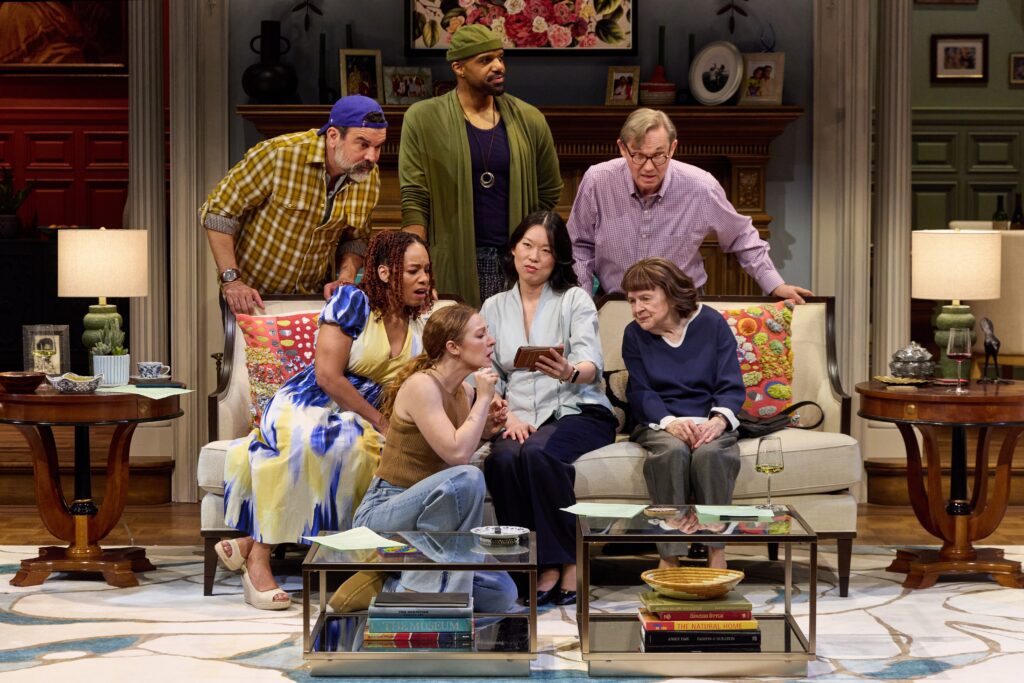
Kayli Carter, Anika Noni Rose, Margaret Colin, Ricardo Chavira, Carl Clemons-Hopkins, Jeena Yi, Maria-Christina Oliveras, Michael Esper, and Richard Thomas. Photo by Jeremy Daniel. Courtesy MTC.
The characters in The Balusters can’t relate. Their idyllic block of historic townhouses is situated on the upper crust of the K-shape in Vernon Point, a town that could be anywhere but certainly seems to be a New York City suburb like Westchester. They gather at each others’ homes for neighborhood association meetings, which they take turns hosting, and discuss pressing issues like sidewalk appeal, package theft, and trash removal. Riveting stuff. The king of the association is Elliot Emerson (Richard Thomas). He grew up in Vernon Point and gets credit for securing the neighborhood’s historic status that keeps the list prices high and the neighbors like-minded, which he handedly engineers as a real estate agent. Elliot is the literal gatekeeper and the literal judge; when he gavels, the others listen.
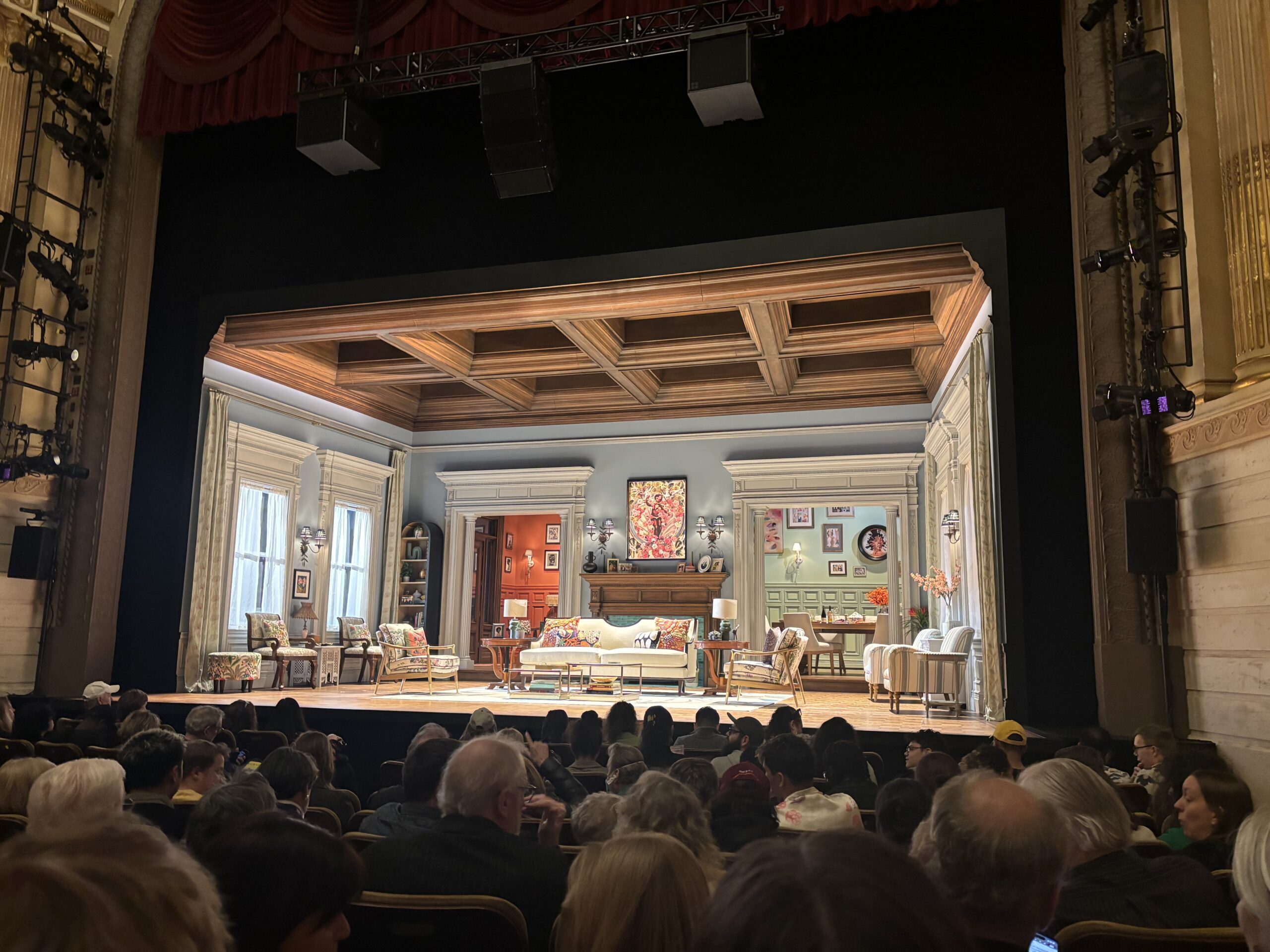
The meetings are hosted by Kyra (Anika Noni Rose), a new arrival to the neighborhood from Baltimore. Kyra is an ex-financier who’s moved to Vernon Point with her husband and two kids. Derek McLane’s shrewd set design channeled clues about Kyra, or at least, who Kyra was trying to be. A large painting above her fireplace depicted a brown-skinned woman with an afro emerging from a sea shell, like Kehinde Wiley had interpreted “The Birth of A Venus”, there was African art in the carrot-colored entryway, pink pillows with mossy tufts of yarn, and, on the side table near the window, a paperback copy of Toni Morrison’s Beloved. This was no coastal grandmother, Southern Living-magazine styled sterilized sitting room — this was a Black woman’s home. The kind of Black woman who pays tithes, grew up reading Essence, stays active in her sorority, keeps a standing hair appointment for her daughters and herself, and had a closet full of Coach bags before Chee Smalls came aboard. And maybe that’s who Kyra is when it’s just family, but those neighbors had her ‘spooked up’.

Derek McLane’s set for The Balusters. Photo by Jeremy Daniel. Courtesy MTC.
This is where the friction started for me. Kyra seemed recognizable until the rubber hit the road. She looked on when the neighbors accused local “hooligans from the projects” of stealing packages off the stoops. She’s unkind to her housekeeper. And most alarmingly, when Elliot asserts that it’s his job to “crack the whip”, she’s unfazed. I started to wonder if she’d even read Beloved, or if she just put it in her living room for decoration. Morrison was inspired to write the novel after reading a newspaper clipping about a woman who killed her own children rather than see them be slaves; it’s essentially a ghost story about the epigenetic impacts of slavery. I feel sort of bad picking at Lindsay-Abaire’s inability to write Kyra in a fully-realized way, but then again, no one asked him to place a Black woman at the center of this story. Kyra is a speed hump in disguise as a fulcrum, and it’s a shame she’s so toothless. She’s trying to tread carefully with her new neighbors because of a previous incident in Baltimore (I won’t spoil it for you), but it can’t be the case that she’d prioritize adult feelings over her own children’s safety. If the goal was to steer her away from the Angry Black Woman stereotype, this was too severe a correction.
Kyra is flat — Black only in skin tone and home decor (maybe she hired a decorator!) — just like Elliot, who’s a stand in for the white male traditionalist who doesn’t want to let go of the past. It felt like deja vu, watching Thomas’s performance as Elliot bleed over from his role as Editor Charles Webb in the 2024 revival of Our Town (another Richard Thomas + Kenny Leon collaboration). This is not a dig at Thomas, but at the script and direction: for all the talk of villain-izing white men, was there no way to make this character seem complex or unique? The remaining characters in the ensemble might as well be named after their identities. We have Brooks (Carl Clemons-Hopkins), or “Gay Black Guy”; Willow (Kayli Carter), or “Woke White Nepo-Baby Vegan”; and Issac (Ricardo Chavira), or “Self-Made Hispanic Landscaper”…plus 5 more. On cue, the Gay Black Guy responds strongly to anything dealing with race or sexuality. The Landscaper is a proponent of law, order, and consequences. This static bunch of characters, who return to their same unassigned seats in the semi-circle, are just as predictable to each other as they are to the audience: the Older White Woman Know-It-All knows to get a rise out of the Woke White Nepo-Baby Vegan just by wearing a fur coat to the meeting. With every character running on identity auto-pilot and Kyra defanged, the voice of reason comes not from a Magical Negro, but instead from a Hard Working Immigrant. In Lindsay-Abaire’s vision, the only inputs to our beliefs and motivation are race and class — and no feedback from our neighbors will compel us otherwise.
This play seems to want to prove the point that cross-racial, cross-gender, and cross-generational conversations are more work than they’re worth and that harmony hinges on getting the white guys out of power. (Maybe that last part is true and Lindsay-Abaire and I agree on something.) But there’s one cross-group that this play didn’t explore: class. All of these character archetypes live in the same neighborhood of million dollar homes, they each have enough spare time to attend these meetings and join committees, they even swap housekeepers. Exercising free will in this world just means nosing around first-world problems: stone or aluminum siding? French or farmhouse doors? Public or private schools? Traditional or modern balusters (for which the play is named)?

Richard Thomas and Anika Noni Rose. Photo by Jeremy Daniel. Courtesy MTC.
At the top half of the K-economy, where I’d imagine most of the Tony voters exist, there is one social-identifier that allows them to find common ground when politics prove divisive: wealth. To people like that, everyone has a price at which they’ll no longer be an obstacle. When Elliot makes this point to Kyra near the end of the play, she fusses at him, only for the audience to later find out she’s throwing stones from her own glass house. I doubt this show will resonate with people who enter congregations like these as opportunities to listen, connect, and empathize, a way of being that’s not beholden to any specific race, education level, or generation. Lucky for this production, there are plenty of people who enjoy futile clashes of identity politics and tone-deaf discussions of wealth. I doubt we could interest them in seeing how the other half lives and even if we could, it may not make a difference. If the melodramatic ongoings of Vernon Point are to be believed, rich people gonna rich.
blacklove 🖤 and starlight 🌟
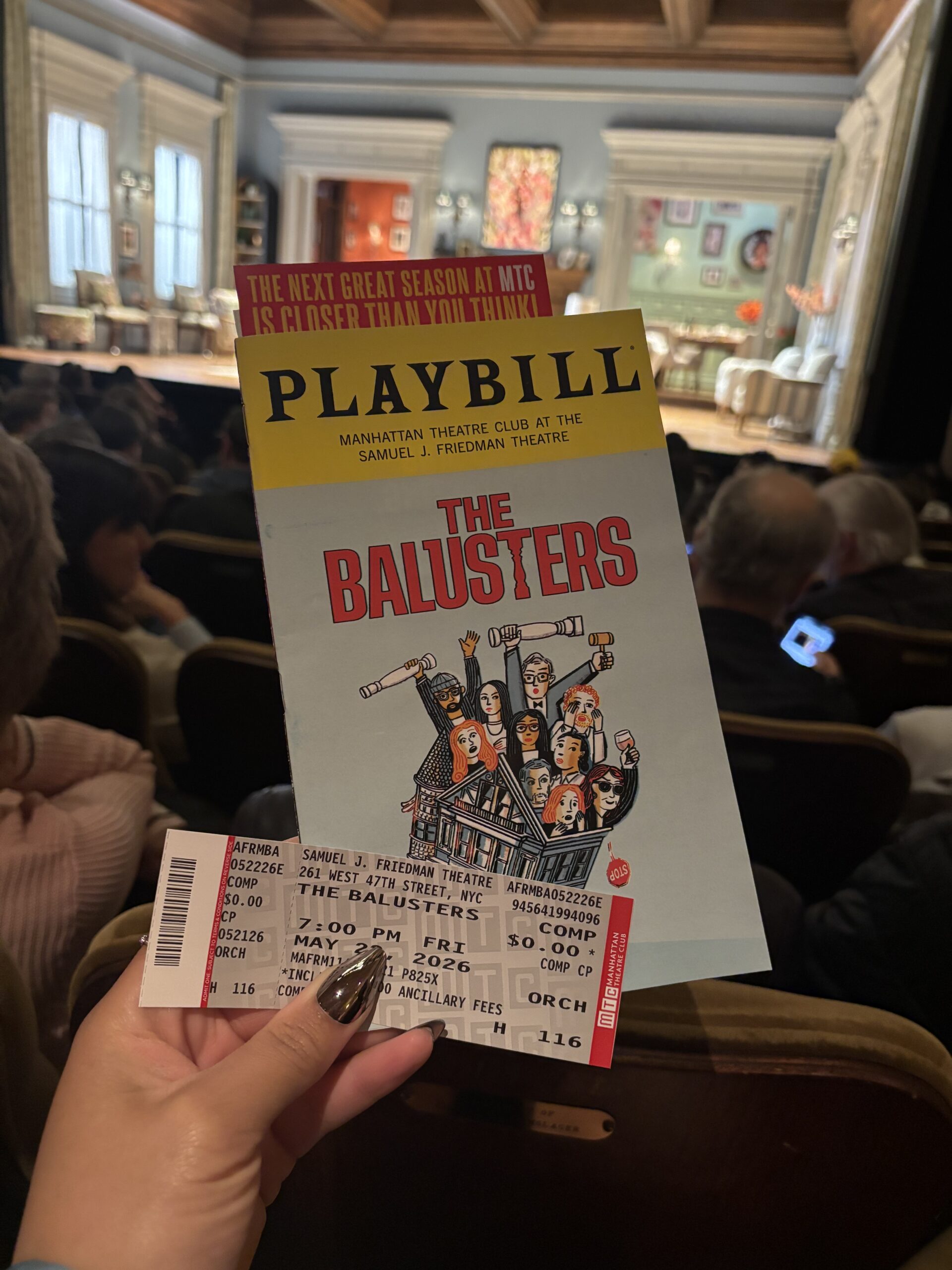
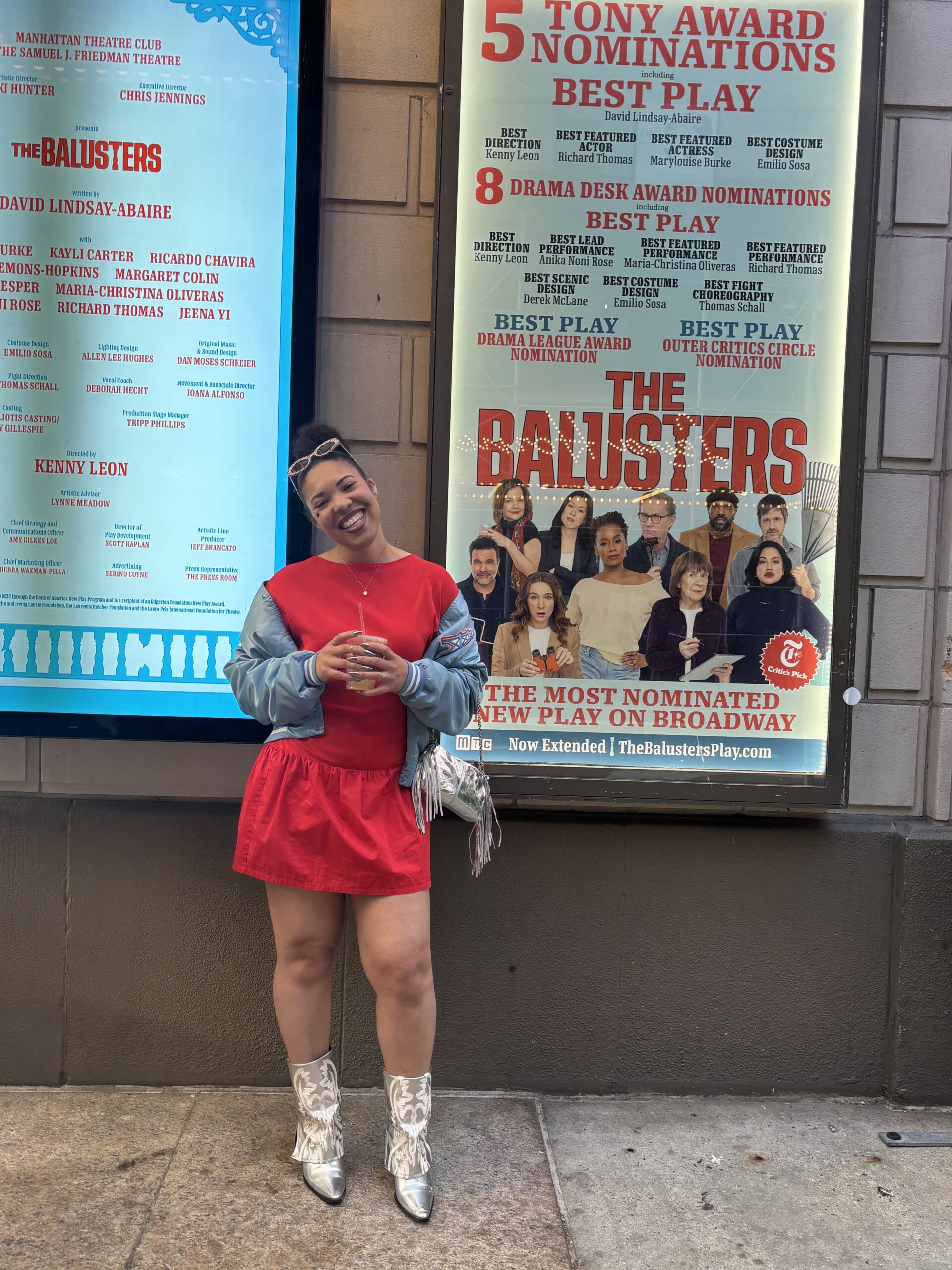
The Manhattan Theatre Club’s Tony-nominated production of The Balusters opened at Samuel J. Friedman Theatre on April 21, 2026. The play was written by David Lindsay-Abaire, directed by Kenny Leon (This World of Tomorrow, Home), and features Marylouise Burke, Kayli Carter (This World of Tomorrow), Ricardo Chavira, Carl Clemons-Hopkins, Margaret Colin, Michael Esper, Maria-Christina Oliveras, Anika Noni Rose (Wonderful Town), Richard Thomas, and Jeena Yi. The play received 5 Tony nominations: Best Play, Best Costume Design, Best Direction. Ms. Burke and Mr. Thomas were nominated for Best Featured Actress and Actor, respectively. I received a press ticket for the performance on May 22, 2026 and offer my thanks to The Press Room.
The production will run through June 21, 2026. Tickets for evening shows are $88 and up.