

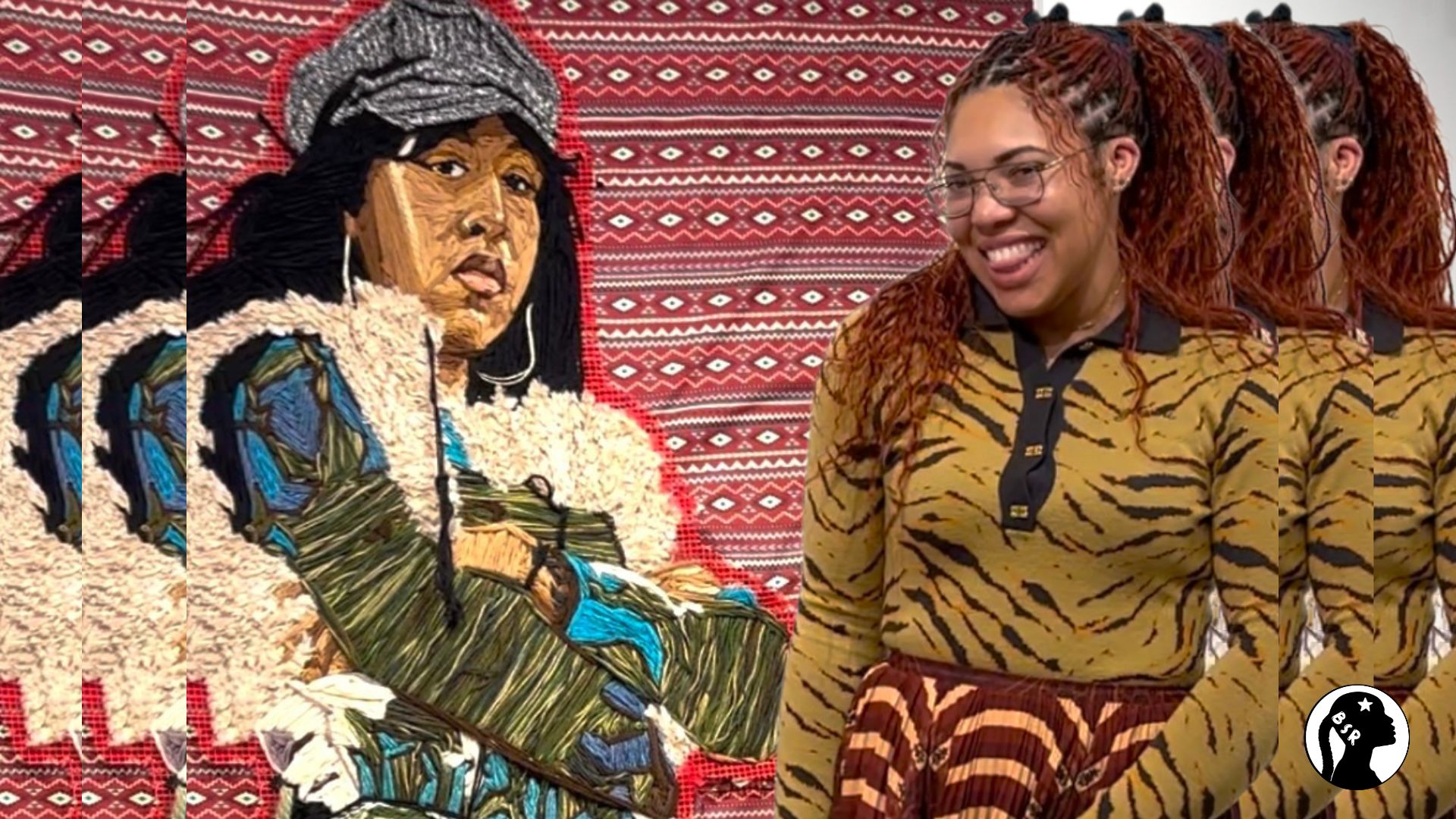
Taking Up Space: New Works by Kandy G Lopez
Kandy G Lopez is back after a splashy solo show at the top of the year
“It’s an interesting position — to be both.”
Natali and I looked up at a portrait of a man and woman in blue feathered regalia fit for playing mas at Carnival. The man had taken a knee, with his sneaker dangling off the mesh while his eyes, inset and beady, stared you down. The woman positioned over his left shoulder, dressed in the same blues but with an elaborate headdress that soared out like wings and reached down to her waist, had a softer disposition. The portrait has all the hallmarks of a painting — lighter shades used to show a glint of shine on a brown bicep or cheekbone, eyes that hold secrets, and an approach to perspective that seats the viewer below the subject no matter how low on the wall the work is hung — but it’s rendered in yarn handwoven through mesh. DNA and Royalty is a “fiber painting”, so named for the real people who posed for the portrait, but also a depiction of cultural legacy carried, literally, on the shoulders of its descendants.
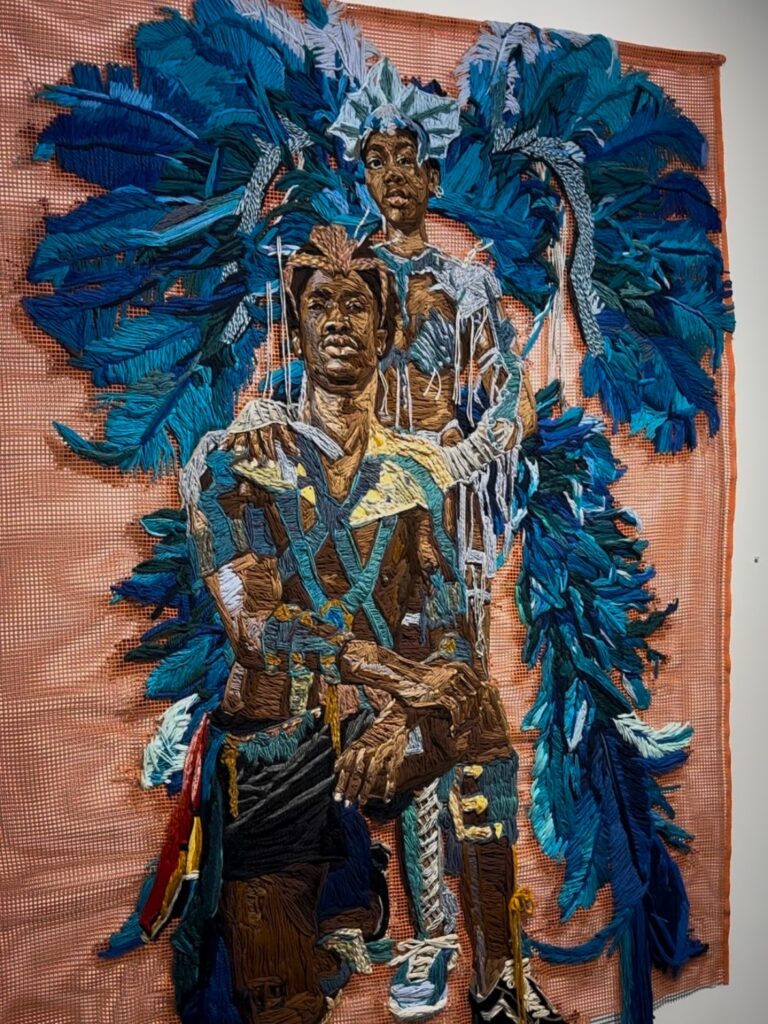
“DNA and Royalty” (2026) by Kandy G Lopez; ACA Galleries
“On one side of my family,” Natali continued, “I’m from here. And then I have my other side, too.”
DNA and Royalty had me curious about Natali’s take on a conversation I’ve been watching online with tired eyes. As Harlem prepares for its 57th Annual African American Day Parade there have been calls to rename the event. The dissenters say they speak for a substantial group of Black people who feel Africa has nothing to do with them, that “delineation” from diasporic people is key to securing our due reparations as descendants of slaves, and that Caribbean and African immigrants to America are trying to “destiny swap” with Black Americans in order to benefit from the hard-won rights we’ve earned and erase our culture. (In extreme cases, these newer Americans are referred to as “tethers” and I have now been accused of being one in disguise). The dissenters have proposed a new name, Black American Day Parade, and want a new logo, one that does not include an outline of the African continent. They ask why we’re the “only ones forced to be inclusive while all the other groups get to be separate” and they point to the West Indian American Day Parade, which celebrates the Caribbean diaspora over Labor Day Weekend in Brooklyn and is two years older than Harlem’s AADP, as proof that Black Americans need their own separate celebration. By their standard, Pan-African culture serves little purpose: DNA and Royalty should celebrate West Indian culture, Africans should celebrate their own cultures (though NYC does not have an African-specific parade), and Black culture should be left to “Foundational Black Americans” only. If that sounds complicated, consider where that logic leaves Natali whose family has roots in Haiti and South Carolina or where it leaves the Afro-Caribbean artist Kandy G Lopez, who is Dominican.
Natali and I were unraveling these mental knots when we noticed cameras flashing on Ms. Lopez. The artist was wearing a denim tank top dress, sporting two slim French braids, and smiling next to a woman who bore an uncanny resemblance to the subject in the “textile painting” titled Diana hanging from the ceiling behind them.
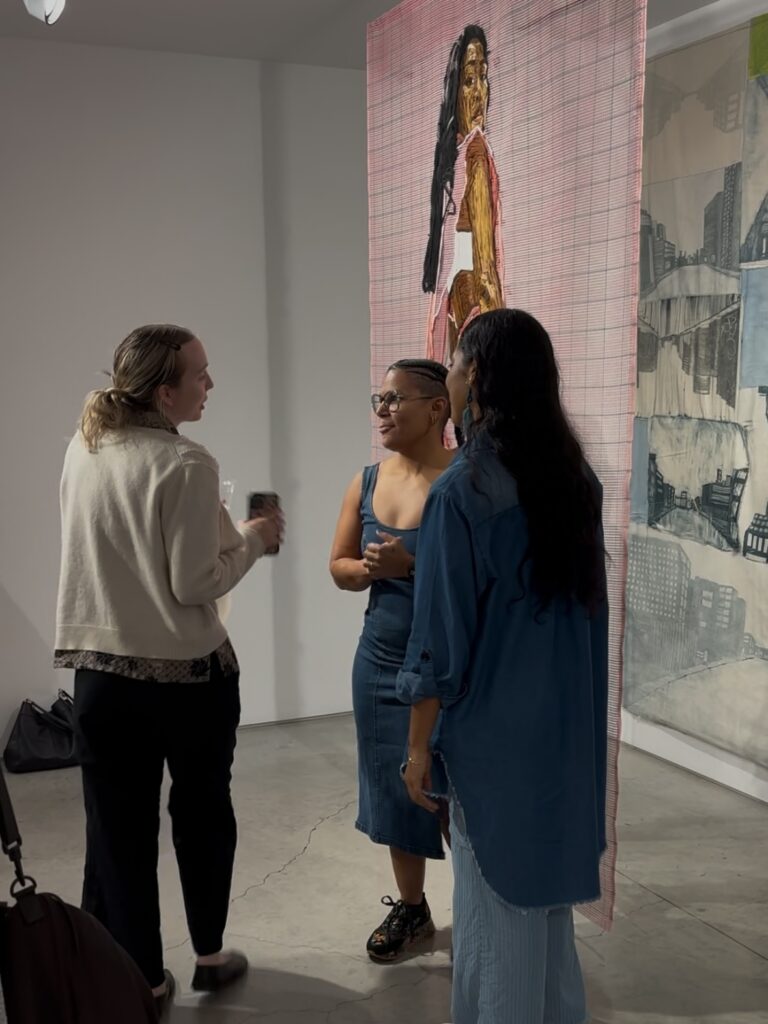
Kandy G Lopez and Diana Eusebio speak with a gallerist at the artist reception.
“I think that’s her,” I said to Natali, lifting my eyebrows toward the women, “I think that’s her in the painting.”
Moments later when she was within speaking distance, we were able to confirm that Diana Eusebio, a textile artist herself, was indeed the Diana from Diana. It was her first time seeing the work in person and experiencing its scale. Though Lopez sent progress photos to Diana over the course of the single week that it took her to weave the portrait, it was different being able to stand in front of a larger-than-life yarn-version of herself. She recalled arriving at Lopez’s Miami studio with 3 different outfits unsure of which to wear and standing still while Lopez crouched down to take her picture with her iPhone (which accounts for the feeling that the figures are towering over you). The outfit Diana ultimately chose was pink and her portrait hangs next to Lin, a man depicted in mostly blues. But Diana’s pink was not a gendered choice, she hand-dyed the garment using Natural Red 4 (its the inspiration behind the synthetic FD&C 40 which gives Hawaiian Punch its signature hue). The natural version of the coloring is harvested from a 6-legged bug called a cochineal but only after it feasts on prickly pear cacti, and it takes 155 1/2 cochineals to make a single gram of the carmine dye making it one of the most priciest substances in the world by weight. Peru is the world’s largest producer of the coloring; Diana is Peruvian-Dominican and like Lopez, raised in Miami. When Diana explained the intention of the ensemble to Lopez, Lopez selected that one out of the three. Thus, Diana’s pink portrait, too, is an expression of lineage.
Taking Up Space: New Works by Kandy G Lopez is my second time seeing the artist’s work this year alone. From November 2025 to January 2026, the result of at least one extension, Lopez’s Textile Truths: Faces of Resilience hung on the same walls in ACA Galleries. Photos and videos of the show earned near-instant virality; people I knew personally who’d never once shown interest in visual art asked me about “the Kandy show”. To have produced another entire body of work (plus her Armory Show presentation with ACA at the end of September) before a full calendar year is certainly a feat. Does volume tarnish the work? There were no signs to me that the art was rushed, or created with less care than the breathtaking Textile Truths, and if Diana is correct in her recollection that each work takes a week to create then Lopez had plenty of time to weave the 16 paintings in the show and even take a vacation. (Lopez also teaches at Nova Southeastern University.) Who am I to penalize a woman of color for working too fast or being too prolific?
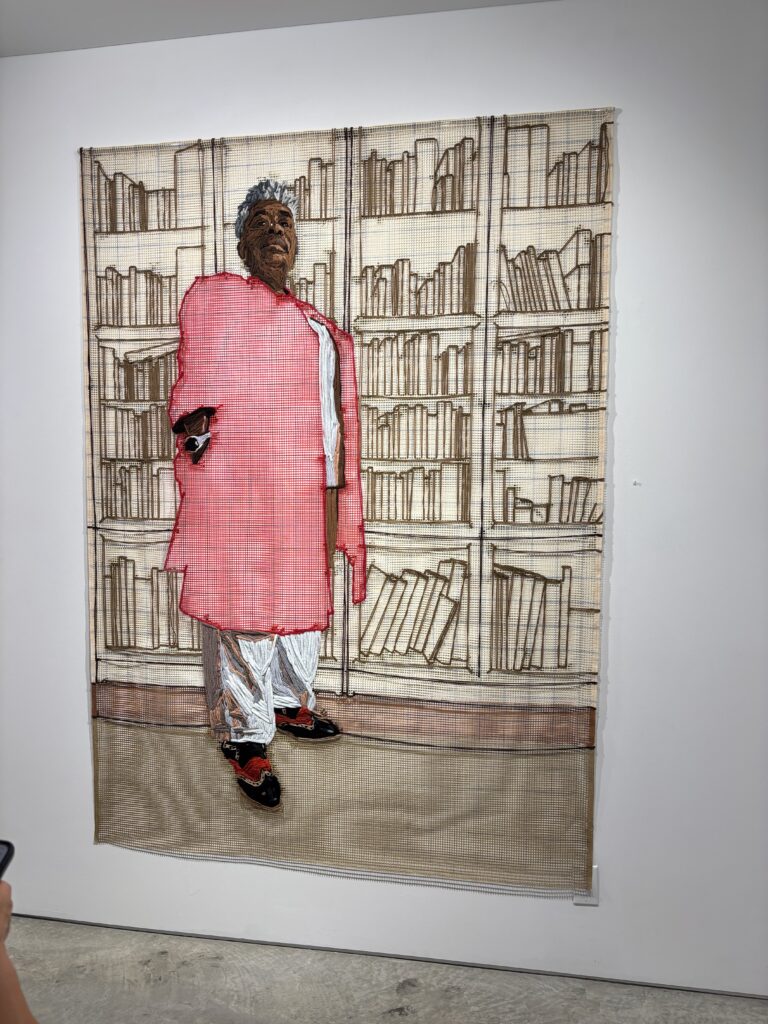
“Dr. Patricia Saunders 2.0” (2026) by Kandy G Lopez; ACA Galleries
What I do wish I understood about Taking Up Space after feeling so wowed the first time I saw Lopez’s textile paintings in January was how, if at all, this second batch tells a different story. (Note: I didn’t see Situational Identity, Lopez’s first solo show in 2023, in-person but photos show how her style then was more geometric and two of the works are rendered in grisaille.) Though the shows have different titles, the latest feels like a continuation of the last. Both ‘Space’ and ‘Resilience’ cite the importance of representation and the relationship between communities of color and themes of “domestic labor, migration, ancestral knowledge, and intergenerational storytelling” associated with fiber and textiles. Where City Girls (2025) and City Boys (2025), both 14 feet wide, command your attention with their mammoth size, there are no large group portraits in this show or any of the glass-backed enamel paintings echoing the fiber works. When I squint, I can make out subtle technical and aesthetic differences. A few more pieces have fabric backings, there are less solo faces in frames, and a handful of backgrounds have become dynamic. For example, Dr. Patricia Saunders 2.0 (2026) places the figure in front of a bookshelf, the brown outlines of the books on the shelf accent Dr. Saunder’s red knee-length coat which is also outlined with yarn like a choppy crop. Both leave room for your imagination while her face and red and black wingtips are meticulously articulated. But why is Dr. Saunders in Space versus Resilience? In other words, what is the feature or focus of this show that sets it apart from its predecessor?
In so many ways, Lopez’s work occupies a “both/and” space: the art is both textile and painting, she identifies as both Afro and Caribbean, her portraits both “acknowledge the historically overlooked” and “reclaim visibility”, the individuals on her mesh canvases are both artist and muse — and this approach deepens the resonance. While I may not (yet!) understand the thematic differences between this show and the last, it may not matter. There’s still much work to be done when it comes to diasporic people being seen fully, in their cultural similarities and differences, gracing the same walls at the same time, connected in ways we can see and those we can’t, woven together.
blacklove 🖤 and starlight 🌟
‘Taking Up Space: New Works by Kandy G Lopez’ is the artist’s third solo exhibition at ACA Galleries. The exhibition is open from September 10 – October 24, 2026. The gallery is open from 11am to 6pm on Tuesdays, Wednesdays, Thursdays, Fridays and Saturdays. Inquire with the gallery for prices.
-
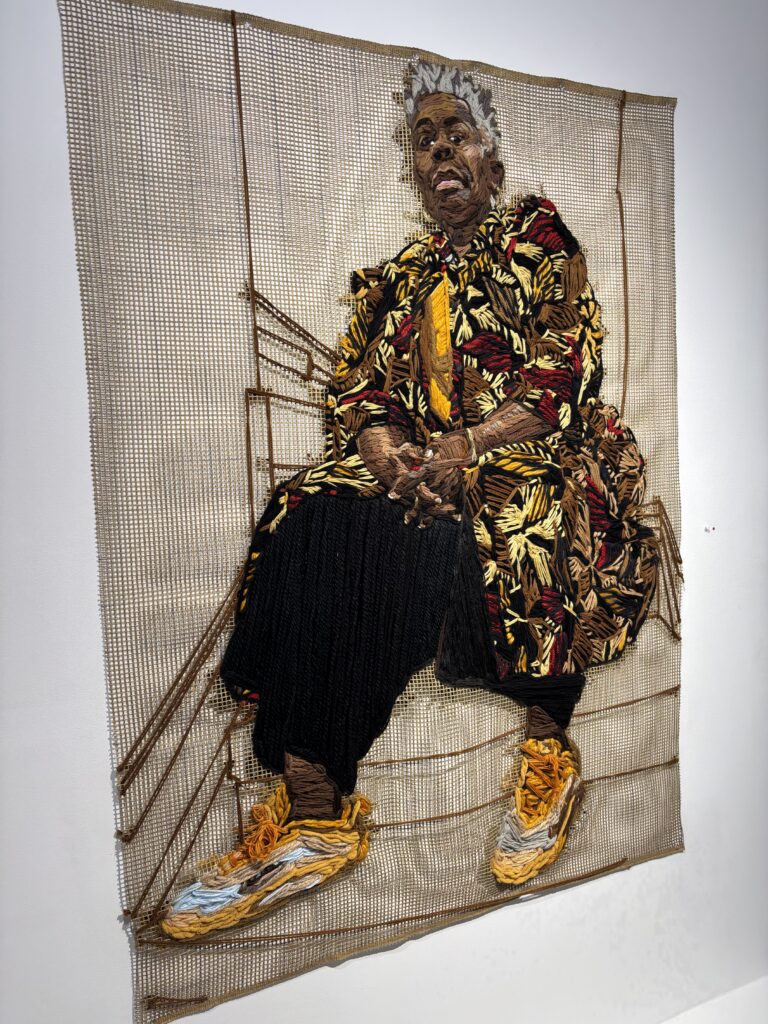
- “Dr. Patricia Saunders” (2026) by Kandy G Lopez; ACA Galleries
-
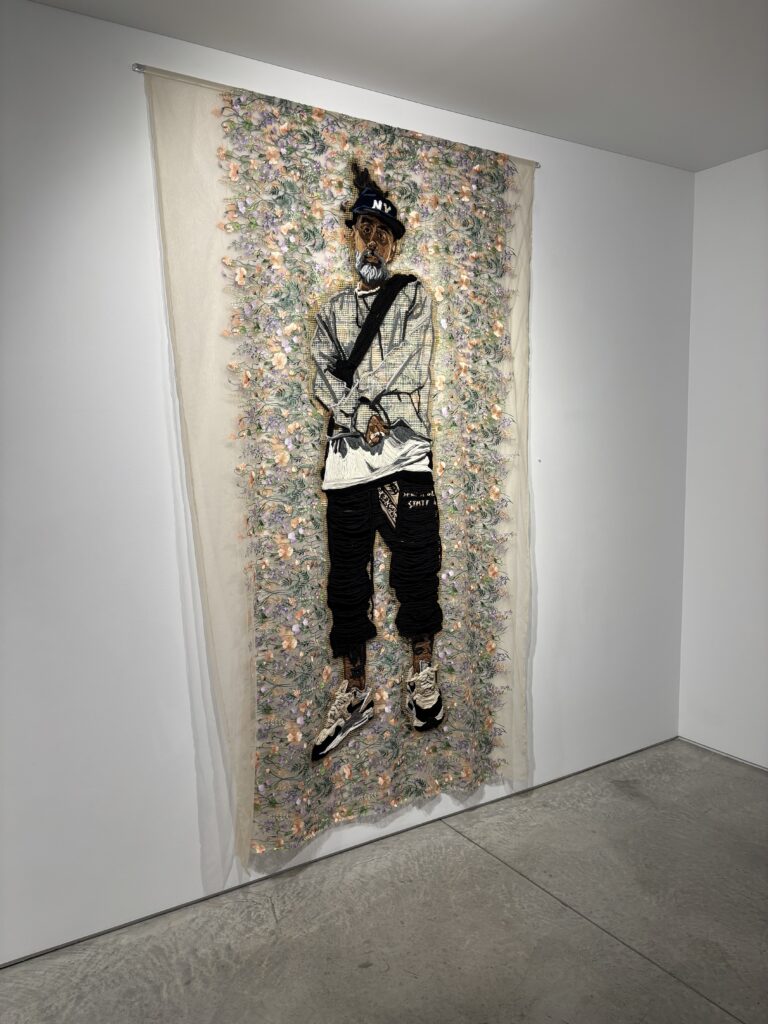
- “Michael” (2026) by Kandy G Lopez; ACA Galleries
-
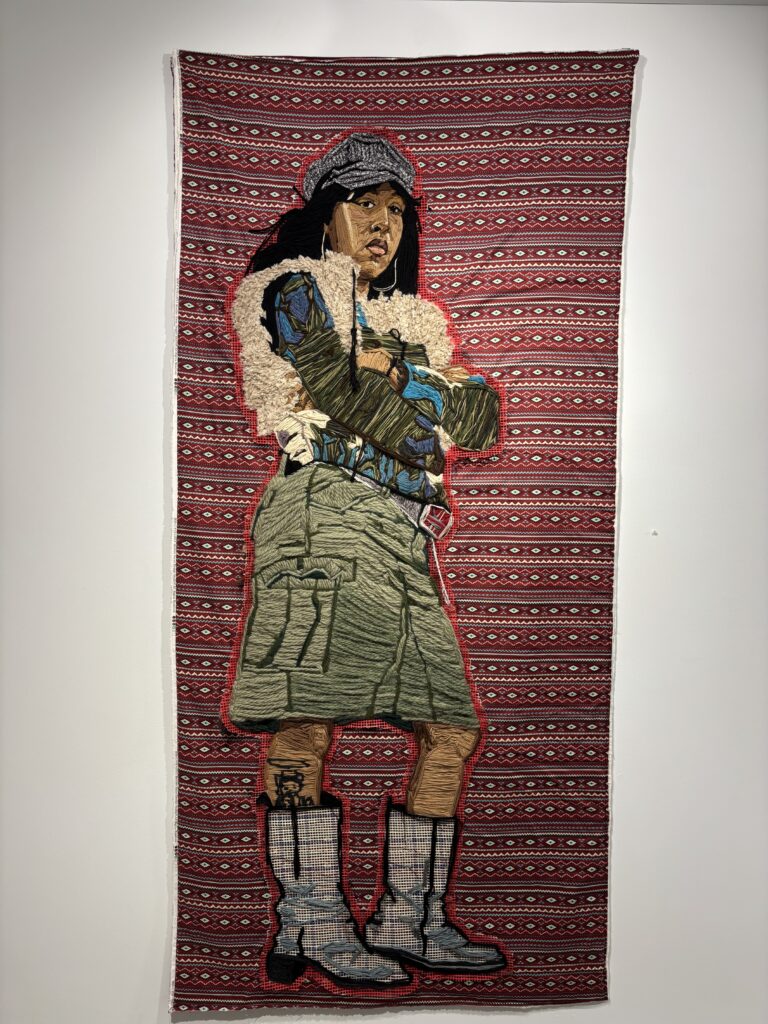
- “Emily” (2026) by Kandy G Lopez; ACA Galleries
-
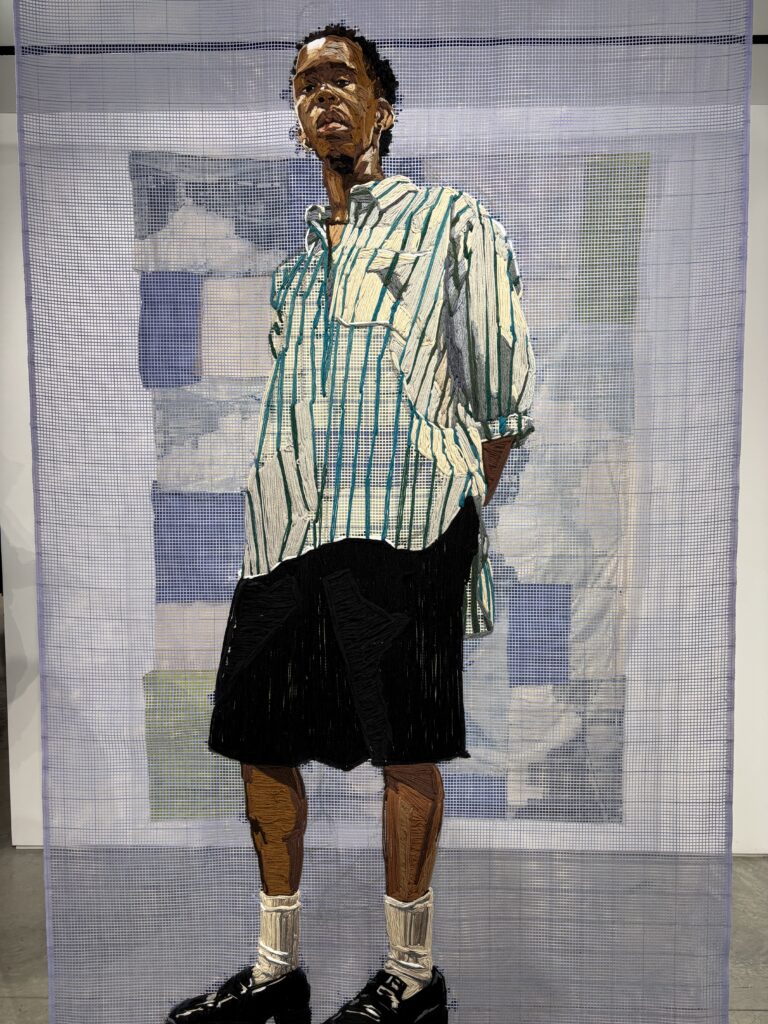
- “Lin” (2026) by Kandy G Lopez; ACA Galleries
-
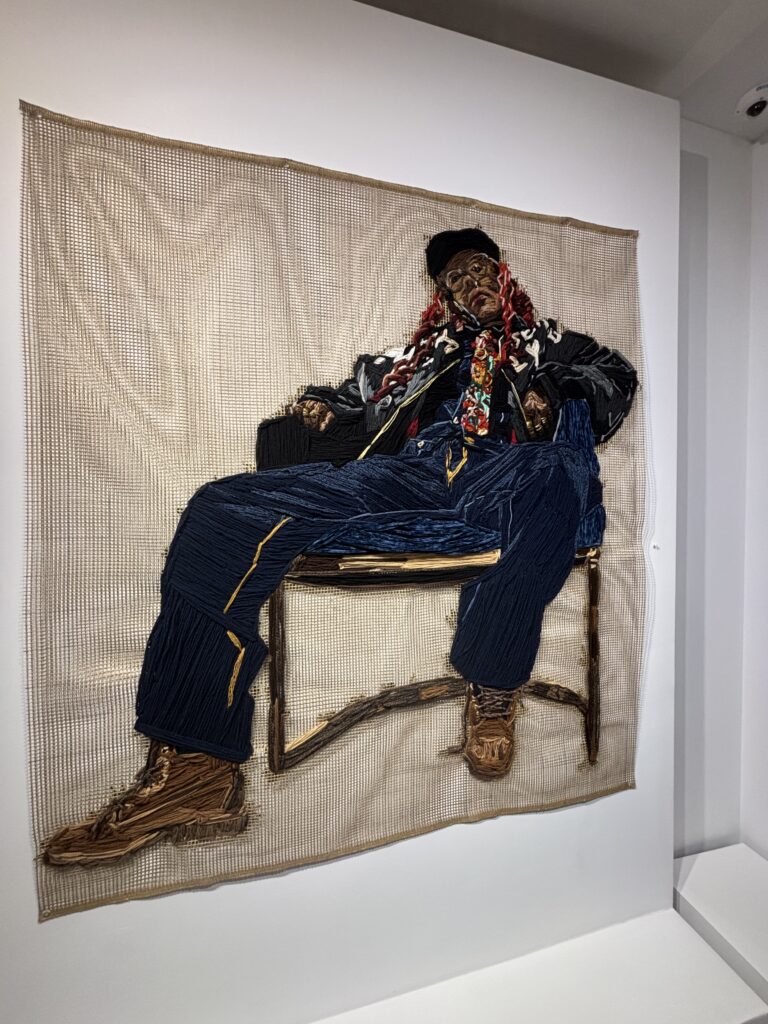
- “Bali” (2026) by Kandy G Lopez; ACA Galleries
-
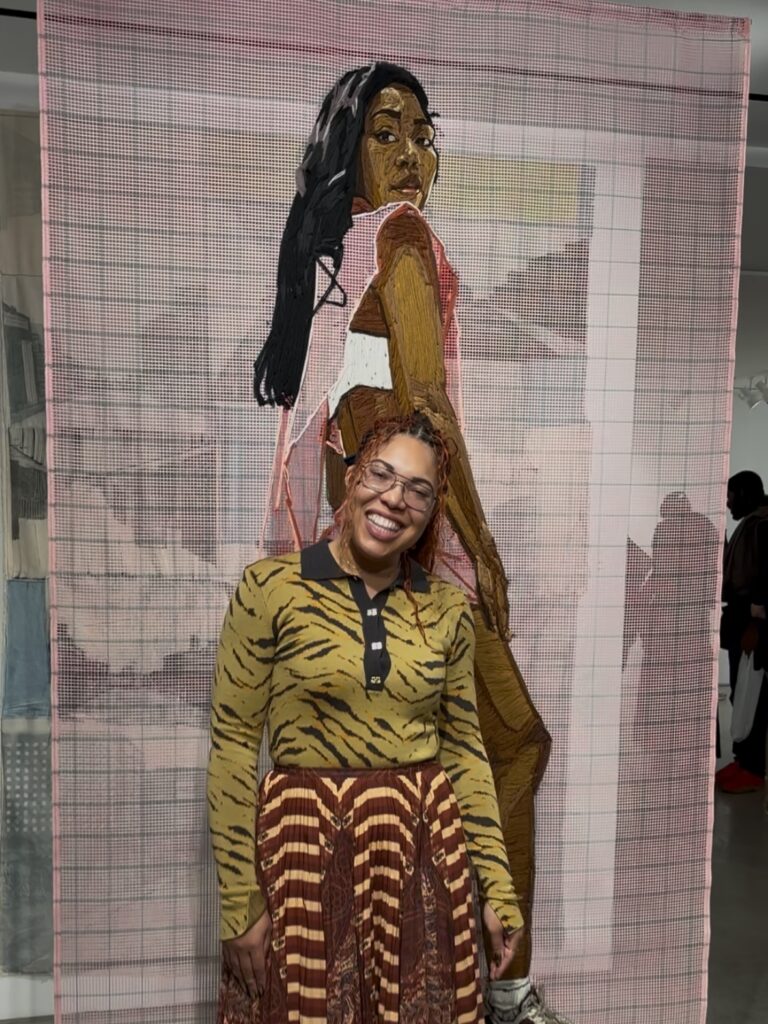
- With “Diana” by Kandy G Lopez
