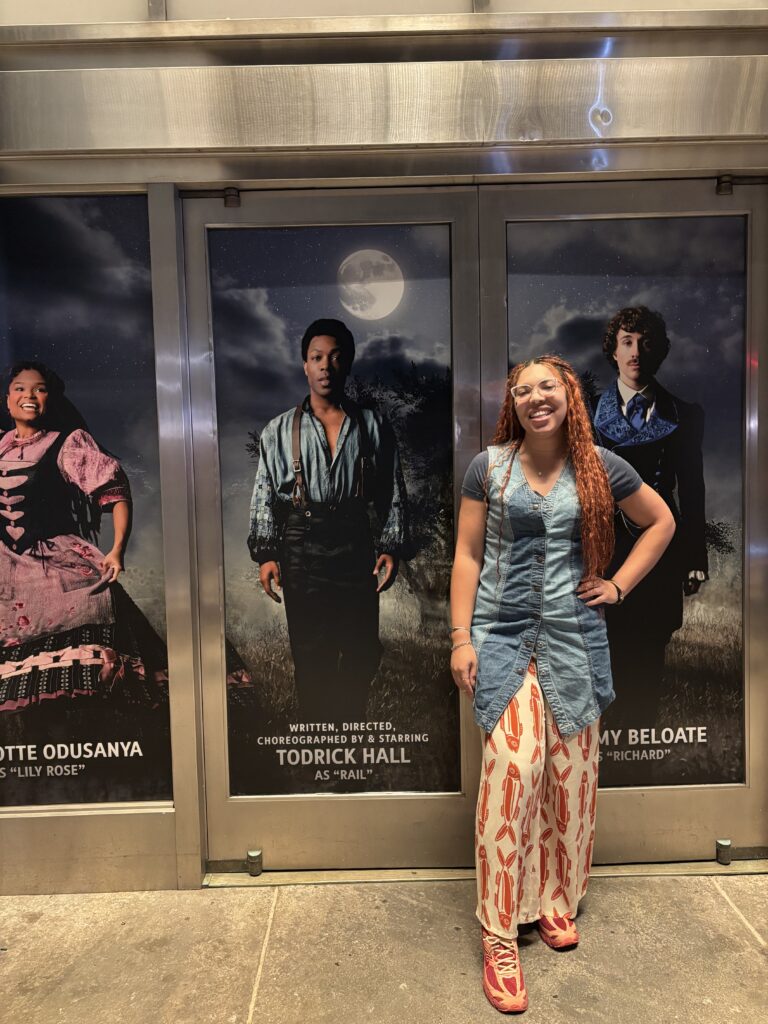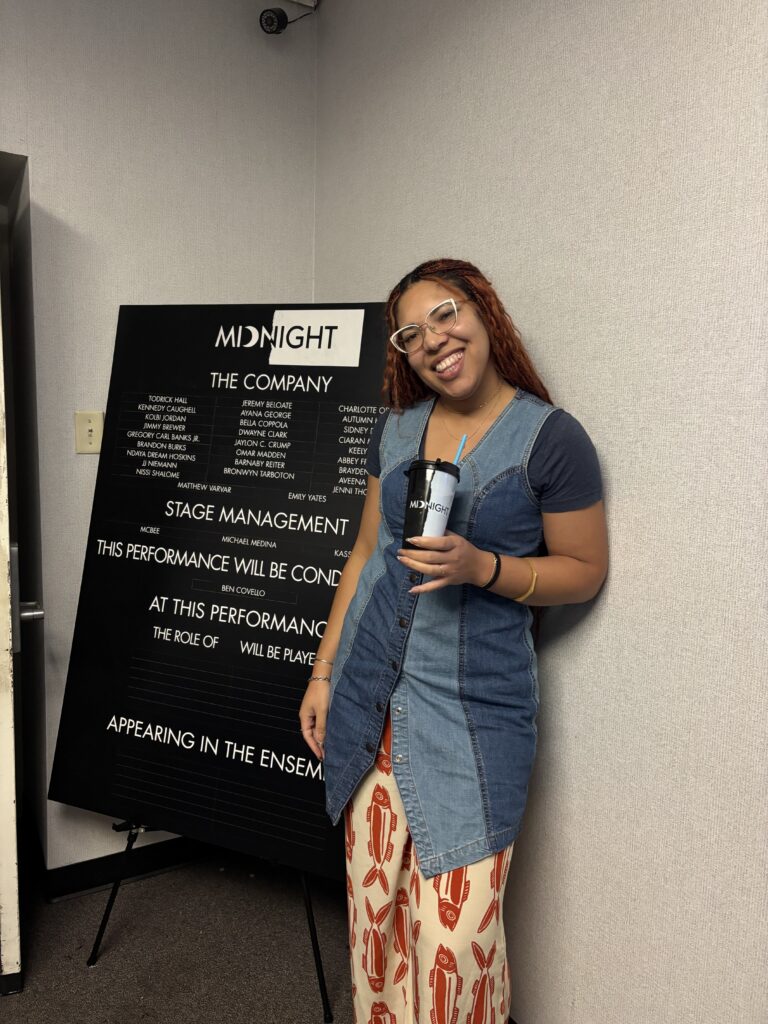

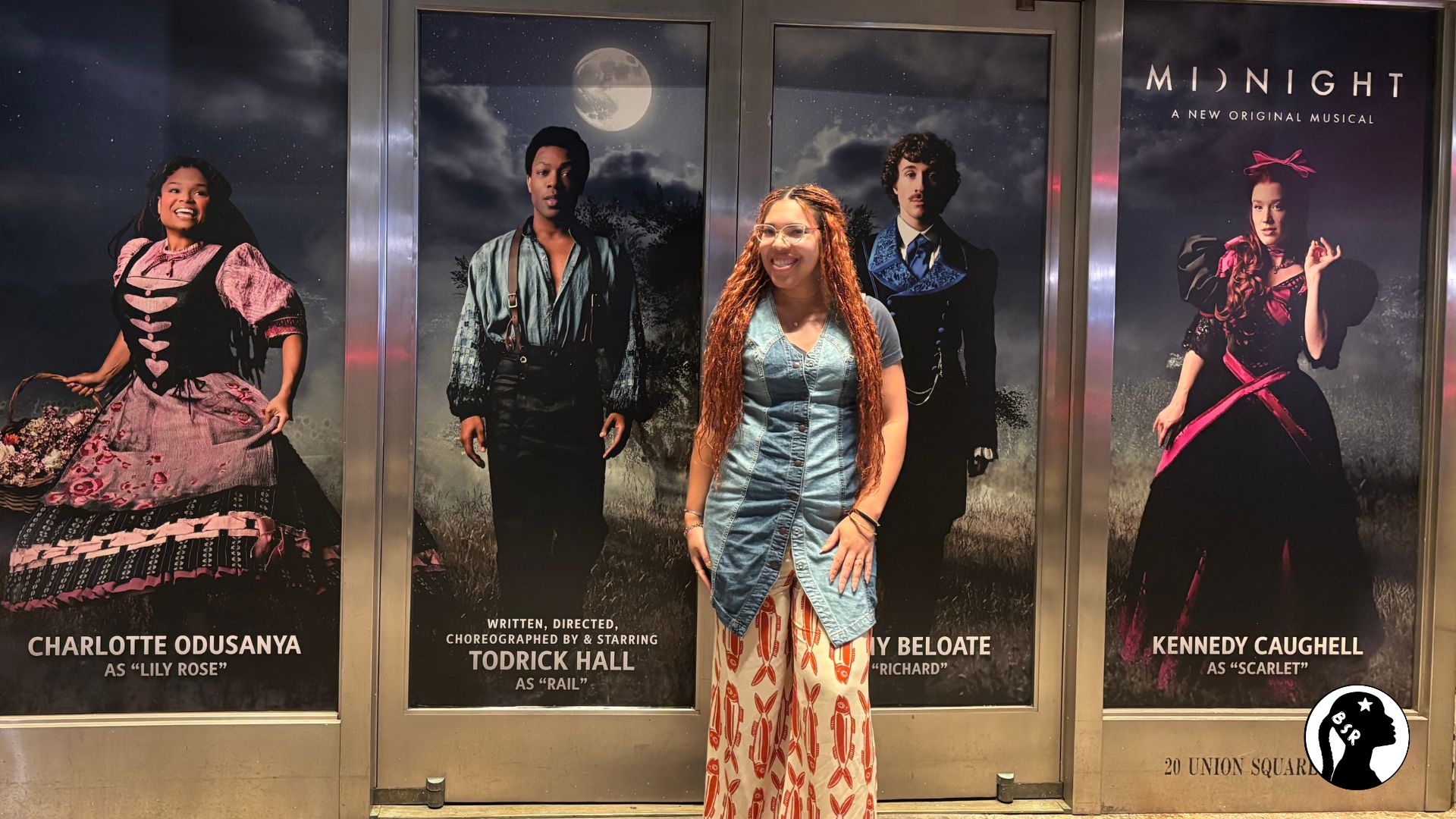
Review: Todrick Hall’s ‘MIDNIGHT’
Todrick Hall’s 2 hour and 45 minute sung-through opera packs a polarizing punch
In one of my mother’s leather-bound photo albums is a picture of me, asleep, dolled up with blush and lightly drooling over my lip gloss, in a gauzy sky blue dress I wore for Halloween that year. The costume was not an official licensed Cinderella outfit — I think the real name was Blue Princess — but the resemblance was close enough to tell that I was dressed as royalty. Because of my parents’ distaste for pagan holidays, it’s one of very few photos I have of myself as a kid in costume. I treasure the moment and the memory.
Until recently, I hadn’t given much thought to the 1950 animated musical that popularized a much older folktale, nor had I used the film’s historical clues from fashion and transportation to consider that Disney’s Cinderella is set in the 19th Century, the same time period as American slavery. While fictional Cinderella was on her hands and knees in her evil stepmother’s house there were millions of existent Black women an ocean away, doing the same with no hope of anthropomorphic rodents, fairy godmothers, or handsome princes to change their station. That I could wear the costume without any knowledge of this friction is the beauty of childhood innocence.
I have Todrick Hall to thank for revealing this overlap to me. His new musical MIDNIGHT adopts Cinderella tropes — dim-minded sisters, a special pair of shoes, a clock striking midnight, and a life-changing wish — to tell the story of Darail (short for Rail), a man who falls in love under socially, emotionally, and physically dangerous circumstances. It’s 1863. Darail is Black and enslaved; his lover Richard is white and part of the slave-owning class, though not a slave-owner himself. Longtime Hall fans may recognize his love for using a classic story as a semi-autobiographical vehicle like he did with 2016 Straight Outta Oz album and tour; Todrick has been in a committed interracial relationship since 2021.
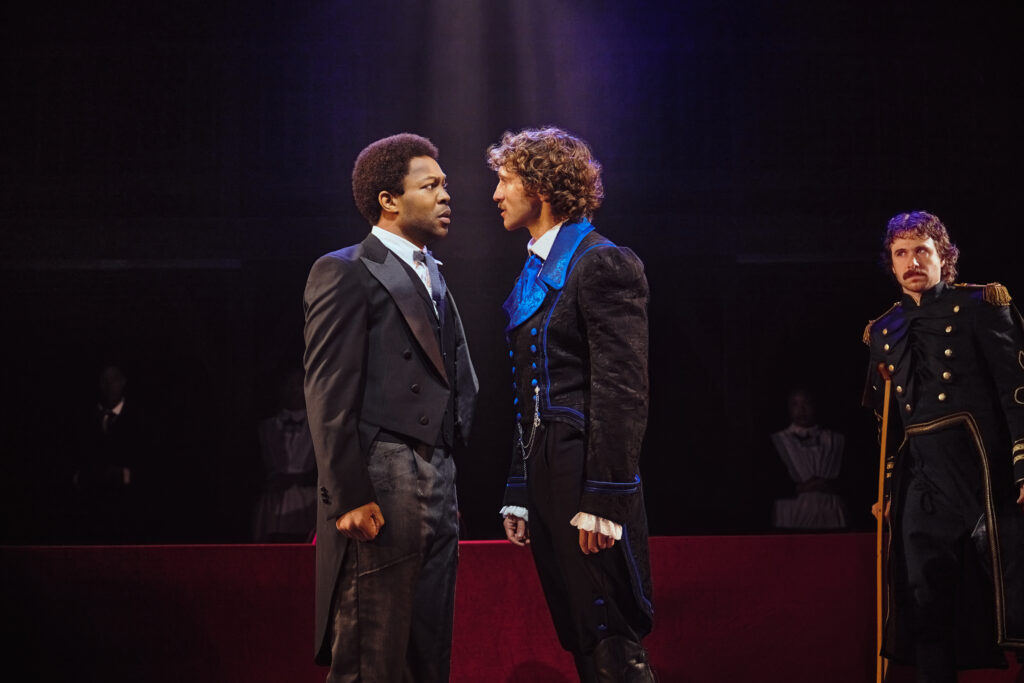
Todrick Hall, Jeremy Beloate and Jimmy Brewer © Valerie Terranova
Like Cinderella, Rail’s meet-cute takes place at a ball. He is there in formal attire and borrowed shoes to serve drinks to the party guests. When he drops a crystal glass maneuvering a serving tray at the party, Richard is able to catch it before it hits the ground. Richard saves Rail from another punishable offense when he’s accused of contaminating the guests’ dessert and he hires Rail for compensated work building his new estate. For two years, Rail goes to the build site with Scarlet, the woman who owns him and is engaged to Richard. For two years, Richard attempts to get Rail to be his friend, or at least respond to his small talk.
Once the two men start chatting, their love story begins. Rail teaches Richard to join wood, Richard teaches Rail to read. The two go swimming together and exchange love letters. They meet under a tree every midnight, sneaking away from the women in their lives while the rest of the world sleeps. Lily Rose, Rail’s pregnant girlfriend, suspects that Rail has fallen for someone else. Scarlet, Richard’s fiancée turns the clocks back to make Richard late for his nighttime trysts and when white men find Rail out at night alone they beat him. When Richard finds Rail in the woods bleeding and injured, Rail spits out an accusation that is tested after intermission: that Richard could never last a day in his shoes.
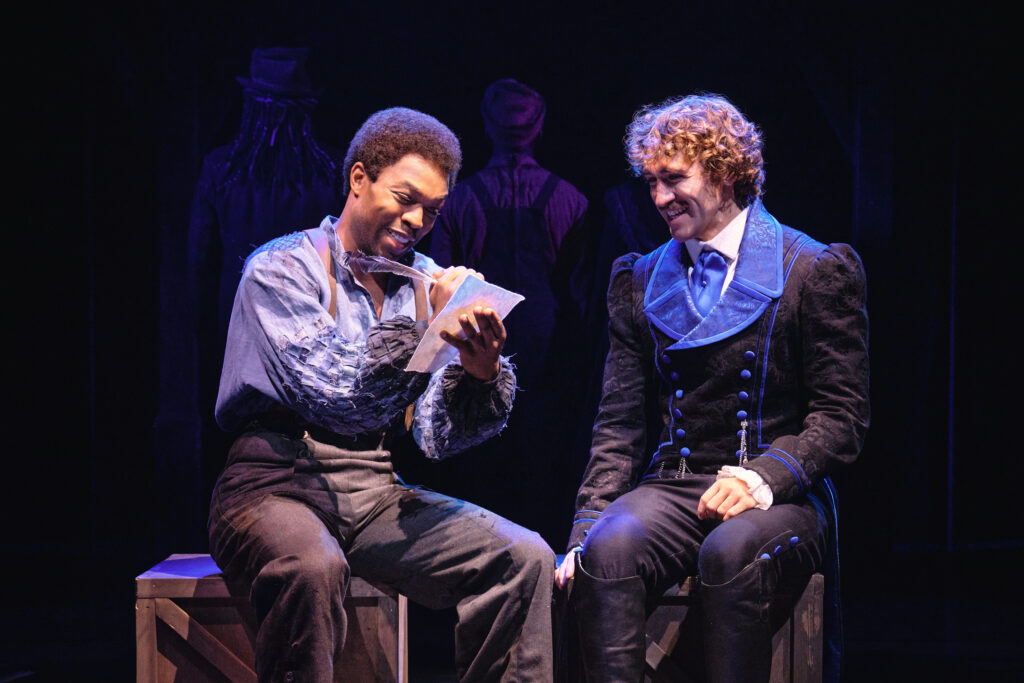
Todrick Hall and Jeremy Beloate © Valerie Terranova
In Act II, the audience is asked to suspend our disbelief as the Cinderella story is turned on its head. Each Black character swaps places and costumes with a white one. Instantly, Rail and the other Black characters occupy a superior class. Now they own and diminish white lives, separate white families, and subjugate white people. It turns out that Rail is right, enslaved Richard is far more cowardly than Rail but Rail finds that the class pressure of keeping up appearances is not easy either. Rail’s mother-in-law finds the men’s love letters hidden in the floorboards. The homosexuality of it all has polite society seeing red for both men, white and Black. Even Rail’s own brother wants to kill him for marring the family name.
This is the neatest retelling of MIDNIGHT that I can manage and it’s only achieved by leaving quite a bit out. In addition to Rail and Richard’s love story, there’s Rail’s relationship with Lily Rose, Richard’s marriage to Scarlet, Sylvester’s affinity for torture, the tragedy of Ethel’s son, and the callous separation of Rail from his mother on the day he was born (which sets up a major, but ill-executed twist, in the second act). In typical opera fashion, there are a lot of people involved. Some of these additional storylines add depth to the musical; some don’t. Happy and Violet seem to exist as flat companions for Lily Rose and Scarlet. The Act II swap requires that Richard’s brother, Harry, switch with Squeak who’s essentially one leg of a narrating trio in Act I. We need Harry, but do we really need Squeak? On Instagram, Hall has corrected reviewers’ assertions of a 3 hour runtime noting that both acts are within 5 minutes of Lin-Manuel Miranda’s 11x Tony-winning musical Hamilton. (Hall didn’t say it, but I will: MIDNIGHT may be long for a musical but it’s short for an opera.)
My retelling also leaves out the violence. An enslaved man is shot by a slaveowner in the opening scene. Two new mothers are separated from their babies, one mother dies from the ensuing sadness. Rail is beaten. A noose appears. The n-word is used with a hard ‘r’. Lynching is referenced in a song. A man was whipped six times before I stopped counting. All of this is historically accurate for the time, but it may feel too intense for some viewers especially in a theater like Daryl Roth where the distance between the stage and the audience is slim.
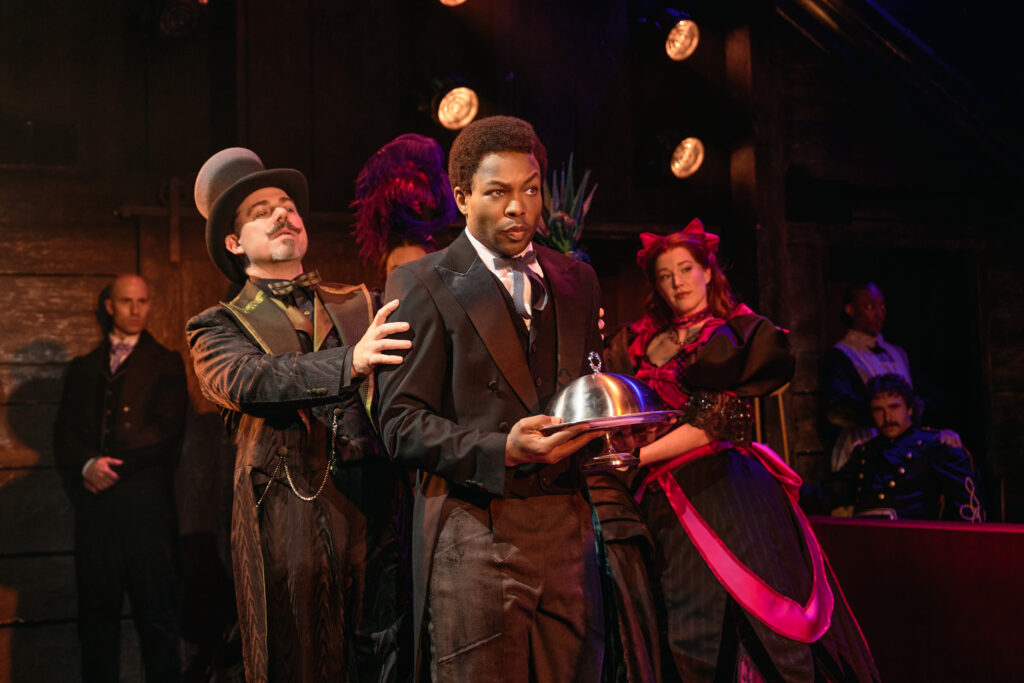
Ciarán McCarthy, Todrick Hall Kennedy Caughell and the Company of MIDNIGHT © Valerie Terranova
And this has been the loudest critique of Hall’s MIDNIGHT: that it puts Black trauma on stage, that it’s a 3 hour play about slavery, or (when reviewers have directly referenced Jeremy O. Harris’ 2019 Broadway production) a “3 hour Slave Play”. The second most common critique has been about Hall himself including allegations that he did not pay his dancers, that he is anti-Black or “not Black enough” to tell this story, and his connection to producer Scooter Braun. Interestingly, some of the critique has come from people who have vowed not to see the show even as their chatter drives ticket prices upwards of $300 and relieves the producers of any responsibility to market the show. It’s buzzy enough via word of mouth. Polarizing online discourse claims that the show is “for white people” and “no one Black likes it” but the truth is, forgive the pun, not that Black and white.
I enjoyed MIDNIGHT in ways I did not enjoy Slave Play or the more recent Mexodus. (I had not begun writing about theatre when I saw Slave Play, but my review of Mexodus was one of three that earned me an award from the American Theatre Critics Association.) I saw MIDNIGHT before any white people could grip me by the arm and tell me it was “powerful” and “eye-opening” which I’m sure worked in Todrick’s favor but that wasn’t the only difference.
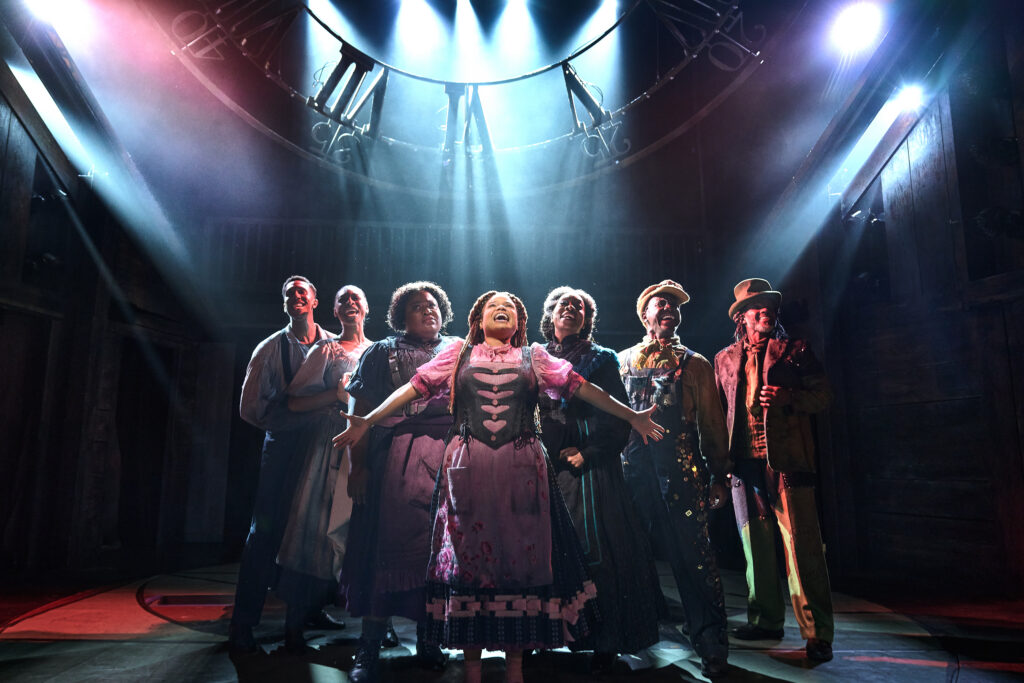
Charlotte Odusanya and The Company of MIDNIGHT © Valerie Terranova
First, the music in MIDNIGHT is undeniable. Clips of the songs went viral before the previews and I imagine it could’ve been a hit concept album. There are high notes, daredevil runs, and harmonies with more than 6 parts. (How did Mr. Hall even find this many performers who were equipped for this vocal challenge 8 nights a week?) I caught myself singing Ayana George’s “I remember…” yesterday while loading my dishwasher even though those were the only two lyrics I could recall. There are 35 musical numbers and Todrick wrote each one. In addition to writing the book (story), music, and the lyrics, Mr. Hall was the director, choreographer, and played the lead role of Darail. It may be a little pot/kettle of me, but I suspect that this was too much creative control. Delegation and collaboration would’ve certainly improved the production, but the idea of a ‘one man creative team’ was pretty awe-inducing in the moment. From my seat in the fifth row, I was riveted by the crispness of the vocals (an issue I experienced twice at Cats: The Jellicle Ball), the complexity of full company movements in numbers like “White People” (though I found it a bit silly that Todrick choreographed a backflip for himself and no one else), the creative use of a revolving stage, and the overall splendor of a production that punches far above its Off-Broadway weight class. MIDNIGHT feels Black in its bigness and the way it swings for the fences. It’s a spectacle in the tradition of The Wiz, Easter Sunday at Black church, and the Bronner Brothers hair show. The Black company members sing along to R&B and gospel orchestrations and give tongue-in-cheek observations about “you know who”. They don stunning haute couture ensembles when they’re not enslaved and wear resilience in the face of impossibility when they are. When the white people are enslaved, they hang their heads and shuffle along in defeat.
The musical concludes with a headache-inducing blitz of numerology and chronology. Midnight is 12 o’clock, 12 million slaves were brought to the U.S., American slavery lasted 246 years, the play ends 246 days before the ratification of the 13th Amendment that would free Rail and company, the digits in 246 add up to 12. It would be another 102 years until interracial marriage was legal, 36 more years to remove sodomy laws, and 12 more years until same sex marriage became legal in 2015. Historically speaking, this is all relatively recent. Rail is only old enough to be your great-great-grandpa. It saddens me to think that people might miss out on seeing this show because sometime in the last 161 years since the Emancipation Proclamation, we’ve decided that seeing depictions of slavery is just as harmful as living through it and we’re willing to let everyone forget it ever happened if it means being shielded from complex emotions. If there’s no way to create a depiction of slavery that is not both triggering and historically accurate, what can a Black artist do within those constraints?
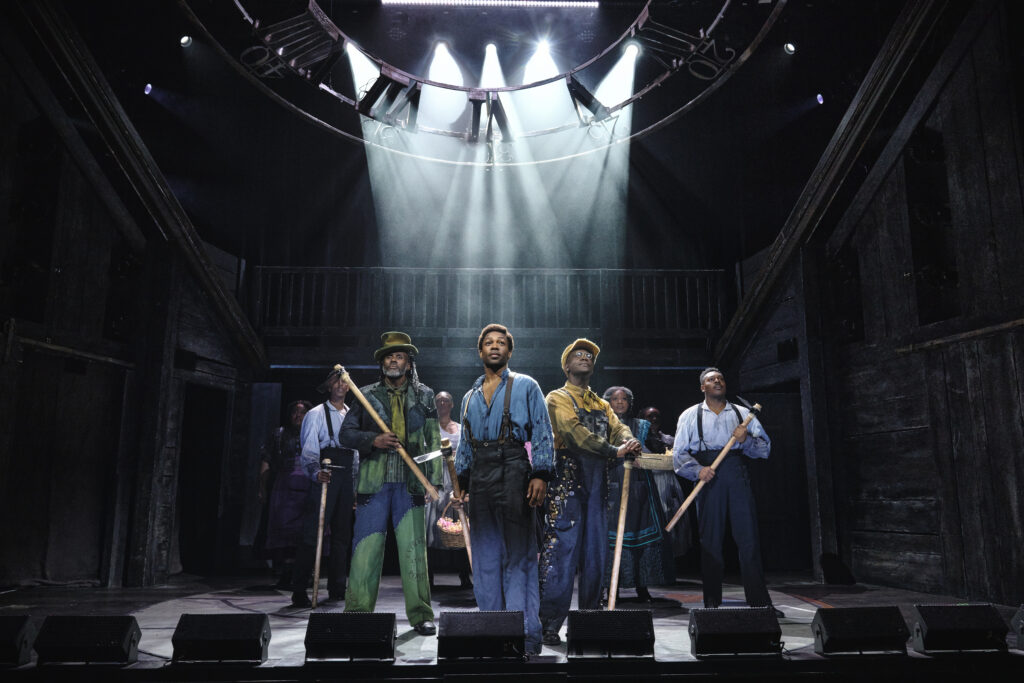
Todrick Hall and the Company of MIDNIGHT © Valerie Terranova
Until now, I hadn’t been curious enough to deduce that while Cinderella was a-scrubbing and a-mopping, so were my ancestors. But now that I see the connection, I feel a different power in the costume, that I could fashion my child self a princess less than 4 generations later. Todrick has written all of himself — Black, gay, talented, hazel-eyed — into a history that has never included perspectives like his and he’s done it with style. Though Rail may be bound in MIDNIGHT, I see glimpses of liberation in Mr. Hall’s impulse to be seen in a story that would rather leave him out.
blacklove 🖤 and starlight 🌟
MIDNIGHT was conceived, written, directed and choreographed by Todrick Hall and produced at the Daryl Roth Theatre. The cast includes Todrick Hall, Jeremy Beloit, Charlotte Odunsanya, Kennedy Caughell, Ayana George, Autumn Hulbert, Kolbi Jordan, Bella Coppola, Sidney DuPont, Jimmy Brewer, Dwayne Clark, Ciarán McCarthy and an 8-member ensemble. After a two-week delay, the production opened on October 15th. I attended the performance on October 14th and offer my thanks to The Press Room.
The production has been extended to January 3, 2027. Digital rush tickets are available for $53. (Note: every seat in the house is a good one and late seating is difficult.)