

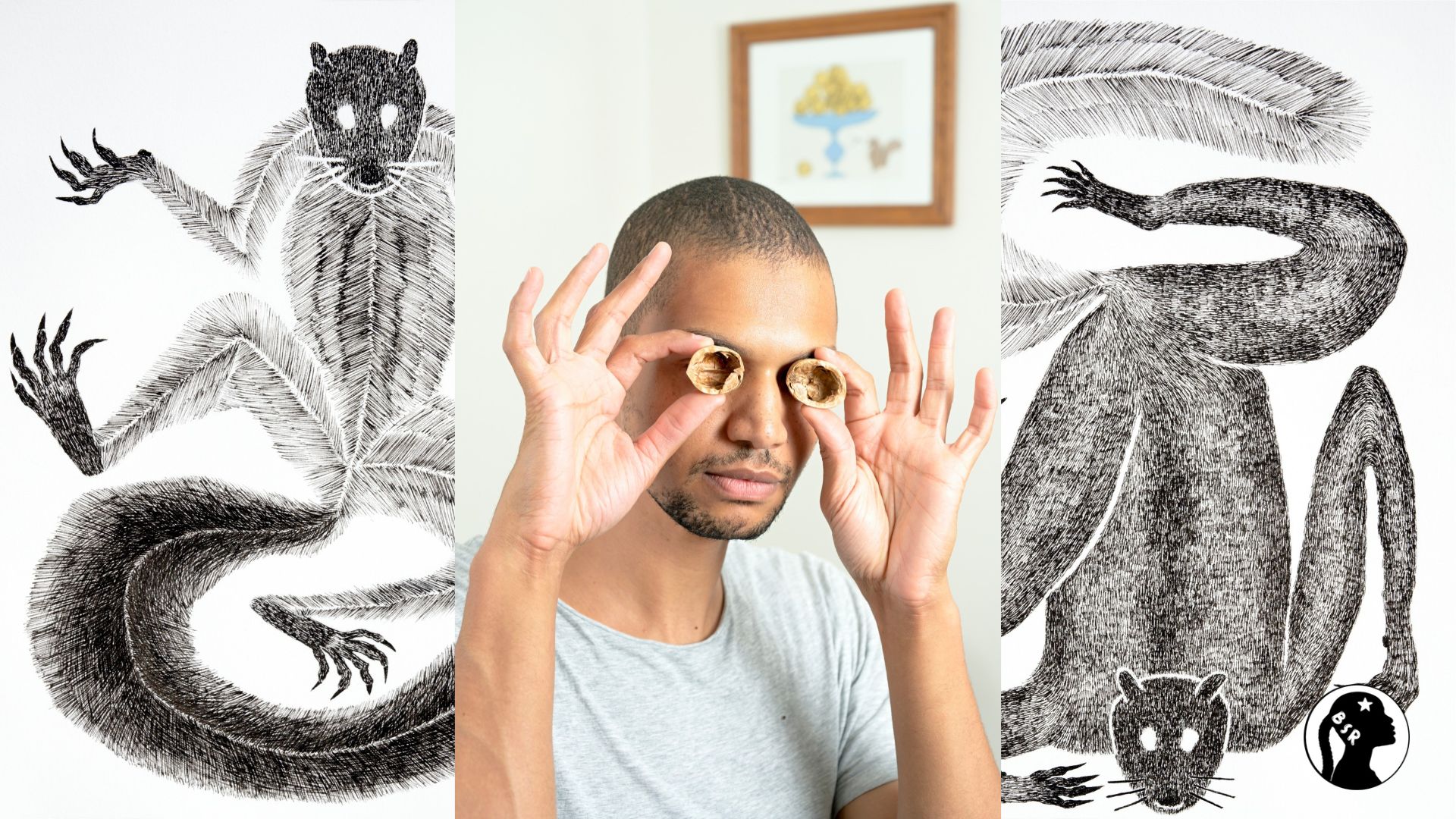
Wilmer Wilson IV: SKIRL! (Review)
Wilmer Wilson IV centers an untamed subject in his signature style of social commentary
I thought my eyes were playing tricks on me the first time I saw the shadow squirrel leaping around the courtyard in my apartment complex. But then I saw another and another and it became an inside joke: in my part of Harlem, even the squirrels are Black.
In Philadelphia, the Eastern Gray Squirrel reigns supreme, not just because of the species’ strength in numbers, but also because of their persistence and the fact that the city “intentionally introduced” the critters into its parks to promote citizenship. (Boy, do I wish I’d been in the room for that conversation.) The squirrels did not get the memo on how to be good neighbors. They’ve been known to startle passersby when they rustle through trash cans at the zoo, take single bites out of ripened fruits and then lose interest, and let’s not forget their TikTok claim to fame: squirreling their way into your walls to stash their nuts and scratch all night, just to stick it to you.
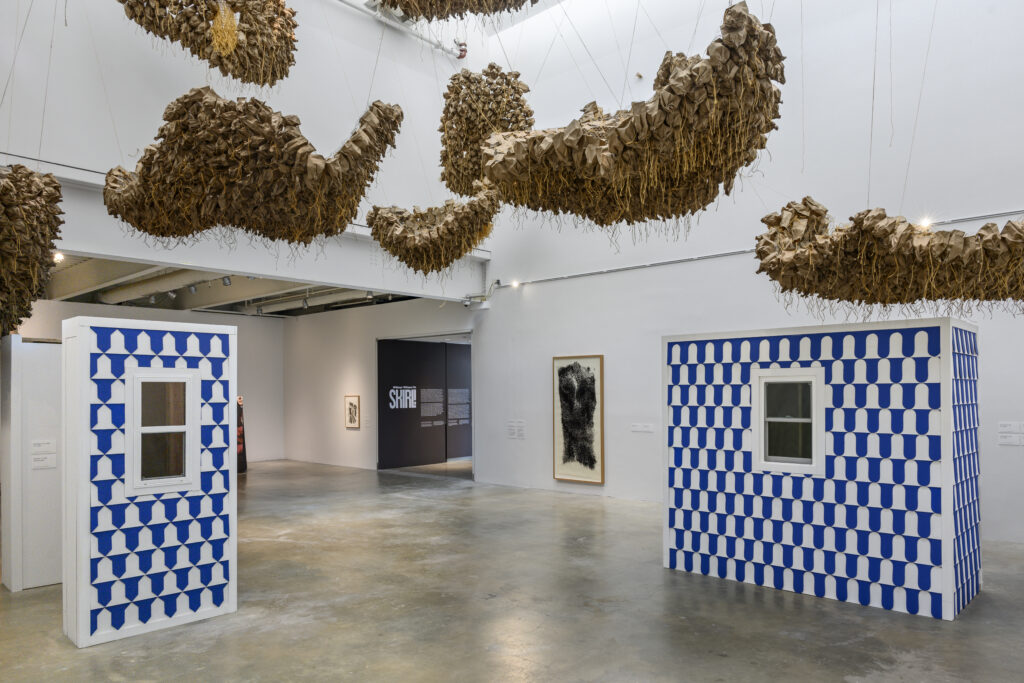
“Co-Evolutionary Pressure” (2026) by Wilmer Wilson IV • Image Credit: Constance Mensh. Courtesy ICA, UPenn.
The humble squirrel’s ingenuity, nuisance, and historical influence is on display in SKIRL! at the Institute of Contemporary Art in Philadelphia. Wilmer Wilson IV was inspired to pursue squirrels as a thematic centerpiece when they got into his walls and drove him crazy. Mr. Wilson has returned the favor by installing structures that resemble skinny, roofless sheds that are just wide enough for him to wiggle into and imitate the scratching sound for anyone who’s in the gallery during his live performances. (You can catch the last performance on December 5th from 11am – 6pm.)
Wilmer Wilson IV is ICA’s first R+D residency artist; he received support conducting research to inform the exhibition. For example, curators Hallie Ringle and Cecilia González Godino described a inquiry call with a squirrel neurologist (yes, real job) during which the specialist argued that squirrels don’t get enough credit for all their eccentricities and are too often overshadowed by “charismatic megafauna” like lions, tigers, bears, and dolphins. Ringle and González Godino shared a fount of other squirrel-related facts that came up in their research: squirrels shut down the NASDAQ in 1974 and 1992 and Philly-favorite Ben Franklin was a squirrel fan as well.
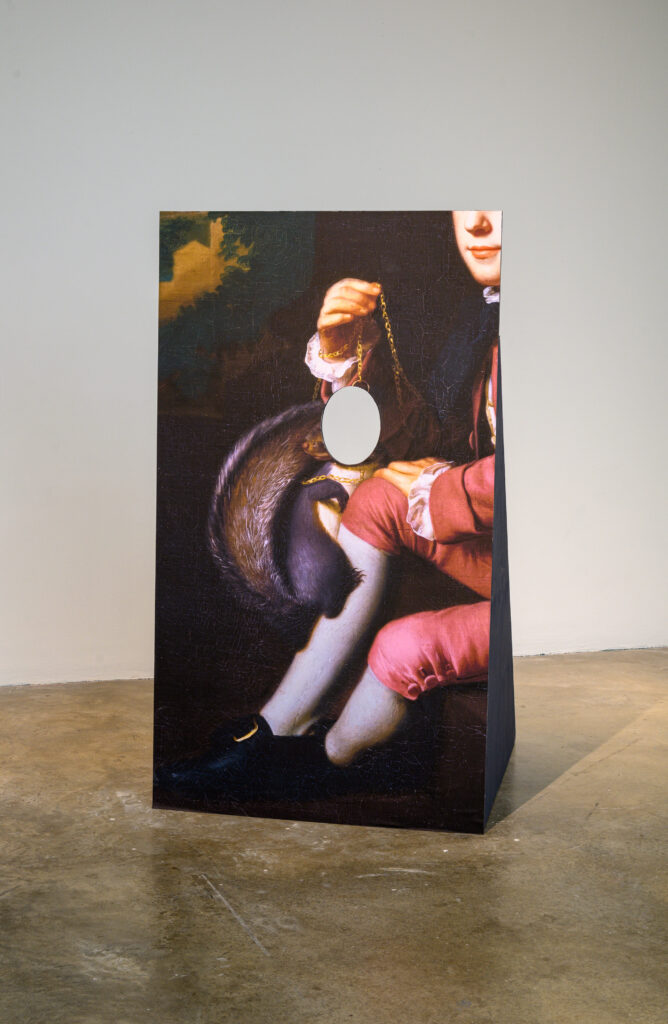
“The Future of This Land” (2026) by Wilmer Wilson IV • Image Credit: Constance Mensh. Courtesy the artist and Susan Inglett Gallery
The research side of SKIRL! adds depth to each of the works in the gallery. “The Future of This Land” (2026) is a detail of a painting that depicts a white man in breeches and hose holding a squirrel by a collar. The painting is superimposed on a wooden board with a cutout for you to put your face where the squirrel’s would be — it’s the sort of thing you’d see at a roadside attraction or a theme park. The painting is a nod to the squirrel’s historical designation as a class indicator. In the 1700s, having a pet squirrel indicated aristocracy. (Add this to the list of reasons why the richest people are not always the smartest.) Put your face in the hole and you could be a dead colonist’s comfort animal.
“Untitled (for Custis Morgan)” (2026) is a chaotic spread of gold-cast squirrel droppings and walnut shells atop a Confederate flag. Wait until you hear the backstory: some say Custis Morgan, General Robert E. Lee’s daughter’s pet squirrel, distracted General Lee enough to cost the South the Civil War.
Both of these works sit below an arcing scale-model of a squirrel dray that Wilson created using inflated paper bags and string. Drays are nests that squirrels build and vacate (much like the abandoned fruit!) If you look close enough at the trees surrounding ICA you can see messy little piles where branches intersect, places that squirrels have, or had, called home. Wilson’s indoor model is titled “Coevolutionary Pressure” (2026) since drays are just as likely to be found in trees as they are in your walls or attic. Squirrels will adapt and they don’t mind infringing on us to do it.
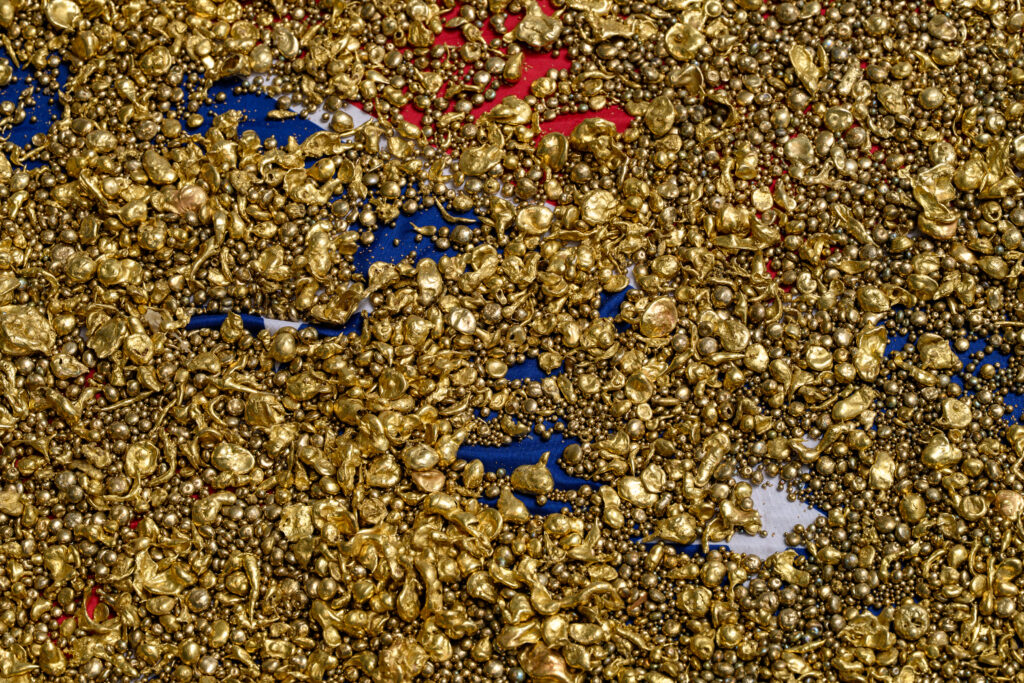
“Untitled (for Custis Morgan)” (2026) by Wilmer Wilson IV • Image Credit: Constance Mensh. Courtesy the artist and Susan Inglett Gallery
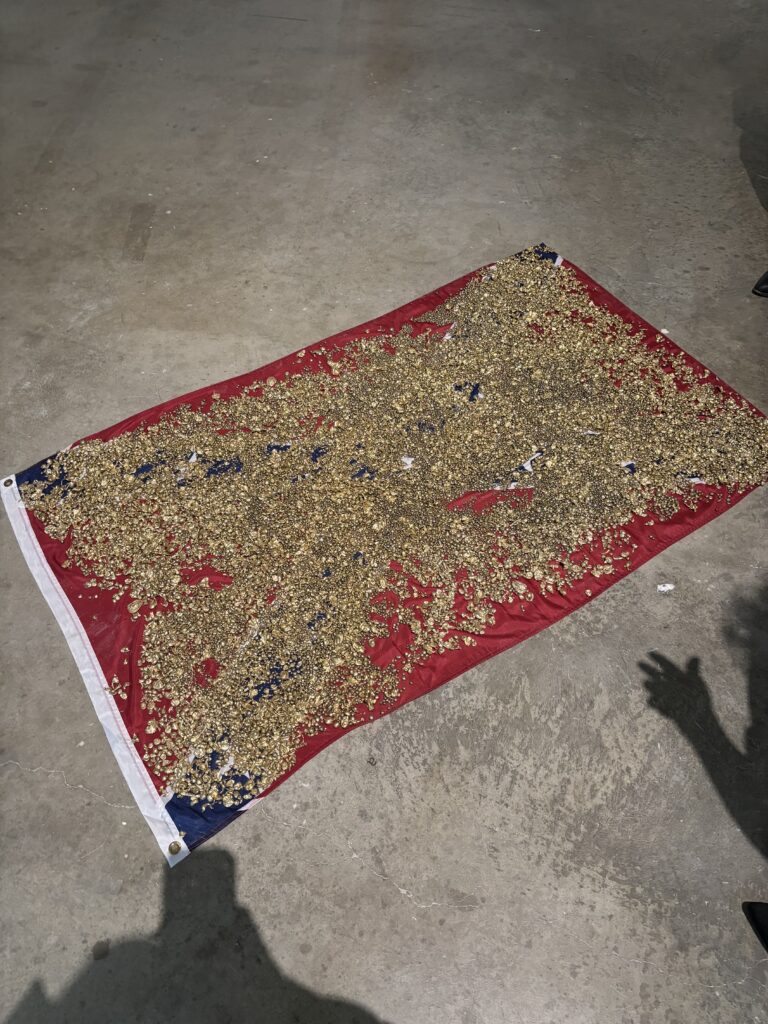
“Untitled (for Custis Morgan)” (2026) by Wilmer Wilson IV
The whimsy of Wilson’s approach to SKIRL! is a gift to the dimensionality of Black art. Wilson was born in Richmond, Virginia and attended Howard University for undergrad before getting his MFA at UPenn. His previous exhibitions at CONNERSMITH and Susan Inglett Gallery “investigate the marginalization of, and the care for, Black bodies” and span on-the-nose figural work, performance art, conceptual photography, and sculpture. For his 2012 Henry ‘Box’ Brown photo series, named for the man who mailed himself out of slavery into freedom, Wilson covered his body in Forever stamps leaving only his eyes visible and went to the post office. SKIRL!, by contrast, ties in themes of enslavement and confederacy, colonial wealth and its absurdity, and social contracts between groups (human to human or human to squirrel) without depicting any Black bodies. In this way, SKIRL! can be as serious or as silly as you’d like it to be, but you’re sure to leave with a new perspective on these tiny neighbors be they Eastern Gray, Eurasian red, or, my favorite, Harlem Black.
blacklove 🖤 and starlight 🌟
“Wilmer Wilson IV: SKIRL!” opened at Institute of Contemporary Art at the University of Pennsylvania on September 26, 2026 and will run through February 21, 2027. Admission to ICA is always free. The museum is open from Wednesday to Sunday from 11am to 6pm, though it stays open until 8pm on Thursdays. I attended a curatorial tour on October 16 organized by Resnicow & Associates and offer my thanks.
